

- Bitcoin’s halving cycle loses power as Saylor identifies capital flows as the price’s direction.
- Strategy holds large Bitcoin reserves and experiences losses, and its stock follows Bitcoin.
- Geopolitical risks and poor technical indicators are external pressures on the halving cycle model.
The importance of the Bitcoin halving cycle in market behavior is under fresh consideration following remarks by Michael Saylor, who said that the four-year cycle of price changes observed during halving events is no longer the dominant force in price dynamics. His remarks shifted attention away from the model that many traders have used for years to explain recurring market booms and declines following halving events.
Bitcoin Halving Cycle Debate Shifts to Institutional Access
For years, halving events were widely viewed as a core part of Bitcoin’s market structure. Many traders linked that supply reduction to recurring bull and bear market phases, making the four-year cycle one of the most cited frameworks in Bitcoin analysis.
In an X post, Saylor said that the framework no longer explains the market in the same way. According to his remarks, Bitcoin’s next phase depends less on supply shocks and more on how money enters the asset through institutions and credit-based systems.
He wrote that “capital flows now drive price” and added that bank and digital credit will shape Bitcoin’s growth path.
Saylor also said Bitcoin has taken on a different role in global finance. In his view, adoption through traditional finance now carries more weight than cycle models built around past halving events. Moreover, his comments added to a broader market discussion over whether institutional demand has become more important than historical supply-based patterns.
Strategy Holdings Keep Focus on Treasury Exposure
The discussion around the Bitcoin halving cycle returned alongside renewed attention on Strategy’s treasury position. The company now holds 762,099 Bitcoin, with a market value of more than $50.9 billion. Its average purchase price stands at $75,699.
Based on the figures provided, the company’s position reflects a loss of 11.70%. That has kept attention on how closely Strategy’s financial profile is tied to movements in Bitcoin’s price. Because of the size of its holdings, any major market change directly affects the valuation of the coins on its balance sheet.
Market commentator Adam Livingston said Saylor and Strategy have effectively “won the game” of institutional Bitcoin adoption through early and aggressive accumulation. That statement pointed to the company’s large position and its long-running use of Bitcoin as a treasury asset.
Nevertheless, Strategy also retains room to continue buying Bitcoin. The company has not exhausted at-the-money shares to sell, which are in billions of dollars, such as common and preferred shares like STRC. Such services are the way to raise additional funds and keep its Bitcoin reserves growing.
However, the same approach poses a risk to shareholders, as subsequent sales of shares can dilute their holdings. That concern has become more pronounced as the company’s net asset value has dropped below 1, a sign that the earlier premium attached to the stock has narrowed.
Stock Weakness Adds Pressure Beyond the Bitcoin Halving Cycle
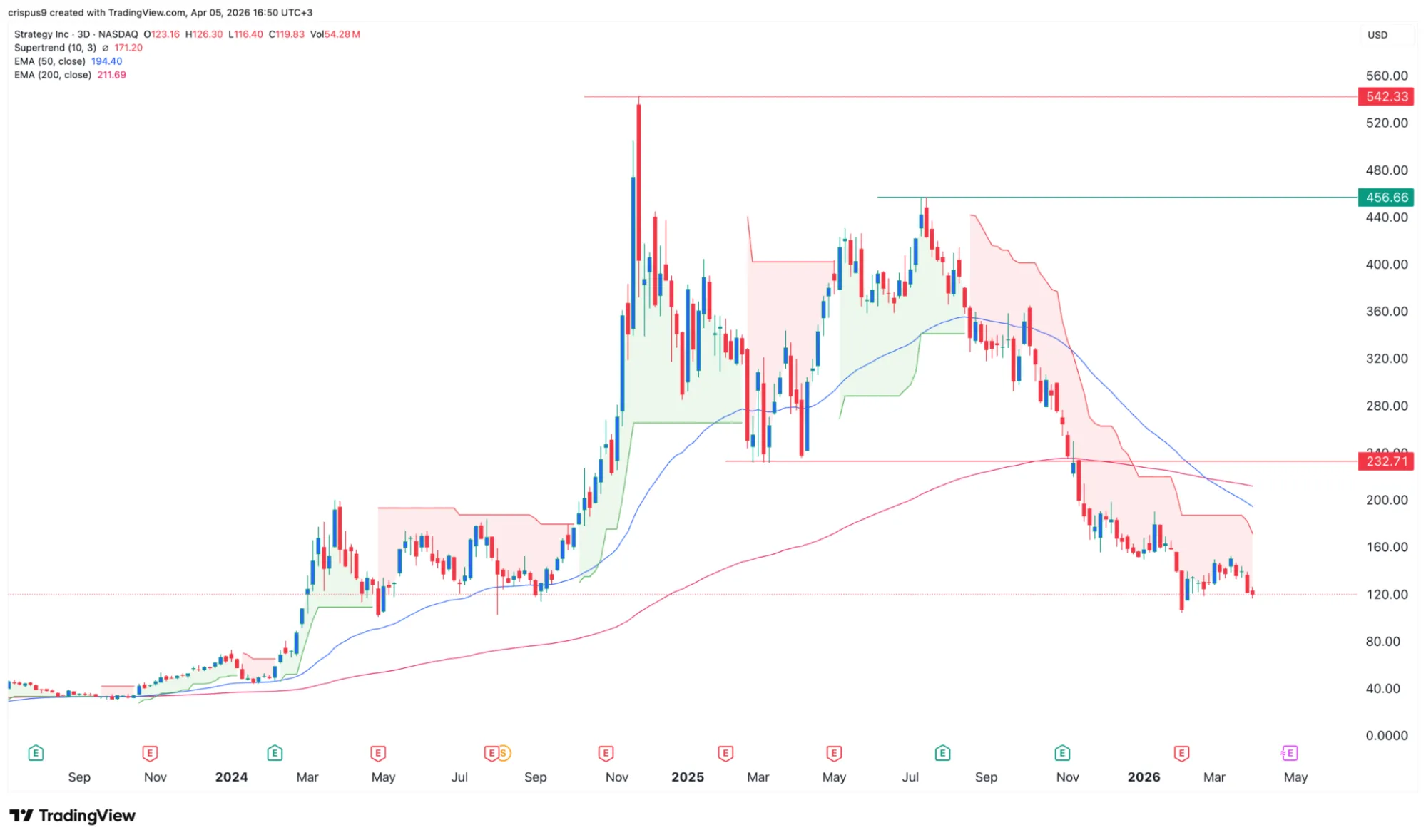
The Bitcoin halving cycle is not the only issue shaping market attention around Strategy. The company’s stock price has also weakened sharply in recent months. On the three-day chart, the stock has fallen from $456 in July last year to about $120.
It has also dropped below the important support level at $232.7, which marked its lowest level in March last year. In addition, the stock has formed a death cross pattern, with the 50-day moving average falling below the 200-day moving average. The stock has also remained below the Supertrend indicator since August last year.
Under technical analysis, an asset is generally considered to be in a bear market as long as it remains below that indicator. Those chart signals have added to the pressure on Strategy at a time when the company’s stock remains highly sensitive to Bitcoin itself.
Source: Trading View
That connection remains central to the company’s outlook. Strategy stock is affected by Bitcoin’s performance because of the scale of the coins held on its balance sheet.
A continued drop in Bitcoin would reduce the value of those holdings and lead to larger unrealized losses. By contrast, if Bitcoin returned to its all-time high of $126,300, the value of Strategy’s current holdings would rise to more than $96 billion.
A separate near-term risk also emerged this week after Donald Trump threatened to escalate the ongoing war in Iran. In an X post on Sunday, he said that Tuesday would be “Power Plant Day” and “Bridge Day.” The remarks were cited as a development that could weigh on Bitcoin prices.