

- Bitcoin Depot entered bankruptcy due to rising regulations and legal proceedings against its business.
- The company saw a 49.2% drop in revenue and a net loss of $9.5 million per quarter.
- During the course of its bankruptcy proceedings, Bitcoin Depot shut down its worldwide network of ATMs.
Bitcoin Depot (NASDAQ: BTM) filed for voluntary Chapter 11 bankruptcy protection on Monday, in the wake of a series of regulatory restrictions, enforcement actions, financial losses, and operational setbacks for the crypto ATM industry over the past few months. The company, which operated more than 9,000 Bitcoin teller machines globally, said it has begun a court-supervised process to wind down operations and sell its assets.
The filing was made in the U.S. Bankruptcy Court for the Southern District of Texas and includes both U.S. and Canadian entities. Bitcoin Depot also confirmed that its entire Bitcoin ATM network has been taken offline as part of its restructuring.
The move followed a sharp decline in revenue, increased compliance obligations across multiple states, and recent disclosures involving security and accounting issues that further strained the company’s financial position.
Bitcoin Depot Begins Court-Supervised Wind-Down
Bitcoin Depot stated that the bankruptcy filing was intended to support an orderly shutdown of the business and facilitate the sale of assets under court supervision. Chief Executive Officer Alex Holmes said the company reviewed available alternatives before deciding to proceed with Chapter 11 protection.
The filing marks a major shift for the crypto ATM operator, which had expanded rapidly during previous market cycles and became one of the largest Bitcoin ATM networks in North America. The company said additional restructuring efforts are planned in Canada, while its non-U.S. operations are expected to wind down in accordance with applicable foreign laws.
Bitcoin Depot’s machines allowed users to convert cash into Bitcoin and other digital assets through kiosk-based transactions. Founded in 2016, the company built a large physical footprint across retail locations globally.
The bankruptcy announcement came days after the company disclosed delays in filing its first-quarter 2026 earnings report. Bitcoin Depot said it needed additional time to complete its financial statements after identifying a “material weakness” in cash-in-transit reconciliation processes.
Regulatory Pressure Reshaped the Bitcoin Depot Business
Bitcoin Depot pointed to significant regulatory changes affecting crypto ATM operators across the United States. The company said that the effects of regulations, compliance costs, transaction limitations, legal actions, and enforcement affected their business processes and revenues.
Holmes disclosed that Bitcoin Depot had tightened its compliance mechanisms due to increased pressure from crypto kiosks. The company had developed an improved identity verification process, a fraud alert mechanism, and reduced transaction limitations to prevent exploitation of its kiosks. Despite those measures, the company stated that operating conditions continued to deteriorate as legal and regulatory pressure intensified across the sector.
Earlier this year, Bitcoin Depot’s money transmission license in Connecticut was suspended. The company later projected that revenue from its core business could decline by 30% to 40% in 2026 due to changing state regulations.
The company also underwent leadership changes during the same period. Holmes became Chief Executive Officer and Chairman of the Board after Scott Buchanan stepped down from the position in March. Founder Brandon Mintz transitioned from Executive Chair to a non-executive board role.
Revenue Losses and Security Setbacks
Preliminary unaudited results showed revenue declined 49.2% year over year for the three months ending March 31. The company also reported a net loss of $9.5 million during the quarter, compared with net income of $12.2 million recorded during the same period a year earlier.
Operational difficulties increased further after Bitcoin Depot disclosed a cybersecurity incident involving its internal systems. According to the company, the breach resulted in approximately $3.7 million being stolen from the company’s crypto wallets.
The security incident added to broader concerns surrounding the company’s operational stability as financial losses accelerated and regulatory obligations expanded.
Bitcoin Depot shares experienced sharp volatility in recent weeks. The stock closed up 5.4% on Friday at $2.93, according to Yahoo Finance data. Despite the daily increase, shares declined 29.6% over the previous month and 79.5% during the past six months.
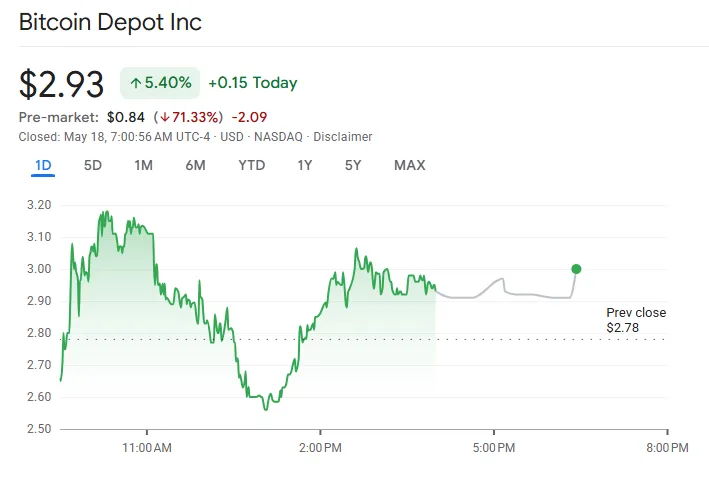
Source: Google Finance
The stock also fell more than 42% last week, pushing year-to-date losses to roughly 67%. The bankruptcy filing added further uncertainty around the company’s future and remaining assets.
The bankruptcy announcement coincided with renewed weakness across the broader cryptocurrency market. Bitcoin traded in the mid-$76,000 range on Monday after falling sharply during the latest market decline. Bitcoin’s price ranged between a 24-hour low of $76,678 and a high of $78,539 on the market. The volume was also high in this period, gaining 13% from the volume in the last 24 hours, as a result of market fluctuations and the capitalization arising from it.