

Key Insights:
- The Ethereum Fast Confirmation Rule has reduced deposit time to about 13 seconds across networks.
- Validator attestations are applied beyond block counting to accelerate transaction confirmation.
- The Ether price fell to $2198.13, with reduced volume and continued selling pressure.
Ethereum client teams are progressing on an opt-in mechanism designed to significantly reduce the time required to recognize deposits across layer-2 networks and exchanges.
Ethereum Fast Confirmation Rule Redefines Deposit Timing
The Ethereum Fast Confirmation Rule is designed to replace the conventional reliance on multiple block confirmations or full finality when processing deposits. In some cases, this process can take close to 13 minutes before funds are recognized on layer-2 platforms or centralized exchanges.
In contrast, the Ethereum Fast Confirmation Rule introduces a model that evaluates validator attestations instead of counting blocks. By doing so, the system determines whether a transaction can be safely treated as confirmed within a single slot, which typically lasts around 12 to 13 seconds.
According to Ethereum researcher Julian Ma, this approach could reduce deposit times by 80% to 98% across most networks and platforms. Currently, several exchanges and layer-2 systems rely on “k-deep” confirmation rules, where transactions are considered final only after a predefined number of blocks have been added.
Validator-Based Model and Deployment Structure.
There are two main assumptions on the Ethereum Fast Confirmation Rule. Nevertheless, it demands that the network be efficient enough to spread validator messages in a few seconds.
Meanwhile, it presupposes that no single party owns more than 25% of the total staked Ether. These requirements are less stringent than Ethereum’s finality requirements, but are believed to be adequate for most real-world use cases involving deposits and transfers.
Notably, the Ethereum Fast Confirmation Rule does not require a hard fork. When deployed, the nodes may start executing the rule without coordinated network-wide upgrading. Ethereum co-founder Vitalik Buterin has indicated that, under certain network conditions, the mechanism can provide a non-revert guarantee for transactions within a single slot.
Controversy arises Regarding Validator Assumptions and Network Resilience
The developers stated that the Ethereum Fast Confirmation Rule can be enacted without a hard fork. After implementation, the nodes will be able to incorporate the rule without network-wide activation, making it easier to deploy and adopt the rule gradually.
The mechanism is expected to be integrated with minor modifications by exchanges, layer-2 providers, and infrastructure providers, as it will run across existing interfaces, and minimal major architectural alterations may be necessary.
The opt-in nature of the Fast Confirmation Rule also allows participants to decide whether to adopt it, depending on their specific needs. Although confirmations within seconds would enhance the user experience, message propagation and the consistency of validators‘ behavior are among the determinants of real-world consequences. Such considerations remain in the current testing and implementation initiatives by client teams.
The structure of the price reflects wider uncertainty
Simultaneously, the Ethereum market structure provides a distinct yet closely related context for implementing the Ethereum Fast Confirmation Rule. The asset is still trading within the broad macro range of $900 to $ 4,900.
In addition, Ethereum has fallen significantly over the past 24 hours, crashing to $2198.13, a 6.14% daily loss, according to CoinMarketCap.
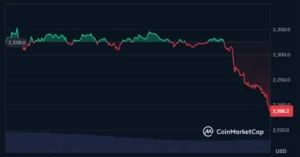
Source: CoinMarketCap
The trend was fairly stable, trading close to $2,320, before falling rapidly. However, its market capitalization has dropped to $ 265.29 billion, and volume has decreased by $34.6 to $21.43 billion, indicating declining interest. The market-cap volume ratio stood at 7.97, indicating low activity during the decline.