
Highlights:
- Prediction markets revised the odds of the Iran conflict before media coverage, and Bitcoin increased in line with those changes.
- Prediction markets with flow options and funding data have been used by institutional desks to monitor risk.
- Ceasefire talks and Iran concerns continue to drive rapid changes in market-based probabilities
Prediction Markets have recorded rapid changes in the perceived likelihood of escalation in the Iran conflict, offering traders a real-time measure of geopolitical risk as events developed. These movements occurred when Washington policy signals interacted with evidence of potential negotiations, which, in turn, led to event-based probabilities being updated incessantly across trading platforms.
Bitcoin gained over 3.5% on Monday, trading at $66,448 in line with the repricing of conflict-related results. The turn of events made prediction markets the focus for how traders tracked geopolitical developments, as conventional indicators were outpaced by the swiftly shifting conditions.
Prediction Markets Track Developments of Iran Conflict in Real Time.
Prediction markets tracked discrete outcomes in the Iran conflict, such as escalation and de-escalation, whose probabilities would change with new developments. These platforms assign capital-weighted probabilities to certain events, and traders can monitor changes as they occur.
In the most recent period of the Iran conflict, de-escalation probabilities shifted ahead of broader financial media reporting, indicating a more rapid uptake of new information.
Nevertheless, the repricing came after the U.S. leadership said it would make renewed threats, but also indicated it could negotiate. With the appearance of these signals, prediction markets began to respond, assigning a constantly changing value to the likelihood of different outcomes.
Fabian Dori, chief investment officer at Sygnum Bank, stated that prediction markets provide a different signal than traditional financial indicators. According to Dori, these markets focus on named outcomes and are backed by capital, allowing for a structured interpretation of risk tied to specific events.
He observed that this structure is a measurable input into monitoring shifts in sentiment in crypto markets, where price fluctuations tend to be binary, such as regulatory actions or geopolitical events.
Prediction Markets Integrated Into Institutional Risk Monitoring
Professional trading desks have been increasingly using prediction markets within broader macro risk-monitoring structures. According to Dori, some desks now include prediction market data alongside funding rates, options surfaces, and capital flow analysis when monitoring fast-moving geopolitical developments.
Institutional workflows have been undertaken by investing in prediction markets, which entail integrating information on the likelihood of occurrence. For example, ARK Invest has included data on regulated prediction market platforms in its analysis.
Dori stated that the purpose of using prediction markets is to assess positioning before outcomes occur.
Ceasefire Proposal Shapes the Market Expectations.
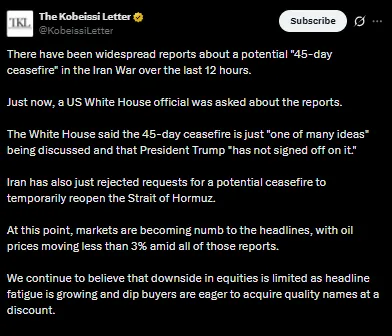
Meanwhile, diplomatic talks between the United States and Iran have entered their most serious phase, with the main focus on a proposed 45-day ceasefire in order to alleviate tensions. United States officials testified that several proposals have been offered to the Iranian authorities within recent days. Iran, however, has not yet assented to the terms.
Source: The Kobeissi Letter
Mediators are discussing possible interim measures and the United States’ guarantees that any agreed-upon ceasefire would be respected. Such developments have led to continued changes in prediction markets, where probabilities reflect the likelihood of de-escalation and of further conflict.
The Iranian officials have also expressed alarm over temporary agreements because, in the past, ceasefires in Gaza as well as hostilities in Lebanon, reoccurred following brief pauses. These issues have affected how market participants explain the prospect of long-run de-escalation and have helped keep event-based probabilities repriced.