Key Insights:
- Card payments now dominate the reported restaurant activity.
- National surveys show declining Bitcoin use for purchases.
- Bitcoin remains available in parts of El Zonte despite weaker demand.
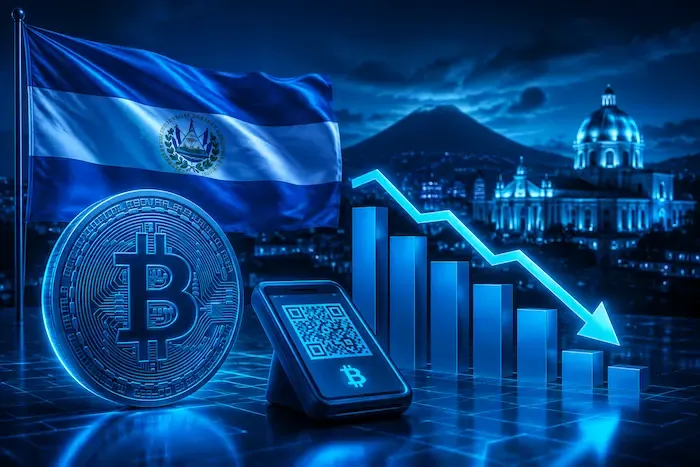
Bitcoin payments in El Salvador have fallen sharply at one El Zonte restaurant, where a single transaction reportedly occurred during August. Bitcoin Core contributor Jon Atack made the observation after paying for lunch on Aug. 23, highlighting a wider decline in everyday cryptocurrency use.
Atack has lived in El Salvador since 2022 and described the restaurant account as anecdotal. Staff reportedly told him that Bitcoin payments once appeared regularly but now occur almost nowhere.
Bitcoin Payments in El Salvador Have Practically Dried Up
Jon Atack, a Bitcoin Core contributor residing in El Salvador, reported that a restaurant in El Zonte (known as "Bitcoin Beach") told him his lunch bill was the establishment's only bitcoin transaction for the entire… pic.twitter.com/j1JgIksRVQ
— Wu Blockchain (@WuBlockchain) August 26, 2026
The workers also said most customers now use bank cards. Atack offered a tip in satoshis, but an employee declined because he had forgotten how to operate the Bitcoin application.
El Zonte gained global attention through Bitcoin Beach, a community project that began in 2019. The initiative helped shape El Salvador’s decision to adopt Bitcoin as legal tender in September 2021.
National data points to weaker adoption
The restaurant experience does not establish nationwide payment volumes. However, earlier surveys show that consumer use had already weakened across El Salvador.
A Universidad Centroamericana survey found that 8.1% of Salvadorans used Bitcoin to purchase goods or services during 2024. The figure fell from 25.7% in 2021 to 21% in 2022 and 12% in 2023.
A separate Universidad Francisco Gavidia survey produced a similar result. It found that 92% of respondents did not use Bitcoin for transactions in 2024, while 7.5% reported using it. Those figures measure self-reported behavior rather than transaction records. That said, they do provide more country context than any one merchant could.
The pattern also reflects a potential HODL phenomenon. If a user thinks the price of the bitcoin will go up, he or she may rather hold on to it rather than spending it.
The introduction of MFS will alter the payment process.
The regulatory environment for Bitcoin payments in El Salvador is also different than in 2021 after the rollout.
In February 2025 El Salvador reached a financing arrangement with the IMF for $1.4 billion. To upgrade the program, it was a need for changes to make Bitcoin acceptance more voluntary for private businesses.
The changes also removed the government’s obligation to guarantee Bitcoin-to-dollar conversions. Tax payments must use U.S. dollars, while merchants can decide whether Bitcoin transactions make commercial sense.
That shift matters because merchant acceptance once formed a central part of El Salvador’s Bitcoin experiment. Businesses now face fewer reasons to maintain payment systems that customers rarely use.
The IMF has also pushed the government to reduce its involvement in Chivo, the state-backed Bitcoin wallet. Its December 2025 review said negotiations over the sale of the government’s Chivo interest had advanced.
Investment demand tells a different story
Bitcoin payments in El Salvador should not be confused with the government’s Bitcoin holdings.
Publicly tracked wallets have shown apparent increases in government-controlled Bitcoin. Yet IMF documents said total public-sector holdings remained unchanged under the program. The difference suggests that wallet movements may reflect transfers between government addresses rather than fresh purchases. Therefore, reserve activity cannot demonstrate stronger retail adoption.
The implications are far more than just Bitcoin for businesses. A reduction in the frequency of payments can reduce the local demand for payment processors, Lightning services, and Bitcoin wallets.
At the same time, card networks and banks have benefits in the areas of familiarity, accounting and dollar settlement. When consumers pay for their regulars with dollars or credit cards, they can also stay out of Bitcoin’s price fluctuations.
What the decline means
Bitcoin payments in El Salvador have not disappeared, and travelers still report successful transactions in El Zonte. Some businesses also continue displaying Bitcoin acceptance signs.
However, the latest restaurant account adds another warning to existing survey evidence. The central question now concerns whether El Salvador can sustain Bitcoin’s role as everyday money after making merchant acceptance optional.
Future merchant data and national surveys will provide a clearer measure of the trend. Until then, the evidence points toward a changing experiment in which Bitcoin may retain investment appeal while losing ground as a practical payment method.
Conclusion
Bitcoin transactions in El Salvador have not gone away, but they are far less important to their daily lives. The new Bitcoin Beach’s account is in line to national surveys revealing that less consumers are buying with Bitcoin.
The policy move has also impacted the incentives for merchants. As Bitcoin demand is limited, businesses now have options to prioritize cards and dollars.
The experiment in El Salvador is thus an important test. However, Bitcoin could still be able to attract a few more holders and investors, but the currency’s ability to become a viable method of payment will rely on whether everyday usage can be regained.