Key Insights:
- CZ says tokenization could widen global capital access for governments and companies.
- Multi-chain issuance could accelerate growth, but fragmented liquidity remains a significant market risk.
- Interoperability could reduce fragmentation if issuers align redemption, backing, and settlement standards.
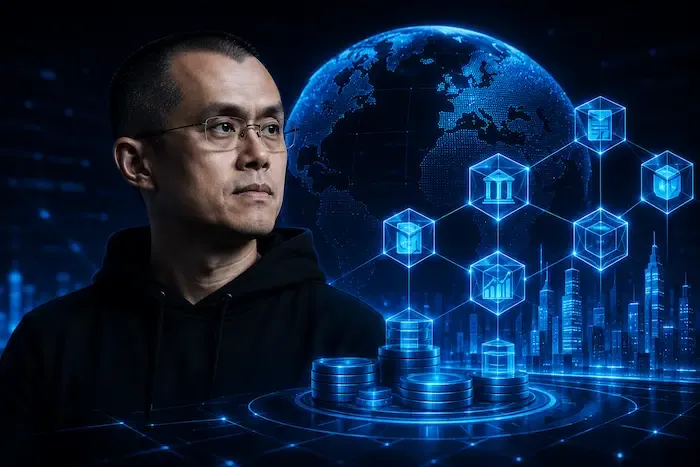
Binance co-founder Changpeng Zhao says tokenization could help governments and companies attract capital from global investors. On Aug. 21, Zhao promoted digital assets as a potential fundraising channel for countries seeking foreign direct investment.
The former Binance chief executive wrote “Let’s tokenize everything” in a post on X. He described tokenization as one of the strongest methods for countries to raise funds or attract FDI.
Zhao also questioned why governments and companies would not want to distribute tokenized shares worldwide. His argument focused on expanding investor access beyond conventional financial and geographic boundaries.
Let's tokenize everything.
Tokenization is one of the best ways for countries to "raise money", or attract FDI (Foreign Direct Investment).
Which country/company won't want to sell their (tokenized) stocks to everyone in the world?
I support tokenization on all blockchains.… https://t.co/RHuVzIB4D3
— CZ 🔶 BNB (@cz_binance) August 21, 2026
CZ sees tokenization widening global investment access
Zhao presented tokenization as financial infrastructure that could connect issuers with a broader international investor base. Companies can represent shares, bonds, commodities, funds, and property through blockchain-based tokens.
Governments could also explore similar structures for eligible financial assets. However, Zhao did not identify any country preparing such an offering. He also announced no new Binance investment initiative, product, or tokenized securities platform. His comments instead outlined a broader policy and industry position.
Yet wider digital distribution does not automatically create foreign direct investment. The distinction matters when assessing Zhao’s argument about international capital flows. The OECD generally defines FDI through a foreign investor holding a lasting interest in an enterprise. Under its benchmark, that relationship is established by holding a 10% voting share.
Thus, the smaller-sized transactions in tokenized stocks might be considered as portfolio investment instead of FDI. The type of investor, the percentage of ownership, and voting rights would impact on that classification.
Even distribution barriers can be reduced and access can be enhanced through tokenization. But ultimately, it is the law and market demand that drive capital to issuers.
Multi-chain strategy brings a liquidity challenge
Instead of focusing on one network to issue tokens, Zhao also enables tokenized assets across multiple blockchains. He thinks simultaneous development may speed up the development of the industry.
That approach allows competing blockchain ecosystems, developers, and issuers to build infrastructure at the same time. Consequently, investors could gain more channels for accessing digital securities.
But, Zhao admitted, there was one major problem. Multi-chain issuance can fragment liquidity into both networks and trading platforms, issuers and distinct versions of similar assets.
Fragmentation can result in a reduction in size of the market and divergent prices for similar instruments. Wider spreads can also be experienced by investors during periods of disbursement of trading activity.
Interchain bridges between chains add extra technical vulnerabilities. Custody arrangements and different issuers can also create counterparty concerns. Zhao suggested greater interchangeability between issuers could reduce some fragmentation. However, that model requires stronger coordination across the market.
Issuers would need compatible redemption rights, settlement processes, asset backing, and legal claims. Zhao did not propose a specific technical standard.
Binance ecosystem growth highlights rising RWA demand
The comments arrived during strong growth in blockchain-based real-world assets. RWA.xyz measured distributed asset value at $38.40 billion in the cited market data. The platform recorded 2,379,918 holders after a 79.74% increase. Meanwhile, represented asset value declined 4.66% to $342.63 billion.
BNB Chain has recorded particularly rapid expansion within the sector. RWA.xyz counted 776,428 RWA holders on Aug. 19. That represented a 368.51% increase over the preceding 30 days. BNB Chain separately reported approximately 776,000 holders after comparable growth.
The cited network data included $5.8 billion in distributed asset value and 1,284 assets. However, wallet numbers require careful interpretation. One blockchain address does not necessarily equal one investor. Holder growth also cannot prove foreign investment or demand for tokenized national assets.
Institutional products have contributed to the network’s expansion. BNB Chain secured 61.7% of assets on Franklin Templeton’s Benji platform during the cited period. That share represented approximately $1.5 billion. The figures demonstrate growing blockchain distribution, although they do not validate Zhao’s broader FDI argument.
Regulation could decide how far tokenized stocks travel
Tokenized securities remain subject to existing securities laws. Moving a stock onto blockchain infrastructure does not remove its underlying legal obligations.
Compliant issuance, investor verification, custody arrangements, disclosures and lawful secondary trading are cross-border offerings. These requirements can be more complex in multiple jurisdictions.
Interchangeability also is linked to the economic and legal rights that must be afforded to the investors by each issuer. These protections must exist separately from technical compatibility if they are to make for a unified liquidity.
This is already a problem that has been noted by big financial infrastructure organisations. Risk of fragmentation in distributed ledger networks is a concern raised by Clearstream, DTCC and Euroclear.
Meanwhile, tokenized securities keep expanding throughout blockchain ecosystems. Ondo has built infrastructure to move tokenized stocks between supported networks and continue to support them.
Tokenized U.S. shares have also expanded into Hyperliquid’s blockchain environment. These developments show issuers increasingly seeking distribution across competing networks.
Conclusion
Zhao’s proposal places global distribution at the center of tokenization’s potential value. Yet broader access alone cannot guarantee sustainable foreign capital flows.
For Binance and the wider digital asset sector, interoperability could become as important as issuance growth. Regulators will also determine how tokenized securities reach international investors.
The market’s next test concerns whether multiple networks can expand access without permanently dividing liquidity. Legal clarity and common standards will heavily influence that outcome.