
Key Insights:
- Brian Armstrong believes that the rise of AI will further drive the adoption of crypto, as blockchain becomes the backbone of a new generation of autonomous AI agents.
- In preparation for machine-to-machine payments, Coinbase is launching a new Agentic Finance ecosystem with x402, Base, USDC, Coinbase for Agents and Agentic.market.
- Regulators and researchers are still skeptical, as AI-powered financial transactions increase, due to security concerns, unavailability of adoption indicators, and a lack of robust protection.
Coinbase AI crypto strategy took center stage after Chief Executive Brian Armstrong argued that artificial intelligence will strengthen, rather than replace, blockchain technology. Writing on X on July 27, Armstrong said autonomous AI agents will eventually execute more financial transactions than humans, making crypto infrastructure a critical layer for the digital economy.
His comments arrive as technology companies race to expand AI capabilities while blockchain firms search for broader adoption. Armstrong maintained that AI and crypto solve different problems, with AI providing programmable intelligence and blockchain delivering programmable money through fast, borderless settlement.
"If you're in crypto, pivot to AI."
I used to hear versions of this, and it's the wrong way to think about the world. It's zero sum, scarcity thinking.
Crypto is a general purpose technology. It's infrastructure, the same way electricity or the internet is infrastructure. It…
— Brian Armstrong (@brian_armstrong) July 26, 2026
Coinbase expands products around autonomous finance
Armstrong rejected claims that crypto companies should abandon blockchain development in favor of artificial intelligence. Instead, he described crypto as infrastructure comparable to the internet or electricity, arguing that emerging technologies depend on foundational networks rather than replacing them.
He said AI agents cannot operate through conventional banking because they cannot open accounts, wait several days for wire transfers, or remain restricted by national financial systems. Instead, they require programmable payment rails capable of settling transactions instantly across global markets.
That vision has shaped Coinbase’s Agentic Finance initiative. The company has introduced several products that allow AI software to manage financial activity within defined user controls.
In June, Coinbase launched Coinbase for Agents, enabling AI systems to access trading tools, monitor markets, rebalance portfolios, and perform financial tasks through command-line interfaces and Model Context Protocol integrations.
Days later, Coinbase expanded the platform by adding live market data and natural-language conditional commands. The company also integrated x402 into Coinbase Business, allowing businesses to receive USDC payments directly from autonomous AI agents. Developers can also enable x402 payment support with minimal code through a dedicated toolkit.
Coinbase introduced Agentic.market earlier this year to help AI agents discover and purchase computing resources, market data, search services, inference tools, and trading products without traditional subscriptions or manually issued API credentials.
Infrastructure ambitions face technical scrutiny
Armstrong identified Base, USDC, and the x402 protocol as the foundation of Coinbase’s long-term strategy.
The x402 protocol is a new pay-as-you-go protocol that expands the HTTP 402 Payment Required Response. Wallets grant access to transactions, facilitators verified payments and digital resources were instantly available upon settlement.
Base offers low-cost blockchain infrastructure, and USDC is the main payment asset on numerous applications. Additionally, Coinbase facilitates payment routing on Solana, Polygon, Arbitrum and World across various facilitator networks.
But Coinbase AI crypto plans are coming under more scrutiny.
Transaction volumes continued to be very skewed, according to a July research paper of x402 activity on Base. A few transactions were deemed to be internal transfers or low-cost automated transactions, making them less representative as signs of general adoption.
In another July study, researchers examined 15 x402 facilitators, and found vulnerabilities in all of the systems studied. Researchers identified risks that included unpaid service access, denial-of-service attacks, asset theft, and gas abuse. According to the report, affected providers, including Coinbase, addressed the disclosed issues after receiving the findings. Both studies remain preprints and have not completed peer review.
Industry momentum grows despite regulatory questions
Armstrong’s prediction remains forward-looking because no evidence currently shows AI agents conducting more transactions than humans. Nevertheless, industry leaders increasingly support that direction.
Franklin Templeton Digital Assets head Sandy Kaul recently described agentic AI as blockchain’s strongest adoption catalyst. Earlier this year, Binance founder Changpeng Zhao also predicted that autonomous AI systems would rely on cryptocurrencies for payments.
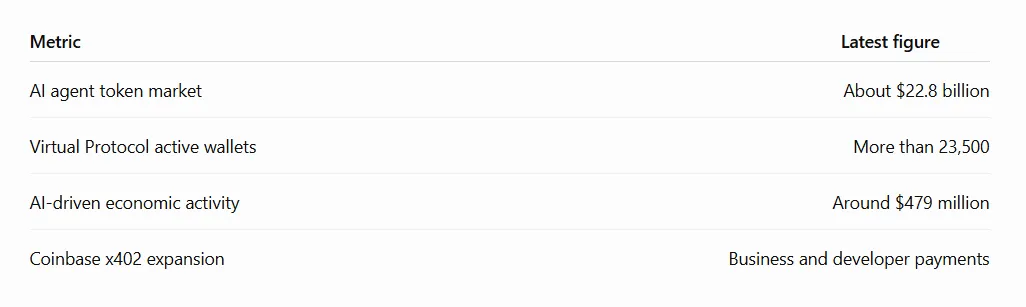
At the same time, OpenAI and Anthropic are pushing AI agent functionality in software development and enterprise automation as well. Also, the entire AI space has experienced a surge in activity, with crypto projects focused on the technology seeing increased interest.
There is also a process going on of examining autonomous finance by regulators. Existing financial regulations are not aimed at AI-powered payment systems, according to a recent warning from the Deputy Governor of the Bank of England, Sarah Breeden. Future protection measures that should be considered include circuit breakers, enhanced recovery measures and greater regulation in the event that autonomous financial activity increases substantially, she said.
The general sentiment of the market
The Coinbase AI crypto strategy is indicative of a wider industry trend towards machine-driven commerce, not only to the payments themselves. Rather than making huge individual transactions for computing power, APIs, software and digital information, autonomous agents can conduct millions of small transactions.
Key market developments.
- Coinbase keeps building out real-world infrastructure rather than theorizing about things.
- More and more leaders and crypto executives are recognizing that blockchain is the most appropriate payment infrastructure for autonomous software.
- Researchers continue pressing the industry to improve security and demonstrate genuine adoption beyond experimental transaction volumes.
Coinbase AI crypto initiatives now place the exchange at the center of an emerging machine economy. Whether AI agents eventually surpass humans in transaction activity will depend on commercial adoption, technical resilience, regulatory clarity, and sustained demand for automated digital services. If those conditions develop together, Coinbase AI crypto products could become an important foundation for the next generation of internet payments.