key insights
- During the initial major trading boom, Tokenized Real World Assets (RWAs) were less active than memecoins.
- The onboarding process was made easier with Pump.fun, and the retail participation was increased as a result.
- Early speculation will not be able to be converted into blockchain growth unless users stay engaged.
Nearly $564 million was traded on Uniswap in 24 hours on July 8, marking its biggest trading session since launch, and triggering an increase in the trading volume of Robinhood Chain. The milestone pushed the new Layer-2 network behind only Ethereum mainnet on Uniswap and highlighted how memecoin activity rapidly outpaced its original focus on tokenized real-world assets.
The network launched its public mainnet around July 1 with a strategy centered on tokenized stocks and other real-world assets. However, trading momentum shifted within days after the memecoin CASHCAT attracted heavy speculation.
According to Dune Analytics, Uniswap volume climbed to $563.9 million, almost ten times higher than the previous day’s $58.9 million. Uniswap founder Hayden Adams confirmed that no other network besides Ethereum mainnet recorded higher Uniswap trading volume during the period.
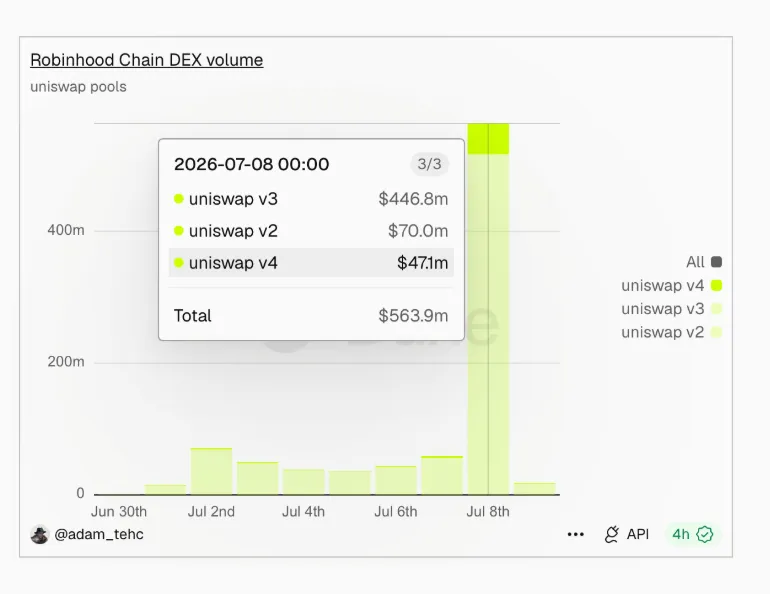
Memecoin demand changed the network’s early direction
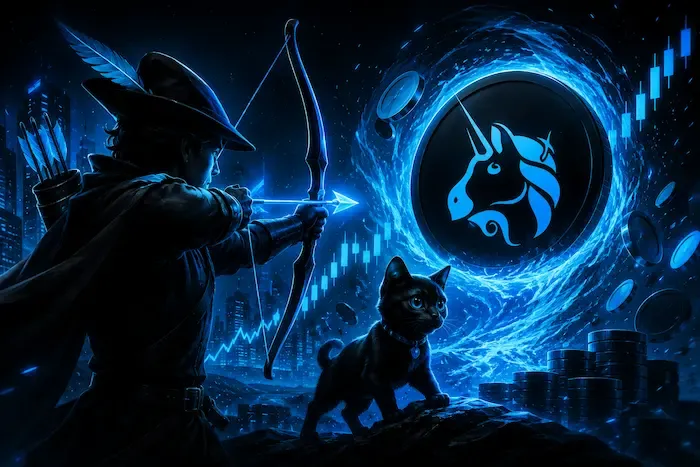
CASHCAT became the main catalyst behind the record-breaking activity. Inspired by Robinhood’s former Cashcat mascot, the token gained more than tenfold within 24 hours and briefly exceeded a $100 million market capitalization.
Its Uniswap V3 WETH trading pair alone generated about $212.3 million in daily volume. At the same time, Robinhood CEO Vlad Tenev acknowledged the growing trend on social media, saying the network built for tokenized assets also worked well for memes.
Momentum accelerated after Pump.fun integrated support for Robinhood Chain. The integration allowed users to purchase tokens using Solana without completing traditional bridging steps. Easier access encouraged more retail traders to enter the ecosystem.
Meanwhile, DeFiLlama showed the network’s tokenized real-world asset market stood at only $12.62 million. At its height, CASHCAT’s value was about eight times that number, demonstrating how speculative assets soon came to dominate network activity.
| Metric | Value |
|---|---|
| Uniswap daily volume | $563.9 million |
| Previous day’s volume | $58.9 million |
| CASHCAT peak market cap | Over $100 million |
| WETH pair daily volume | $212.3 million |
| RWA market capitalization | $12.62 million |
| New tokens created | Nearly 16,000 |
| New wallet addresses | More than 140,000 |
| Daily active addresses | Nearly 200,000 |
User growth arrived at remarkable speed
Trading activity extended well beyond a single token. Nearly 200,000 active addresses interacted with the blockchain during the record session. More than 140,000 completed their first transaction on the network.
Developers and traders also launched almost 16,000 new tokens within one day. Seven of those memecoins surpassed $1 million in market capitalization.
On-chain analyst Ai Yi described memecoins as the primary traffic driver for Robinhood Chain. The analyst also noted that users could connect through wallets including MetaMask, Binance Wallet, and OKX Wallet using Chain ID 4663. Cross-chain access became available through Robinhood Wallet alongside services such as Relay, Stargate, and Across. But there is still a 7-day waiting period for withdrawals via the official bridge.

The ecosystem grew too, as well. In addition to Uniswap, traders were able to use other decentralized exchanges like NOXA Fun, and DEXScreener and GMGN monitored new meme tokens.
Long-term adoption remains the real challenge
The record volume delivered immediate visibility for Robinhood Chain, yet the next phase may prove more important than the initial surge. Daily trading volumes reportedly began returning to tens of millions after the July 8 peak, suggesting speculative enthusiasm may already be cooling.
The blockchain still offers infrastructure for continuous trading of tokenized equities alongside crypto assets. Chainlink supplies pricing oracles, while Morpho has attracted most of the network’s total value locked, which exceeded $100 million during the first week after launch.
That focus can also be hazardous. A heavily dependent lending protocol ensures growth of the ecosystem relies on wider adoption of the protocol. Meanwhile, the regulatory uncertainty around tokenized securities in the U.S. keeps them from expanding in the long term.
The deployment will serve as another live chain in Uniswap’s expanding multi-chain ecosystem. The more important question for Robinhood is whether the new users will continue to stay on the app once all the speculation dies down.
With even a small percentage of users sticking with the platform to invest in tokenized assets on Robinhood Chain, the network could turn a memecoin trend into a long-term trend. Otherwise, Robinhood Chain might just be another case of a single-time “hype” crash to a single-time “real world asset” vision.
Conclusion
Robinhood Chain has already made good strides following its record trading session, but continued progress will rely more on retention over short-term buying and selling. The challenge for the network is now to shift memecoin-related activity to more widespread adoption of tokenized assets.
The coming weeks will reveal whether trading volume will become stable in the coming years with the launch of more decentralized applications and financial products. With new users continuing to stay on board, Robinhood Chain may have its momentum even after CASHCAT.