

- President Trump asked the Fed to examine crypto access to the U.S. payment infrastructure.
- Regulators have 90 days to examine regulations on fintech and crypto banking.
- The Kraken payment rail approval led to discussions on Fed master account access regulations.
United States President Donald Trump has directed the Federal Reserve to review its policies regarding fintech and cryptocurrency firms seeking direct access to the central bank’s payment infrastructure. The move came through a new executive order focused on financial technology innovation and regulatory modernization.
The order calls on federal agencies to examine whether existing policies prevent fintech companies, including blockchain-based businesses, from integrating with traditional payment systems.
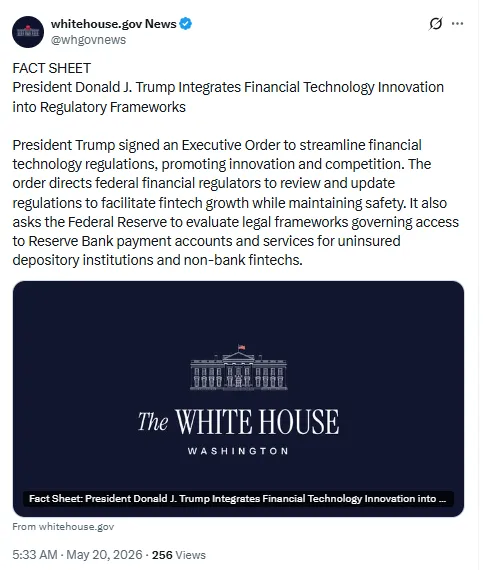
Source: White House government news
Moreover, it also asks regulators to review supervisory frameworks that may limit partnerships between fintech firms and federally regulated financial institutions. The directive places renewed attention on Federal Reserve “master accounts,” which could allow eligible crypto firms to connect directly to U.S. payment rails without relying on intermediary banks.
Trump Executive Order Targets Crypto Payment Access
The executive order, titled “Integrating Financial Technology Innovation into Regulatory Frameworks,” was signed on Tuesday. According to the document, the administration aims to reduce regulatory barriers that may hinder the development of financial technology in the United States.
Under the Federal Reserve Act, regional Federal Reserve banks have the authority to approve or deny access to payment accounts and payment services. Those services are generally available to licensed depository institutions. As a result, some crypto companies have pursued federal charters to qualify for direct access.
Trump’s order directs the Federal Reserve to conduct a comprehensive review of its framework governing Reserve Bank payment accounts and payment services.
The review will also examine whether the 12 regional Federal Reserve banks have independent authority to grant or reject such applications. The order also asks federal financial regulators to identify existing rules, guidance, supervisory practices, and application procedures that may hinder innovation.
Agency heads have been given 90 days to review regulations, orders, and no-action letters tied to fintech partnerships with federally regulated institutions, including credit unions, broker-dealers, and investment advisers.
Debate Around Federal Reserve Master Accounts Continues
The discussion surrounding crypto access to Federal Reserve payment systems intensified earlier this year after the Kansas City Federal Reserve approved a limited-purpose account for Payward, the parent company of crypto exchange Kraken.
The arrangement allowed Kraken to access payment infrastructure used for high-value dollar settlements. The approval could enable faster institutional deposits and withdrawals, though the account structure excludes interest on reserves and certain central bank lending facilities.
Kraken Co-CEO Arjun Sethi described the development as a convergence between crypto infrastructure and sovereign financial systems.
The approval drew criticism from traditional banking groups. The Bank Policy Institute, which represents major United States banks, stated that it was concerned that the decision was made before the Federal Reserve finalized a broader policy framework for limited-purpose or “skinny” master accounts.In December, the Federal Reserve published a proposal outlining a framework for these restricted accounts.
Under the proposal, institutions could gain access to payment systems while remaining excluded from benefits such as earning interest on reserves or borrowing from the Federal Reserve discount window.
The debate over direct payment rail access has remained active across both the banking and digital asset sectors. However, crypto companies claim that the access to the Fed’s payment systems will make the settlement process more efficient and minimize dependency on intermediary banks.
On the other hand, banks have highlighted the issue of regulatory uniformity and other challenges associated with non-banks’ access to payment systems.
Regulators Face New Review Timeline
The executive order establishes a formal review period across multiple federal financial agencies. During the next 90 days, regulators are expected to evaluate whether existing policies limit fintech participation in federally regulated financial markets. The order also arrives as lawmakers continue discussing legislative proposals tied to payment system access.
Last month, Representatives Sam Liccardo and Young Kim introduced the Payments Access and Consumer Efficiency Act, also known as the PACE Act. The proposal seeks to allow certain providers direct access to Federal Reserve payment services.
According to the executive order, the administration views financial technology as a growing component of the U.S. financial system. Trump stated in the order that the United States remains a global leader in financial innovation, partly due to the expansion of fintech firms.