

Key Insights:
- Ethereum whales have amassed a total of 322M ETH, which is an indication that they have great confidence in the institution.
- The inflows of ETFs (over $350M) support the rise in demand in regulated investment options.
- The decreased supply and constant accumulation imply the enhancement of market structure.
Ethereum has found itself in a new accumulation phase with large holders accelerating their accumulation.
This has been confirmed by the market data that whales have received more than 140,000 ETH in 96hours recently. The cumulative acquisition value is above 322 million, indicating great belief in the current price levels.
This aggressive purchasing is usually indicative of the hopes of a better situation within the larger crypto markets. This resurgence is after a long phase of feebleness that afflicted Ethereum during the last part of 2025.
The change has now indicated that institutional and high-net-worth participants are re-strategizing the portfolios. Increasing scale demand generally decreases liquid supply, which changes market dynamics in the short term substantially.
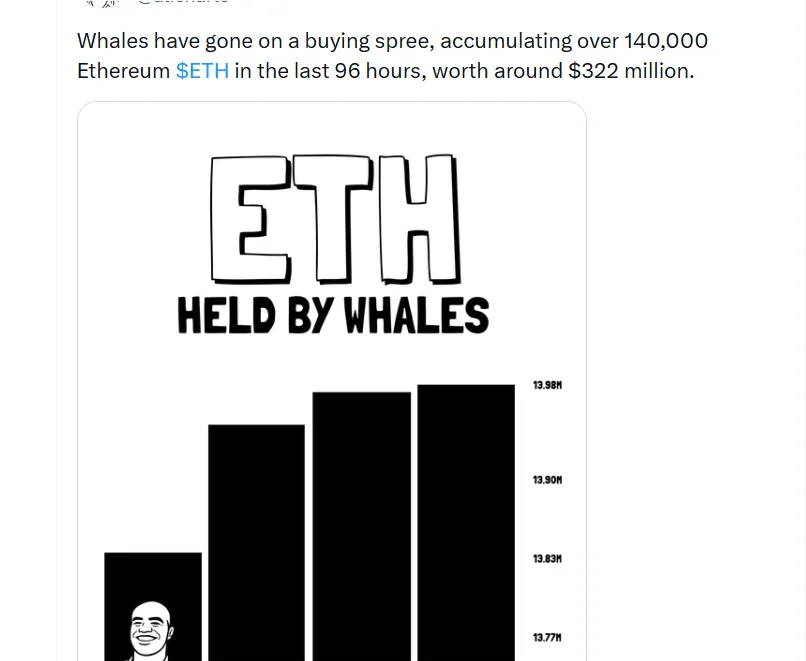
Whales buying behavior reflects trends of growing confidence.
Wallet distribution statistics indicate that the ETH balances of large holders have been steadily increasing in the recent past. The holdings have been on a steady upward trend and are closing in on about 13.98 million ETH. This growth implies that accumulation is not an isolated phenomenon but rather a part of a more generalized trend.
The rate of inflows also brings urgency among key investors keen on early positioning. This type of behavior tends to decrease instantaneous selling pressure among exchanges and over-the-counter markets.
Reduced supply may result into circumstances where the stability of prices is slowly changed to increase in price. These signals are often interpreted by retail investors as evidence of the reinforcement of positive market sentiment.
Ethereum ETF inflows reinforce institutional demand momentum
The accumulation wave coincides with an influx of capital into Ethereum-linked exchange-traded funds in recent times.The amount invested was over $350 million, a step backward towards a long-term history of straight withdrawals.
This move shows new institutional interest in being exposed to Ethereum in regulated investment vehicles.
The demand of ETF usually plays a complementary role with the whales, as they support a greater confidence in the market at the same time.The flows are usually institutional in nature and they bring about sustained capital as opposed to short term speculative liquidity.
Such dynamic gives more stable demand base that is allowing gradual increase of prices over time. The fact that the ETF inflows coincided with the whale accumulation is a very strong force that makes the overall market structure stronger.
Growth of prices is an indicator of recovery following a long period of decline.
Ethereum posted a 7.3% growth in April, as it moves toward recovery following the previous month.The last month has brought about an increase of 7% which is quite evident with a clear change in the direction of the price.
Prior to this rebound, the asset was on a six-month downward trend starting in September 2025.This protracted recession had undermined the mood and diminished the overall market participation.
The recent recovery indicates that the accumulation phases might be followed by the sustained upward momentum in the next few months.Regular flows both in the retail and the institutional channels make this transition more robust. The market participants are currently tracking whether Ethereum will be able to continue this trend in the face of changing macroeconomic factors.
Market impact suggests tightening supply conditions ahead
High accumulation lowers the supply in circulation, and this can affect the pricing efficiency in exchanges. Together with the institutional inflows, the effect usually results in stricter liquidity conditions.
This atmosphere may help to appreciate gradually, as opposed to sudden bursts of volatility in short-term cycles.Such conditions are usually perceived as positive by the investors, in their medium-term growth plans.
Whale behavior also gives a directional signal that often is closely followed by the smaller investors. This effect of cascade can increase demand particularly in initial stages of a recovery period.
When the accumulation is sustained, Ethereum can continue enjoying the benefits of less sell-side pressure in markets.
Conclusion
Ether is undergoing an organized build-up of whales and institutional investors.The buying of 140,000 ETH worth $322 million underlines the high confidence in the future price development.
Together with inflows of ETFs and the gradual improvement of the price, the market structure seems to be more favorable.The long-term demand and the constraint of supply conditions can predefine the direction of Ethereum in the next months.
FAQs
1. What is the reason behind Ethereum whales purchasing large quantities at this time?
The accumulation of whales is as a result of the improvement of market sentiment and expectation of increase in the price over time.
2. What was the recent amount of Ethereum that was purchased by whales?
In four days, they had amassed more than 140,000 ETH, which was worth around 322 million dollars.
3. How do ETF inflows affect Ethereum demand?
Inflows in ETFs inject institutional capital, which strengthens long-term demand and market stability.
4. What has been the performance of Ethereum in the recent past?
Ethereum increased by 7.3 percent in April, following an increase of 7 percent in March.
5. What is the whale accumulation to the market?
It lessens selling pressure and usually is an indication that the price may move upwards.