

Key Insights:
- Bitcoin could reach $125,000 as $4 trillion floods the market.
- Technology has created hidden credit risks for banks.
- Ramping up defence spending is pushing markets to inflate assets.
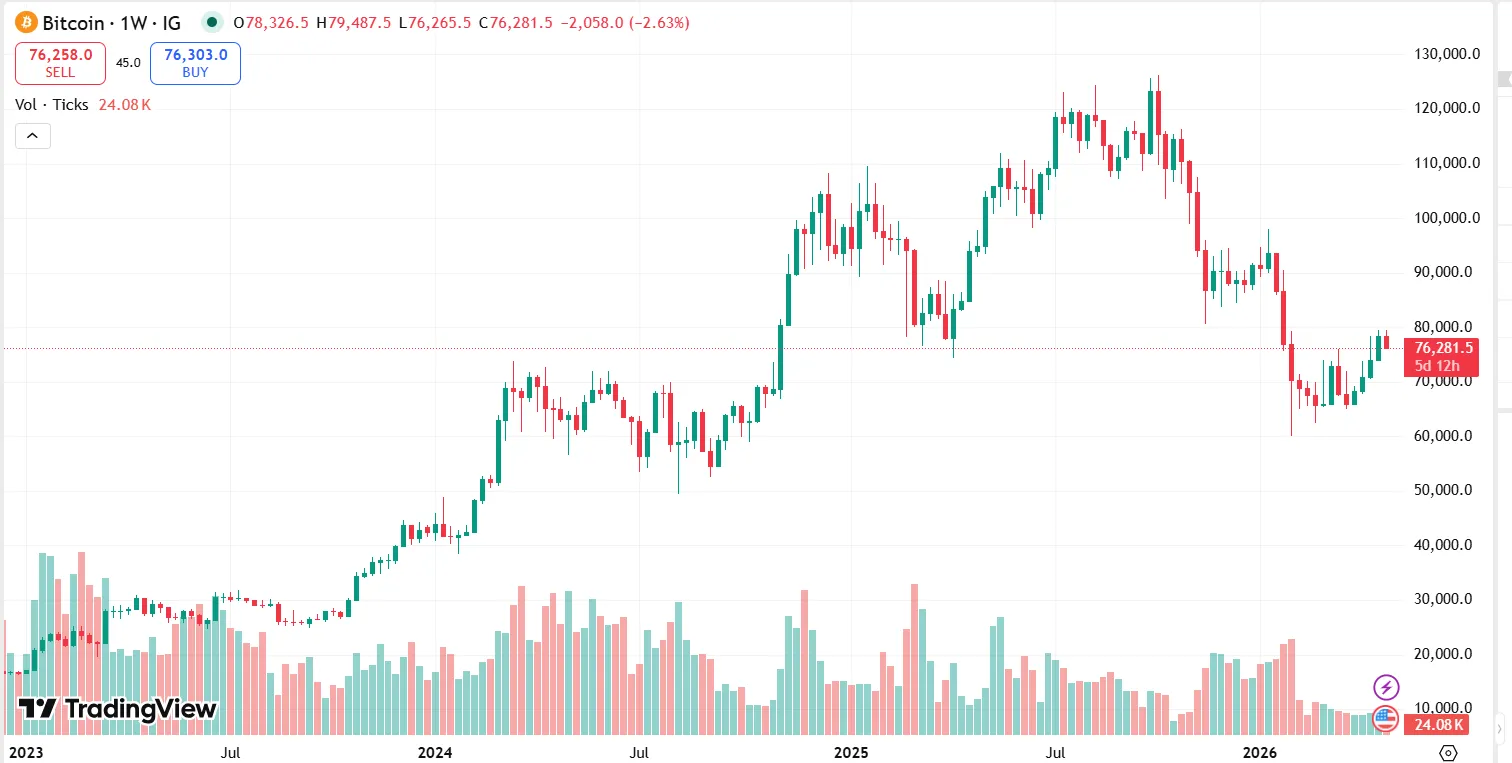
Bitcoin, after a failed attempt at a run-up this week, has fallen below $77,000 on lower oil prices and central bank uncertainty in the short term. But Arthur Hayes sees Bitcoin entering a new phase of growth due to macroeconomic change and gains in liquidity.
Hayes told the crowd at Bitcoin Vegas 2026 that Bitcoin could reach $125,000 by the end of the year, a 63% increase on the current price of $76,600. He emphasised the short-term volatility has no impact on the bigger trend, with improving liquidity and fiscal policy outweighing temporary market uncertainty.
Hayes based his prediction on a shift in capital dynamics, suggesting that Bitcoin is increasingly linked to global liquidity, rather than market-specific factors. This trend is set to accelerate and sees the asset poised for a long-term run-up.
Banks unleash trillions of new credit in global economy
A key element of Hayes’ thesis is the expanding lending capacity within the U.S. financial system, driven by regulatory changes that took effect on April 1. The Enhanced Supplemental Leverage Ratio reduces the amount of reserve funds that large banks like JPMorgan Chase and Citibank are required to maintain, freeing up more money for lending and to hold government debt.
S&P Global estimates that this change alone could free up $1.3 trillion for new lending in the banking system. Hayes went on to expand this analysis, estimating that with normal credit expansion factors, the total increase could be around $4 trillion in liquidity.
He noted that this expansion in credit would have a positive impact on Bitcoin since greater liquidity is likely to enter risk assets. He believed that this expansion could be large enough to reverse previous declines and help the market rebound.
Artificial Intelligence Disruption Triggers Hidden Credit Stress
Arthur Hayes identified artificial intelligence as a “hidden” credit stress. He referred to AI as the “new subprime”, saying that technology is displacing well-paid workers who underpin much of the bank loan book.
These individuals frequently hold loans backed by their steady incomes, thus causing credit stress. Hayes noted that after Bitcoin’s October 2025 high, it experienced a 50% drop while the Nasdaq Composite was largely unchanged.
He attributed this to declining SaaS earnings, as demand for services was replaced by AI. But now Hayes sees growing liquidity as countering these factors to favor Bitcoin.
Bitcoin Liquidity and Demand Increase with War Spending
Market sentiment is also being influenced by geopolitical issues, including the U.S.–Iran war. Investors are shifting from a deflationary outlook driven by AI to inflation because of the warhe lending boosts liquidity and increases the money supply. It also creates a pressure for governments to keep spending.
This has helped Bitcoin outperform the Nasdaq, gold and silver. Hayes said this is due to a shift towards investing in inflationary assets, with Bitcoin seeing a benefit from money printing. This indicates investors are looking for more stores of value.
Monetary Policy Changes Align with Credit Market Trends
In response to concerns about tighter policy, Arthur Hayes noted new Federal Reserve leaders probably won’t curb liquidity. He cited Kevin Warsh and Scott Bessent, who both need to maintain demand for U.S. debt, now exceeding $38 trillion.
Hayes said changes to the system’s structure can maintain liquidity despite a reduced Federal Reserve balance sheet. Banks can trade reserves for Treasurys and repos, enabling money to continue to move without apparent growth in reserves.
He said the pace of foreign purchases of U.S. Treasurys has slow, so more will be demanded in the country. This, along with regulatory reforms and increased borrowing, is helping credit growth and a strengthening outlook for Bitcoin towards $125,000.
Conclusion
Bitcoin still faces short-term challenges, but the long-term outlook is turning more positive as financial liquidity increases. According to Hayes, credit expansion, war-time stimulus and central bank moves are all pointing to higher prices.
As these factors play out, Bitcoin may see new inflows and a shift in investor attention. Though risks are apparent, the macro factors combined create a strong argument for higher prices over the coming months.
FAQ
Why is liquidity good for Bitcoin?
Liquidity injects capital into the markets, which can then be used to buy assets like Bitcoin.
What’s the $4 trillion credit expansion?
This is expected to be the rise in loans after credit multipliers by banks.
How will war affect Bitcoin?
Government spending on armaments increases borrowing and the money supply, which is good for inflationary assets like Bitcoin.
Will Bitcoin hit $125,000?
Macro dynamics will permit this, says Hayes but volatility may be a problem.