
Key Points:
- The CFTC obtained a court order preventing the state of Arizona from enforcing its gambling laws on Kalshi contracts.
- The court ruled that contracts involving the Kalshi events are swaps, subject to federal jurisdiction.
- The CFTC has established a task force and tracker to lead crypto and prediction market regulation.
A temporary court order blocking Arizona officials from applying state gambling laws to Kalshi by the Commodity Futures Trading Commission is a significant development in a legal battle that remains unresolved regarding the classification of event-based trading contracts. The decision, made by a federal judge in Arizona, comes after the CFTC and the federal government requested that it be issued, following state officials’ efforts to enforce local law.
Court Sides With CFTC on Federal Jurisdiction
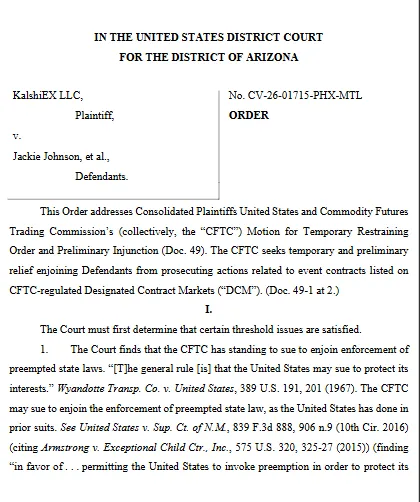
The order, granted by Judge Michael Liburdi of the U.S. District Court of the District of Arizona on Friday, granted the Commodity Futures Trading Commission its request. The decision prohibits Arizona authorities from commencing or proceeding with any civil or criminal enforcement actions against any of Kalshi’s contracts listed on CFTC-regulated markets.
Source: United States District Court, Arizona
The legal dispute emerged after Arizona authorities sought to apply state gambling laws to Kalshi’s event contracts. In response, the CFTC filed a request earlier in the week asking the court to block the state’s actions, arguing that such contracts are governed by federal derivatives law.
According to the agency, these products fall under the scope of the Commodity Exchange Act. In its judgment, the court said that the CFTC would have a high likelihood of proving that the contracts are indeed swaps, thereby bringing them under federal jurisdiction.
Under the Commodity Exchange Act, the CFTC is responsible for swaps traded on specified contract markets, and thus, states cannot independently regulate such instruments.
The temporary restraining order will be in place until April 24. At this stage, the court may issue a preliminary injunction that may prolong the limitations on the measures Arizona implements. Until a further decision is made, the state is prohibited from taking legal steps against Kalshi tied to these contracts.
CFTC Innovation Task Force Expands Regulatory Focus
At the same time, the Commodity Futures Trading Commission has moved forward with internal efforts to address emerging financial technologies by forming an innovation task force
Michael Passalacqua, a current senior advisor to Selig, leads the task force. In an announcement released Friday, the agency confirmed that five additional members will join Passalacqua, with backgrounds in law, regulation, and digital asset markets. The initial group includes Hank Balaban, Sam Canavos, Mark Fajfar, Eugene Gonzalez IV, and Dina Moussa.
Selig stated that the group is intended to deliver clearer regulatory guidance for innovators, highlighting its role in defining operational standards across evolving sectors. The formation of the task force reflects the CFTC’s continued efforts to address regulatory questions related to new financial instruments and technologies.
Innovation Tracker Outlines Key Areas of Work
On Friday, Mike Selig also introduced the agency’s “innovation tracker,” a platform that presents ongoing regulatory efforts and initiatives. The tracker identifies three primary areas of focus: crypto and blockchain, artificial intelligence and autonomous systems, and contracts and prediction markets.
These additions of contracts and prediction markets are aligned with the problems in the Kalshi case, where contracts based on events are being considered. The tracker aims to document the agency’s work and provide a systematic picture of its regulatory priorities.
As the announcement explains, the tool identifies initiatives that aim to develop regulatory clarity, promote market integrity, and advance technological development within specific frameworks. The project is part of CFTC’s overall approach to regulating gaps in new industries.
CFTC Role Relates to Current Legislative Trends.
Regulatory roles in the digital asset markets are still being established, with the Commodity Futures Trading Commission potentially playing a larger role. In mid-March, the Securities and Exchange Commission indicated that it does not consider most crypto assets to be securities under its jurisdiction.
This position could expand the CFTC’s authority, though final determinations remain tied to pending legislation. The proposed Clarity Act should clarify the positions of federal regulators, the CFTC and the SEC, regarding the regulation of digital assets.
Paul Atkins has called for the legislation to move forward, noting the need for defined regulatory boundaries. The outcome of the bill will influence how authority is distributed between agencies and how different asset classes are classified under U.S. law.