
Key Insights:
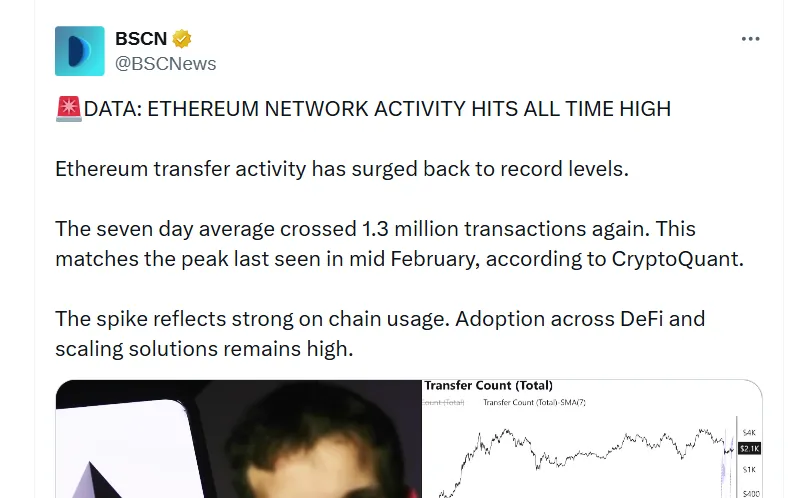
- Ethereum network activity reached a fresh peak, with average daily transfers rising above 1.3 million.
- Staked supply climbed to 31.2% of total ETH, even as annualized rewards stayed near 2.9%.
- Low gas fees, expanding DeFi use, and stronger Layer 2 demand widened the gap between usage and price.
Ethereum is showing renewed fundamental strength as on-chain activity climbs to levels not seen during earlier market cycles. Average daily transfers have moved above 1.3 million, according to the source material, signaling broad network demand across payments, stablecoins, tokenization, and smart contract execution. That activity has returned even after older trends, including NFT speculation and blockchain gaming mania, cooled noticeably across the market.
The current pattern suggests utility has not disappeared but has instead shifted toward more durable categories of usage. CryptoQuant data cited in the material also points to heavier interaction across DeFi protocols, Layer 2 blob demand, and routine transfer activity. At the same time, the asset held above the $2,200 region, helping keep liquidation pressure relatively contained across lending markets.
Gate data described sentiment as one of extreme fear, which makes the contrast more notable. Network use is expanding while token valuation remains restrained, creating an unusual divergence between price behavior and blockchain demand. That split has encouraged closer attention from analysts searching for underlying momentum beneath a still-cautious market backdrop.
Low Fees Support Broader On-Chain Demand
One of the more striking details in the material involves costs, which remain exceptionally low despite the jump in activity. Regular transfers reportedly cost less than $0.01, while decentralized exchange swaps and lending interactions cost around $0.11. Those figures matter because heavy blockchain use often appears during congestion, where sharply rising fees distort normal participation and push smaller users away.
This time, however, the higher baseline appears to reflect broader access rather than a temporary scramble around a single event. Ethereum is therefore processing heavier throughput without the kind of fee shock that previously discouraged smaller transactions. That combination supports the view that the chain is now serving more practical use cases on a consistent basis.
The report also notes that not every transfer should be treated as organic demand, since some contract interactions were linked to malicious address-seeding activity that benefits from cheaper execution costs. Even so, the overall trend remains difficult to dismiss. The network is carrying real transaction volume across several sectors while supporting smart contract operations, stablecoin settlements, and decentralized finance usage at relatively modest cost. That environment strengthens the case that actual utility has expanded beyond earlier speculative cycles.
Staking Growth Adds Security And Scarcity
Ethereum is also seeing a steady rise in staking participation, adding another layer to the network’s changing structure. The material says 31.2% of the total supply is now staked, while annualized staking rewards remain near 2.9% as of April 2026. That figure shows a meaningful share of circulating coins is being committed to network security rather than immediate sale.
Several notable holders were mentioned as participants in that broader staking trend, including Bitmine, the Ethereum Foundation, Grayscale, and Gate. Their participation underscores the fact that treasury management and institutional positioning is becoming more and more intersecting with validator economics. Even with stronger activity, the chain is not currently operating in a deflationary state. The source notes that more than 19,000 coins are still being produced weekly, while annualized network inflation stands near 0.83%. That rate is higher than earlier periods when supply growth was flat or briefly negative.
Ethereum therefore presents a mixed but increasingly important picture: stronger utilization, higher staking participation, and continued issuance at a moderate pace. Some skepticism remains around whether ETH’s clearest utility lies in payments, settlement, staking, or its role as collateral throughout decentralized finance. Still, the rise in locked supply reflects growing long-term conviction among holders.
Price Divergence Keeps Breakout Debate Alive
The only missing element in an otherwise constructive on-chain narrative is price. Despite record transfers, a surge in smart contract usage, and a growing share of its supply being staked, ETH has stubbornly held its ground, staying within the $2,100 to $2,200 range.
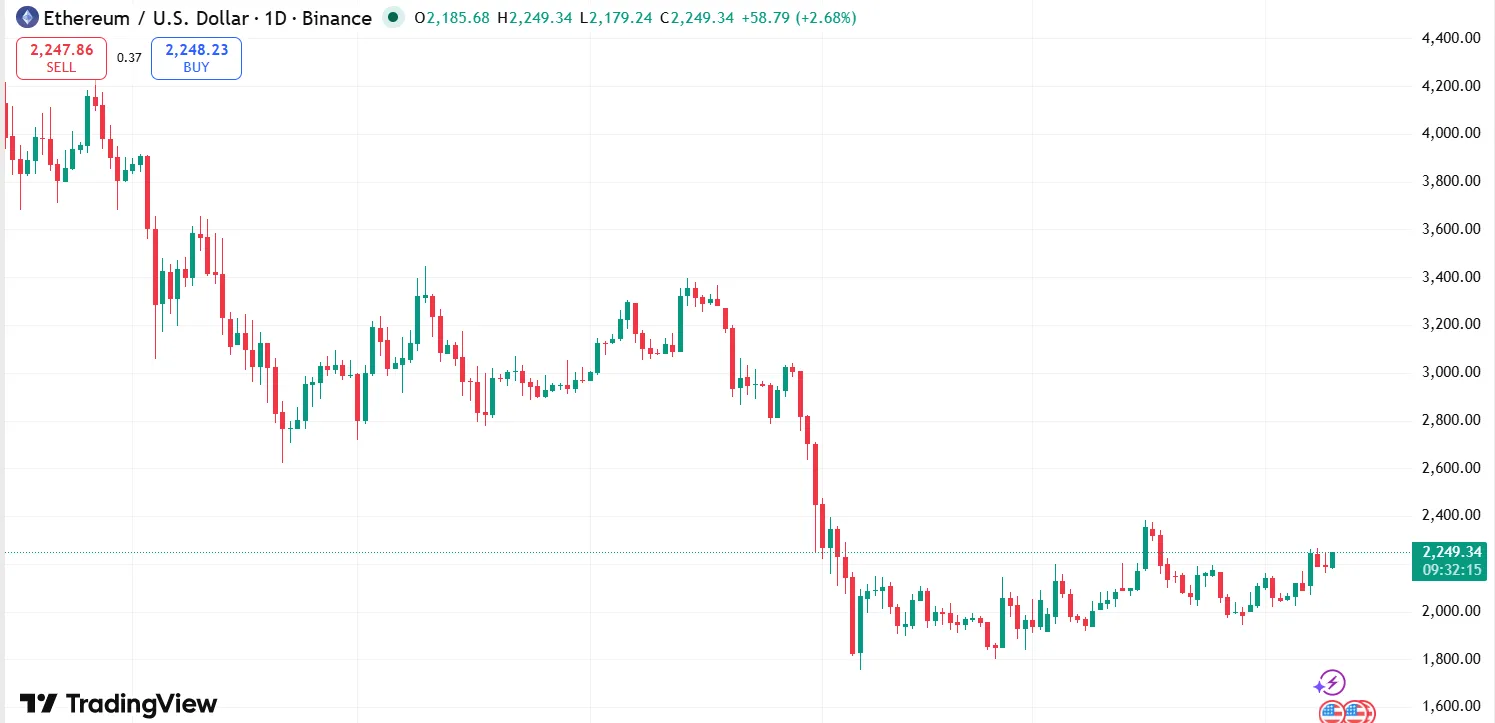
It is also reported that almost 2 million wallets are communicating with the network every day, a fact that supports the notion of user involvement that has grown well beyond the point of single spurts of speculation.
Ether is thus being used even as the market prices are kept low, a disenfranchisement that has taken center stage in the debate. Analysts cited in the content believe that such a gap will ultimately close as long as activity is strong and sentiment is better. Traders seem to be reluctant at the moment and the rest of the market seems to be fearful. However, the network picture below is less vulnerable than price would suggest.
The participation in DeFi is an ongoing activity, Layer 2 usage is still sustaining throughput, and the demand of on-chain settlement is still developing. That combination, according to the source, is an indicator that the foundation is getting firmer under a serene surface. It is still unclear whether the market will re-rate the asset in the near future but the indicators demonstrate a network with increasing relevance, sustainable participation, and an increasing base of committed capital.