
Key Insights:
- Pi also gave out validator rewards when it had done more than $526 million identity checks on its decentralized KYC network.
- More than 1 million validators were engaged in the verification of 18 million users worldwide.
- The reward pool was more than 26 million Pi, with 10 million Pi being donated by the foundation.
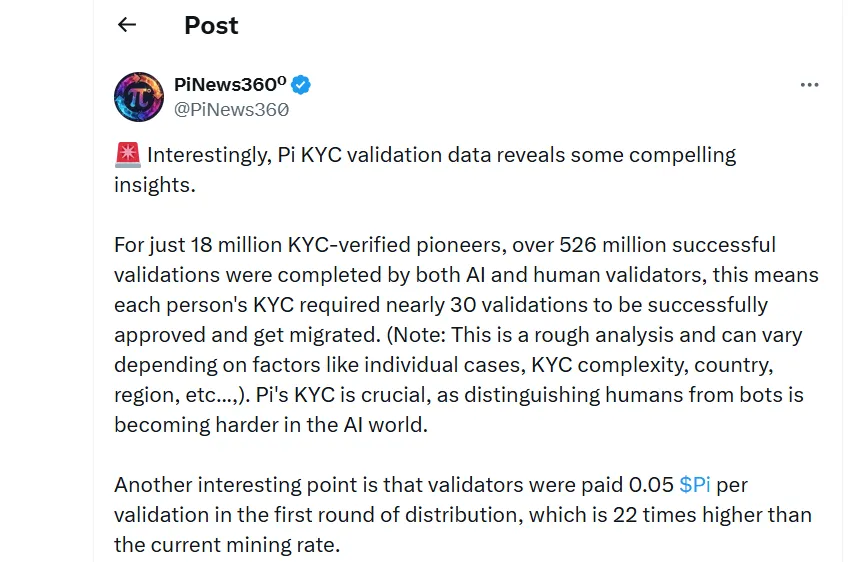
Pi has successfully made its first validator reward allocation following the implementation of one of the biggest decentralized identity verifications in the history of blockchain.This achievement comes after it had successfully processed 526,970,631 validations that assisted in confirmation of over 18 million users spread across the world.
The reward distribution started with a snapshot at March 5, 2026, where the activity of the validators and the amount of rewards in the pool were recorded at the time of the snapshot.The payouts were transferred straight to the wallets of the validators who had finished at least 50 correct checks and it was a significant move towards Pi.

Record-breaking international verification is made by validators.
Over 1,094,680 human validators took part in the process and formed a distributed workforce that verified work at an unprecedented level.The user applications were broken down into smaller tasks and different components of identity verification could be evaluated by multiple independent validators.
Each identity was on average validated 20 to 30 times before final approval, depending on complexity and other verification requirements.This multilayer method minimized the chances of fraud and enhanced precision, especially in identifying deepfakes and synthetic identities.
Contrary to most blockchain solutions that rely on centralized KYC providers, Pi created its own internal system of verification, which is operated by human participants and AI-based tools.The model also guarantees that user data (which is sensitive) is not stored in one external entity, which improves privacy and decentralization.
Validators were used to perform document authentication, liveness detection, and profile matching, and AI systems were used to support consistency checking and the identification of anomalies.Human judgment combined with automation enabled Pi to remain reliable as it expanded its operations to other parts of the world.
Reward pool over twenty six million tokens.
The overall amount of validator reward pool was 16,568,774 Pi, which is an accumulation of users who have successfully transferred to the Mainnet network.The foundation injected an extra 10 million Pi to promote early validators that assisted in training and stabilization of the system.
According to the final computation, one successful validation was rewarded about 0.0504179 Pi, or what was roughly 21 times the base mining rate.The rewards were shared on an equal basis, i.e. the validators received in accordance with the number of correct validations performed within the period of time recorded.
The possibilities of the future increase with the increase in the network participation.
After the first allocation, Pi will launch more validation rounds, which will mean that new users who did not participate in the previous rounds can earn.The network is also striving to optimize its validator performance algorithm to have enhanced accuracy tracking and reward fairness during subsequent distributions.
The more AI is used, the fewer humans might be needed to validate an application, which could increase the reward rate of the tasks carried out.This development can be seen as the wider vision of Pi to integrate human input in a decentralized form and automated systems to facilitate scalable digital infrastructure.
Milestone achievement is not accompanied by market reaction.
Even though the magnitude of the success is big, the performance of Pi in the market has been quite low with the token trading at about $0.176 in the recent past.The price is considerably lower than the all-time high, indicating that adoption indicators have yet to become robust market movement.
The successful implementation of such a massive verification system however is a sign that the network has the capability to operate and be viable in the long run.The coordination of more than one million contributors underscores the ability by which Pi can expand to wider areas of decentralized workforce application, beyond identity verification.