Key Insights:
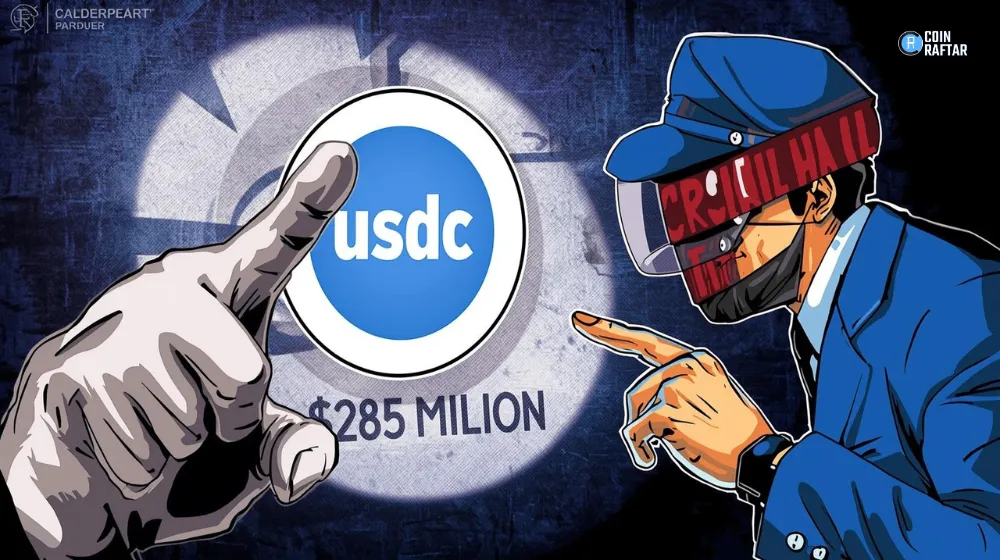
- USDC is under scrutiny after the $285M Drift Protocol exploit raised concerns over Circle’s delayed response and monitoring gaps.
- The attack caused Drift’s TVL to fall from $550 million to $247 million, reflecting severe liquidity shock.
- The incident intensifies debate over centralized control risks in USDC cross-chain transfer systems.
The hub of the controversy was the USDC when on April 1, 2026, the exploit targeting the Drift Protocol led to gigantic losses in the decentralized markets. Between $200 million and $285 million digital assets were lost as a result of the attack and this is the largest DeFi breach of 2026 so far.
Onchain investigator ZachXBT alleged that Circle had not intervened when stolen USDC was transferred across wallets and networks. It has been reported that the transfers took place during U.S. working hours but no immediate action of freezing and no action of interrupting transactions were taken.
Table of Contents
ToggleThis event rapidly turned into a larger industry discussion regarding the timing of response and the ability to enforce it. Analysts pointed out that the attacker transferred money in systematic steps, which made it more challenging to detect and interfere with the cross-chain settings.
Security firms trace massive USDC outflows
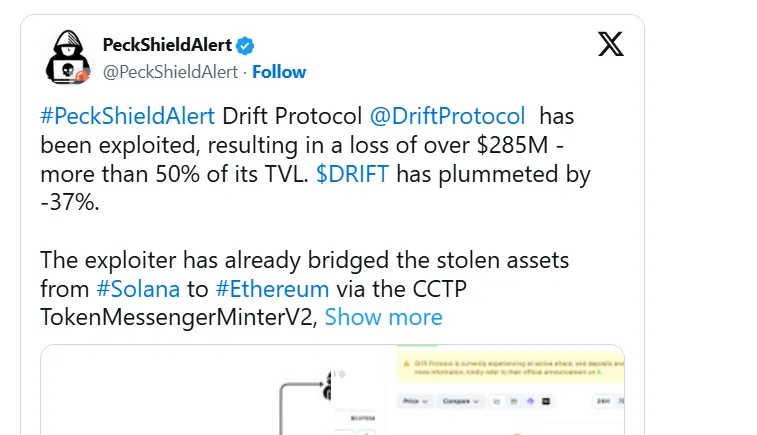
PeckShield and Arkham Intelligence, blockchain security firms, found about $285 million of suspicious outflows of the primary vault of Drift. The attacker quickly divided money into several wallets to minimize the traceability and slow down recovery process.
Investigators noted that stolen USDC was left idle either one to 3hrs before more movement across addresses was recorded. Analysts now consider this delay an important killing field, which was not used well at the initial stage of the response.
The systematic movement pattern indicated preparation and coordination, where assets were very well redistributed to prevent activating automated risk systems. Security researchers are still examining transaction clusters to discover potential recovery paths.
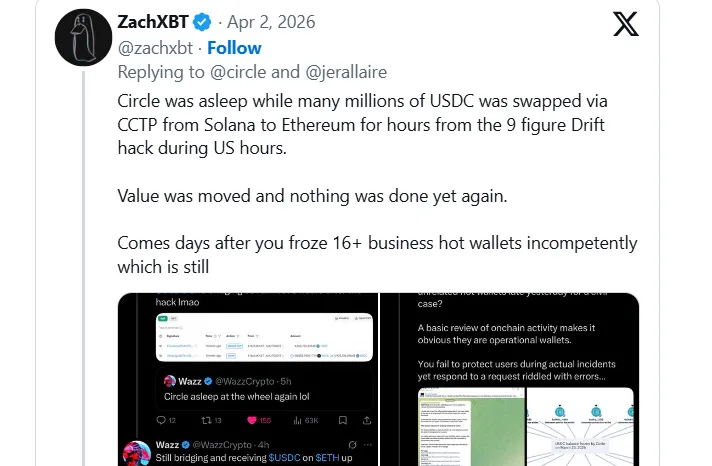
Drift USDC passes through cross chain bridge.
Later, the attacker transferred assets across Solana and Ethereum with the help of the Cross-Chain Transfer Protocol of Circle. This system burns USDC on one chain and mints equal tokens on another, and has a constant value transfer mechanism.
Security researcher Specter reported that the attacker did not convert money into Tether when transferring them. This action indicated the assurance that USDC movements were not going to be disrupted by enforcement measures when the routes were in the routing stages.
Cross-chain infrastructure usage raised issues about visibility monitoring between networks. Analysts have observed that after the flow of funds into bridge flows, monitoring becomes extremely complicated and time sensitive to all involved parties.
Circle response timing is subject to criticism.
The scandal became even more intense as the analysts and investigators reexamined the USDC imposed enforcement actions in the past. In March, Circle blocked several business wallets in a closed civil case with unrelated parties, interfering with transactions and payment services.
Observers noted the difference between swift enforcement in cases of compliance and slower response in the Drift exploit. ZachXBT had earlier condemned the consistency of decision-making by Circle, claiming that the time of response seems disproportionate in various types of incidences involving USDC.
It has now been discussed in terms of larger questions regarding thresholds of operational intervention. Players in the industry are arguing on whether automated freezing systems ought to run faster in high-value exploit situations.
Drift collapse strengthens market effect.
The exploit severely affected the financial position of Drift Protocol, the amount of money locked in it decreased by about half, to about $247 million. This constitutes a large liquidity contraction in hours of the attack being announced.
The native DRIFT token also dropped almost 28%, which indicates a loss of investor confidence and an increase in withdrawal. SOL on the other hand dropped to $79.08 and this is a 4.45% drop in the company with the volume of trade soaring to $5.17 billion as the sell-off was taking place.
There was increased uncertainty in the broader market sentiment as traders reviewed the risk exposure on decentralized finance platforms. Analysts observed that outflows of liquidity increased immediately after the confirmation of exploits and hastened the decreasing valuation of the protocol.
USDC control controversy is heating up.
The case has rekindled the discussion on centralized powers in decentralized financial systems and, more specifically, on the power to issue USDC. Due to the fact that Circle has the power to control the minting and freezing of the token, it is able to limit the addresses in the supported blockchains.
According to critics, this power has made them responsible to act fast when it comes to exploits in large scale. But others stress that real time enforcement must be verified, coordinated and legally approved and implemented in more than one network.
The Drift case remains influential in the discourse concerning the tradeoff between the speed of security responses and procedural protection in cross-chain ecosystems. It has also brought out the necessity of better monitoring infrastructures in the decentralized platforms that deal with high-value assets.