
- California broadens regulations to prevent government officials from profiting by predicting markets as insiders.
- The Congress suggests bills that prohibit officials and their families from trading event-based contracts.
- The platforms tighten their regulations when trading volumes reach record highs and scrutiny expectations rise.
Prediction market insider trading moved to the center of a new ethics debate on Friday after California Governor Gavin Newsom signed an executive order expanding restrictions on public servants and people close to them from profiting on event-based contracts tied to outcomes they can influence or know about through government work.
California Broadens Limits on Prediction Market Insider Trading
Under the order, the prohibition applies specifically to political appointees selected by the California governor for public office. The stated purpose is to prevent individuals with privileged access from using government information for private financial benefit through prediction markets.
Newsom said public service should not be used to get rich and described the California action as a clear ethical line for those serving in appointed roles. The governor also linked the order to broader concerns about insider profiting tied to government information. In a statement included with the announcement, he said California would not tolerate corruption involving public appointees and their access to information.
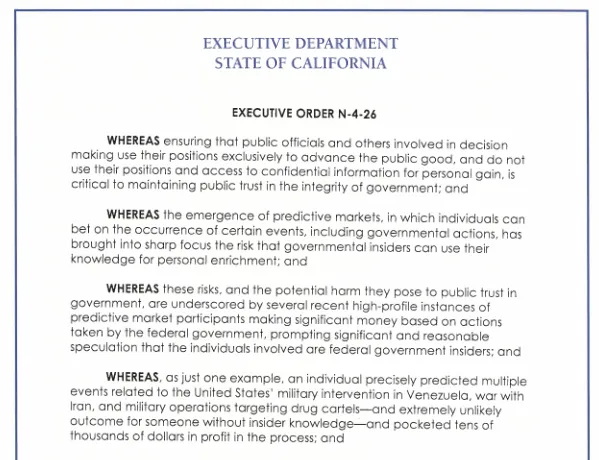
Source: California Governor Newsom’s Executive Government Order
The California order did not stop with appointed officials alone. It also extended the restrictions to include spouses, family members, and former business partners who could benefit from non-public information connected to the work of those officials. That expansion marked a broader attempt to address indirect use of privileged information in prediction markets.
Newsom’s office pointed to a January case involving suspected insider trading activity as part of the broader concern. According to the information cited, a Polymarket trader made $410,000 after betting that former Venezuelan leader Nicolás Maduro would be arrested, placing the wager hours before the capture. The case was referenced as an example of how prediction markets may raise concerns when traders appear to act ahead of sensitive government-related developments.
The executive action arrived amid intensified questions about market integrity. Stories have continued to accumulate about large wagers placed shortly before U.S. military strikes in Venezuela and Iran, with those bets reportedly generating millions of dollars for suspected insiders.
Those incidents have added pressure on lawmakers and market operators to address whether participants with special access or influence are using prediction platforms improperly.
Congress Introduces New Bills on Sensitive Event Contracts
Federal lawmakers also moved this week to respond to the same set of issues. Members of Congress from both parties introduced the Preventing Real-time Exploitation and Deceptive Insider Congressional Trading Act, or the PREDICT Act.
The proposal would prohibit members of Congress, federal officials, and their families from trading event contracts linked to political developments, policy decisions, and other government actions. The bill also outlines penalties. According to the proposal, violators would be expected to pay all profits to the United States Treasury and an additional 10% penalty.
Moreover, the Banning Event Trading on Sensitive Operations and Federal Functions Act, or the BETS OFF Act, is another bill introduced in March 2026 by Texas congressman Greg Casar and Connecticut senator Chris Murphy. That legislation would prohibit government insiders from using prediction platforms to profit from markets tied to war or death.
A separate proposal was introduced in March by U.S. Representative Adrian Smith and Representative Nikki Budzinski. Their bill, also titled the Preventing Real-time Exploitation and Deceptive Insider Congressional Trading Act, would prohibit the U.S. president, lawmakers, and other high-ranking government officials from betting on prediction markets.
Platforms Add Restrictions as Volume Reaches New Highs
Prediction market operators have also begun updating their own controls. Polymarket and Kalshi introduced new restrictions and surveillance measures this week in response to concerns about insider trading. The reforms involve restrictions on players that can directly affect market performance, as well as broadening current regulations on insider trading and market manipulation.
The platform measures were taken at a time when the sector continued to grow, according to data from Coinraftar, Kalshi, and Polymarket, which recorded more than $20 billion in combined monthly trading volume for the first time this month. The total marked a seventh straight monthly record high, showing that user activity has continued rising even as regulatory and ethics concerns have become more visible.
That growth has made oversight questions more urgent. As trading volumes increase, so does attention on whether market participants have equal access to information. The recent executive order in California, combined with legislation introduced in Congress and the rule changes adopted by major platforms, shows that officials and operators are now taking direct steps to address those concerns.