Why Everyone Is Talking About Crypto in 2026
Let’s be honest a few years ago, crypto felt like something only tech enthusiasts and Wall Street insiders understood. But 2026 looks very different. Major banks now offer Bitcoin custody services. Governments are passing clear regulations. And millions of everyday people from students to retirees are buying cryptocurrency for the first time.
If you’ve ever Googled “how do I buy a Bitcoin” or “how do I get cryptocurrency” and felt more confused after reading the results, this guide is for you.
We’re not going to drown you in technical jargon or assume you already know what a blockchain is. Instead, we’ll walk you through everything from what crypto actually is, to how to buy it safely, where to store it, and how to invest without putting yourself at unnecessary risk.
By the end of this guide, buying cryptocurrency for beginners will feel far less intimidating. Let’s start from the very beginning.
What You’ll Learn in This Guide
- What cryptocurrency is and how it works
- How to buy crypto step by step — from choosing an exchange to storing your coins
- The safest ways to invest in cryptocurrency as a beginner
- Common mistakes that cost beginners money — and how to avoid them
- Answers to the most frequently asked questions about buying crypto
What Is Cryptocurrency?
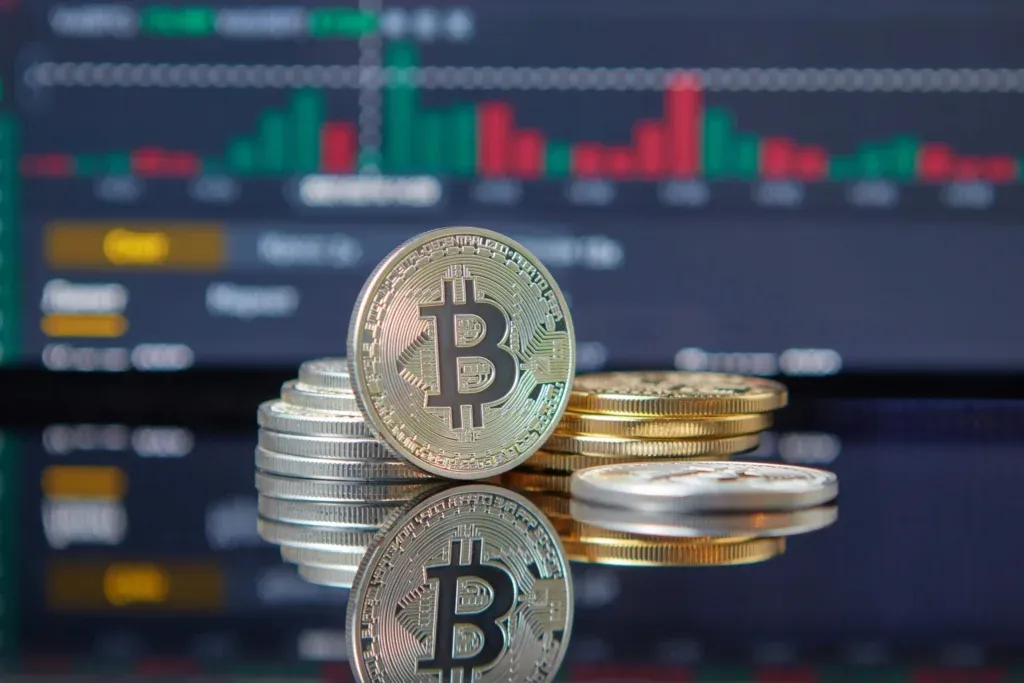
Cryptocurrency is digital money but it’s different from the money sitting in your bank account in one important way: no bank, government, or central institution controls it.
Instead, it runs on a technology called the blockchain, a shared, public record book where every transaction is logged permanently. Think of it like a massive Google Sheet that thousands of computers around the world maintain simultaneously. Nobody owns it. Nobody can secretly edit it. And that’s what makes it trustworthy.
The Two Names You’ll Hear Most
When people talk about buying crypto, they usually start with two coins:
- Bitcoin (BTC): Created in 2009, Bitcoin was the world’s first cryptocurrency. It’s often called “digital gold” because, like gold, there’s a limited supply only 21 million Bitcoins will ever exist. Most beginners buy Bitcoin first.
- Ethereum (ETH): Launched in 2015, Ethereum is both a digital currency and a platform. It powers smart contracts, decentralised apps (dApps), and most of the DeFi and NFT ecosystems. It’s the second-largest crypto by market value.
Beyond these two, there are thousands of other coins called altcoins like Solana, XRP, Cardano, and Dogecoin. As a beginner, it’s wise to start with Bitcoin or Ethereum before exploring anything else.
Key Terms Made Simple
- Blockchain — A digital ledger shared across thousands of computers. No single person owns or controls it.
- Wallet — A tool (app or device) that stores your crypto. Like a bank account, but you’re fully in charge.
- Exchange — A platform where you buy, sell, and trade cryptocurrency — similar to a stock brokerage.
- Private Key — A secret password that proves you own your crypto. Never share this with anyone, ever.
- Altcoin — Any cryptocurrency that isn’t Bitcoin.
Must Read: Best Crypto to Buy in 2026: BTC, ETH, SOL & ADA
How to Buy Cryptocurrency for Beginners: Step-by-Step Guide
Ready to actually buy some crypto? Here’s how the process works, from start to finish. It takes most beginners less than 30 minutes to complete all five steps the first time.
1. Choose a Crypto Exchange
A crypto exchange is where you buy and sell digital currencies. Think of it like a brokerage but for crypto. For beginners, the most important factors are ease of use, security, and fee transparency.
Recommended Exchanges for Beginners
| Exchange | Best For | Highlight |
|---|---|---|
| Binance | Beginners & advanced traders | Largest exchange by volume, low fees |
| Coinbase | First-time buyers (especially US) | Extremely user-friendly interface |
| Kraken | Security-focused users | Strong regulatory compliance record |
| Gate.io | Wide coin selection | Supports 1,400+ cryptocurrencies |
2. Create and Verify Your Account:
Sign up with your email, create a strong password, and complete KYC (Know Your Customer) verification. This means submitting a government ID and sometimes a selfie. Most platforms approve within minutes to a few hours.
Verification is legally required on regulated exchanges. It protects you and the platform. If an exchange lets you buy large amounts of crypto without any verification, consider that a red flag it may not be trustworthy.
3. Deposit Funds
Once verified, link your payment method. Most exchanges accept bank transfers, credit/debit cards, and UPI (in India). Bank transfers usually have lower fees; card purchases are faster but typically cost 1.5–3.5% extra.
Pro Tip: Watch the Fees
Always check the full fee breakdown before depositing. Some exchanges show a low trading fee but charge a hidden withdrawal fee. A good exchange shows all costs clearly before you confirm any transaction.
4. Buy Your First Crypto:
Navigate to the “Buy” section, choose your coin (Bitcoin or Ethereum are good starting points), enter the amount you want to spend, and confirm. You don’t need to buy a whole Bitcoin, you can buy $10 worth if you want.
Most exchanges show you the exact amount of crypto you’ll receive before you confirm. Take a moment to check the rate, any fees, and the final amount. Once confirmed, the transaction is usually instant or settles within a few minutes.
5. Store Your Crypto Safely (Wallets):
This is the step most beginners skip and regret later. Leaving your crypto on an exchange is risky. If the exchange gets hacked or goes bankrupt, you could lose everything. Moving your crypto to a personal wallet gives you full control.
Types of Crypto Wallets:
- Software Wallets (Hot Wallets): Apps on your phone or computer. Examples: MetaMask, Trust Wallet, Exodus. Free, convenient, but connected to the internet.
- Hardware Wallets (Cold Wallets): Physical USB-like devices. Examples: Ledger Nano X, Trezor. Cost $50–$150, but offers the strongest security. Recommended for anyone holding significant amounts.
- Exchange Wallets: The default when you buy on an exchange. Convenient but you don’t hold the private keys the exchange does. Fine for small amounts or active trading.
🏆 The Golden Rule of Crypto
“Not your keys, not your coins.”
If you don’t hold your private key, you don’t truly own your crypto. For any serious investment, move your coins to a personal wallet.
How Do I Get Cryptocurrency?
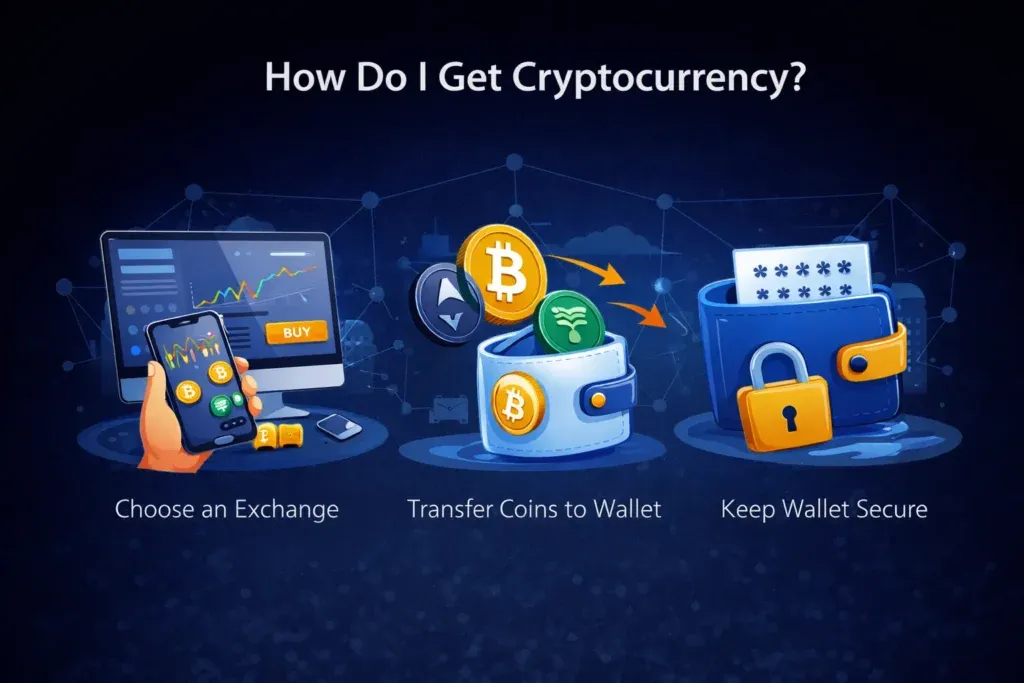
Buying from an exchange is the most common route, but it’s not the only way to get cryptocurrency. Here are the main methods, each with different trade-offs:
Buying from a Centralised Exchange (CEX)
This is what we walked through above using platforms like Binance, Coinbase, or Kraken to purchase crypto with regular money. It’s the fastest, simplest method and recommended for beginners. You get instant access to major coins with customer support if anything goes wrong.
Peer-to-Peer (P2P) Platforms
P2P platforms connect buyers and sellers directly, without an intermediary. Binance P2P and LocalBitcoins are popular examples. You can often get better exchange rates and pay using local methods like UPI or bank transfers. The trade-off is you need to be more careful always check seller ratings and use escrow protection.
Earning Crypto
Some platforms pay you in crypto for work. Freelancers use services like Bitwage or direct crypto payments from clients. Content creators on platforms like Audius or Brave Browser earn tokens for their activity. It’s a growing option as crypto becomes more mainstream in everyday work.
Crypto Staking and Yield Rewards
Once you own crypto, you can earn more through staking, essentially locking up your coins to help validate transactions on a blockchain network. In return, you earn rewards, somewhat like interest on a savings account. Ethereum, Cardano, Solana, and Polkadot all support staking.
How to Buy Crypto Safely: Essential Security Tips
Crypto scams cost investors billions every year. The decentralised nature of cryptocurrency, the very thing that makes it powerful, also means there’s no central authority to reverse a fraudulent transaction. Once your crypto is gone, it’s gone.
Here’s how to protect yourself from the very beginning:
Use Only Regulated, Reputable Exchanges
Stick to well-known exchanges that are registered with financial regulators in their home countries. Binance, Coinbase, Kraken, and Gate.io are among the most widely used globally. Before signing up anywhere, search “[Exchange name] regulated” or “[Exchange name] review” and read recent user experiences.
Enable Two-Factor Authentication (2FA) Immediately
Two-factor authentication (2FA) means that even if someone steals your password, they still can’t log in without a second code from your phone. Set this up on day one every reputable exchange offers it. Use an authenticator app like Google Authenticator or Authy rather than SMS codes, which can be intercepted.
Never Share Your Private Key or Seed Phrase
Your seed phrase is a set of 12–24 random words that is the master key to your crypto wallet. Anyone who has it can access everything. No legitimate exchange, support team, or crypto project will ever ask for your seed phrase. If someone does ask, it’s a scam, full stop.
Recognise Common Crypto Scams
- Fake giveaways: “Send 1 BTC and get 2 back.” This is always a scam, even if it appears to come from a celebrity account.
- Phishing websites: Fake versions of real exchanges designed to steal your login. Always type the URL manually or use bookmarks.
- Pump and dump groups: Telegram or WhatsApp groups hyping an obscure coin. Usually, insiders dump their coins on latecomers.
- Romance scams: Someone builds an online relationship then asks you to invest in “their” crypto platform. Never invest based on a stranger’s recommendation.
Use a Hardware Wallet for Large Amounts
If you’re holding more than a few hundred dollars in crypto, a hardware wallet like a Ledger Nano X or Trezor Model T is worth the investment. These devices keep your private keys completely offline, making them virtually immune to online hacks.
Security Checklist for New Crypto Buyers
- Use only registered, well-reviewed exchanges
- Enable 2FA with an authenticator app (not SMS)
- Write your seed phrase on paper and store it somewhere physical and secure
- Never click links in emails or DMs claiming to be from your exchange
- Use a unique, strong password for your exchange account
- Consider a hardware wallet for holdings above $500
How to Invest in Cryptocurrency Safely for Beginners
There’s a big difference between buying crypto and investing in crypto wisely. Buying is the mechanics of the steps we’ve covered above. Investing is the mindset and strategy that determines whether you come out ahead.
Only Invest What You Can Afford to Lose
This is the first rule of crypto investing, and it’s worth repeating until it sticks. Cryptocurrency is a genuinely volatile asset. Bitcoin has dropped 70–80% from its peaks more than once and recovered each time but that recovery can take years. Before you put a single rupee into crypto, make sure you have an emergency fund and no high-interest debt.
Manage Risk Through Diversification
Don’t put all your money into a single coin. A sensible beginner approach might be 60–70% in Bitcoin and Ethereum (the most established coins), with a smaller percentage in a few carefully researched altcoins. The more speculative the coin, the smaller the position should be.
Long-Term Thinking Usually Wins
The vast majority of people who have made meaningful money from crypto did so by holding over the long term a strategy sometimes called HODLing in crypto communities. Short-term trading requires deep market knowledge, discipline, and emotional control that most beginners haven’t developed yet. If you’re new, start with a “buy and hold” approach.
Avoid the Hype Coin Trap
Every market cycle produces dozens of new coins promoted by influencers, YouTube videos, and social media posts promising 10x, 50x, even 100x returns. Most of these projects have no real use case, no credible team, and no long-term roadmap. The people promoting them are usually paid to do so or are already holding large bags they want to unload.
Before investing in any coin, ask yourself: What problem does this solve? Who built it? Has it been independently audited? What’s the token distribution? If you can’t find clear answers, that’s your answer.
Dollar-Cost Averaging (DCA) The Beginner’s Best Friend
Instead of trying to time the market which even professionals consistently fail to do, consider dollar-cost averaging. This means investing a fixed amount at regular intervals (e.g., £50 every week or ₹5,000 every month), regardless of price. Over time, this smooths out volatility and removes the emotional pressure of trying to buy at the perfect moment.
| Example: DCA in Practice : Imagine you invest ₹5,000 in Bitcoin every month for 12 months regardless of price. Some months you buy at a high, some at a low. At the end of the year, your average cost is somewhere in the middle and you never had to guess which direction the market would move. This simple strategy outperforms most active traders over time. |
How Do I Buy Bitcoin? A Realistic Step-by-Step
Let’s bring everything together with a real-world scenario. Meet Priya, a 28-year-old teacher in Delhi who’s heard about Bitcoin for years but never taken the plunge. She has ₹10,000 to invest and zero technical knowledge. Here’s exactly what she does:
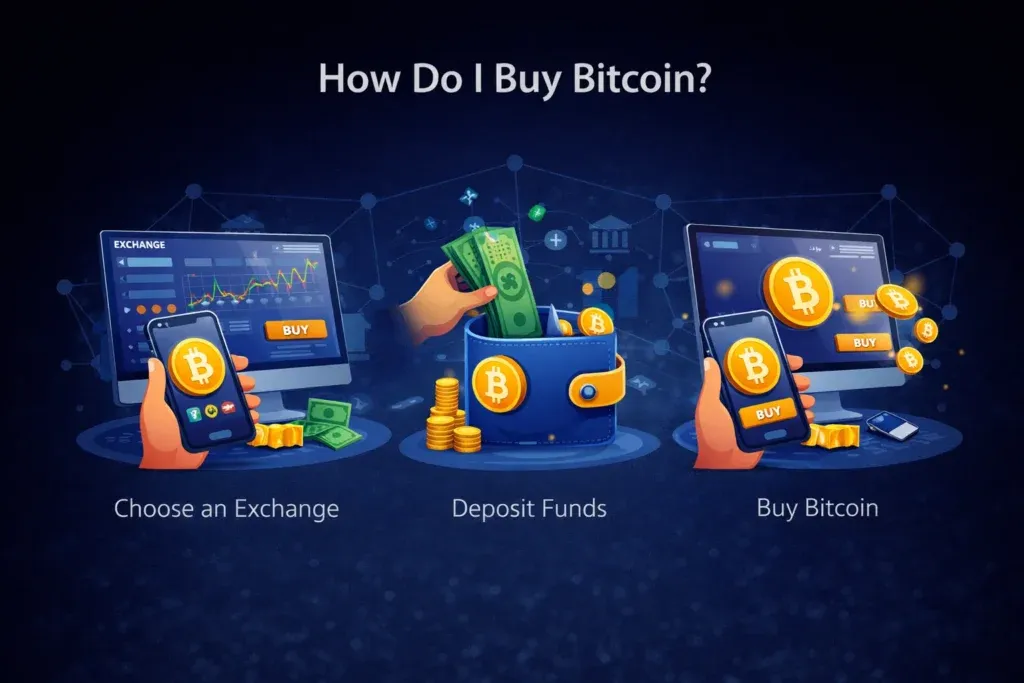
1. Priya researches exchanges:
She Googles “best crypto exchange India” and reads reviews of Binance, CoinDCX, and WazirX. She chooses Binance because it’s globally regulated, has low fees, and has an app that looks easy to navigate.
2. She creates and verifies her account:
Priya downloads the Binance app, registers with her email, and sets a strong password. She enables Google Authenticator for 2FA immediately. KYC verification takes 10 minutes and she uploads her Aadhaar card and a quick selfie. Approval comes within 2 hours.
3. She deposits money
In the app, she taps “Buy Crypto” and selects UPI as her payment method. She enters ₹10,000 and sees the estimated amount of USDT she’ll receive (Binance often uses stablecoins as an intermediate step in India). The transaction completes in under 5 minutes.
4. She buys Bitcoin
Priya goes to the “Spot” market, searches for BTC, and places a simple “market buy” order for her full USDT balance. She gets approximately 0.00089 BTC, a fraction of one Bitcoin. She checks the total including fees and confirms.
5. She moves her Bitcoin to a wallet:
Priya downloads Trust Wallet on a separate device, writes her 12-word seed phrase on paper and stores it in a locked drawer (not on her phone). She then sends her Bitcoin from Binance to her Trust Wallet address. She double-checks the address before confirming crypto transactions are irreversible.
That’s it. Priya now owns Bitcoin. The whole process from zero to holding crypto took her one afternoon.
The amounts don’t matter. You can start with ₹500 or ₹500,000. What matters is following each step carefully, especially the security ones.
Must Read: Bitcoin Rally Signals 12% Market Confidence As War Tensions Ease
Common Mistakes Beginner Crypto Buyers Make (And How to Avoid Them)
Learning from other people’s mistakes is a lot cheaper than making your own. Here are the most common errors new crypto investors make:
Investing Without Doing Any Research
Buying a coin because someone on Twitter hyped it, because a friend mentioned it, or because its price chart “looks like it’s about to go up” is speculation, not investing. Always understand what you’re buying the project, the team, the use case, and the risks before committing any money.
Ignoring Trading and Withdrawal Fees
Fees add up fast, especially if you’re making frequent trades or withdrawals. Some exchanges charge flat fees; others charge a percentage. Always calculate your total cost trading fee plus network (gas) fee plus withdrawal fee before placing an order. A trade that looks profitable can easily turn unprofitable once fees are factored in.
Leaving Everything on an Exchange
Exchanges do get hacked. Exchanges do go bankrupt as FTX’s collapse in 2022 dramatically proved, wiping out billions in customer funds overnight. If you’re holding crypto for the medium or long term, move it to a wallet you personally control.
Panic Selling During Dips
The crypto market is volatile; that’s a feature, not a bug. Prices dropping 20–40% in a week is not unusual. Many beginners panic sell during downturns and lock in losses, only to watch the price recover weeks later. If you’ve done your research and believe in what you’re holding, a temporary dip isn’t a reason to sell.
Investing More Than You Can Afford to Lose
Some people take out loans, sell their car, or drain their savings to buy crypto. This is extremely dangerous. Crypto’s volatility means your investment could drop significantly before recovering. Never risk money you need for rent, food, or emergencies.
Falling for Unrealistic Promises
If someone guarantees returns “guaranteed 5x in 60 days,” “our algorithm has never lost money” run. There are no guarantees in crypto. Anyone promising otherwise is either lying or setting up a scam. Legitimate projects and platforms never guarantee returns.
Frequently Asked Questions About Buying Crypto
1. Is crypto safe for beginners?
Crypto is safe for beginners if basic precautions are followed. Use trusted exchanges, enable 2FA, never share private keys, and invest only what you can afford to lose.
2. How much money do I need to start buying cryptocurrency?
You can start with as little as ₹100 or $1. Beginners should start small, learn the process, and gradually increase their investment.
3. Can I lose all my money in crypto?
Yes, especially with risky or new coins. To reduce risk, invest only what you can afford to lose and focus on established assets like Bitcoin and Ethereum.
4. Do I need to buy a whole Bitcoin?
No. Bitcoin is divisible. You can buy small fractions, even worth ₹500 or less.
5. Is cryptocurrency taxed in India?
Yes. India applies a 30% tax on crypto gains and 1% TDS on transactions above ₹10,000. Keeping records is essential.
6. What is the best cryptocurrency for beginners?
Bitcoin and Ethereum are best for beginners due to strong history, liquidity, and adoption.
7. How long does it take to buy crypto?
Buying crypto takes minutes after verification. KYC may take a few minutes to hours, while bank transfers can take 1–3 days.
Conclusion: Your First Step Into Crypto Starts Here
Buying cryptocurrency in 2026 is more straightforward than it’s ever been. The exchanges are more regulated, the apps are more intuitive, and the educational resources are more abundant. The learning curve that intimidated beginners a few years ago is significantly flatter today.
But that doesn’t mean it’s effortless or risk-free. The market can be volatile, scams are still rampant, and the decisions you make with your security setup, especially around wallets and seed phrases, have real consequences.
Here’s what to take away from this guide:
- Start small. You don’t need a large amount to begin learning how crypto works.
- Use reputable, regulated exchanges. Don’t chase obscure platforms with promises of zero fees or guaranteed returns.
- Secure your account properly. Enable 2FA, use a strong unique password, and keep your seed phrase offline.
- Move your crypto to a personal wallet. Especially for anything beyond a small amount.
- Invest with a strategy. Dollar-cost averaging and a long-term mindset outperform emotional trading for most beginners.
- Keep learning. Crypto is a fast-moving space. The more you understand, the better your decisions will be.
The best time to understand cryptocurrency was years ago. The second best time is right now with clear eyes, reasonable expectations, and the knowledge to protect yourself along the way.