
Key Insights:
- Diamond tokenized its assets for $280M on XRPL and verified the issuance.
- XRPL fixed a security vulnerability and also blocked an amendment aimed at securing ledgers.
- AI tools identified the bug, and XRP fell to $1.39, down 30% in volume.
Diamond tokenization has moved into focus after a $280 million transaction placed certified polished diamonds on the XRP Ledger, while a separate security update prevented what developers described as a potentially severe network exploit.
Diamond Tokenization Increases XRPL’s RWA.
Merrick, Ripple’s managing director for the Middle East and Africa, stated that more than AED 1 billion in certified polished diamonds, equivalent to over $280 million, have been tokenized on the XRP Ledger. The assets are secured using Ripple’s enterprise custody infrastructure, with digital tokens minted to represent physical inventory.
“The tokenization of 1 Billion+ AED in diamonds by Ctrl Alt and Billiton Diamond isn’t just a win for the UAE; it’s a masterclass in how the XRP Ledger handles high-value RWA at scale,” Merrick said in a public statement.
Source: XRP Ledger Foundation
Moreover, data cited alongside the announcement indicates that tokenized assets on XRPL have reached $1.96 billion to date.
Ctrl Alt and Billiton Diamond structured the transaction to link digital tokens directly to certified polished diamonds held in custody. However, it occurred on the XRP Ledger, and the blockchain was utilized to issue and track the issued tokens.
Merrick also mentioned cooperation with Dubai regulatory and trade organizations, such as DMCC and VARA, in support of the initiative’s broader ecosystem. According to him, the project indicates coordination with UAE-based institutions responsible for oversight of commodities and digital assets.
The companies involved have stated that XRPL’s infrastructure supports scalability, transaction speed, and low fees, and that the ledger aligns with regulatory frameworks in relevant jurisdictions. The tokenized diamonds are intended to convert physical inventory into digital units that can be tracked and transferred on-chain.
Emergency Patch Blocks Critical XRPL Vulnerability
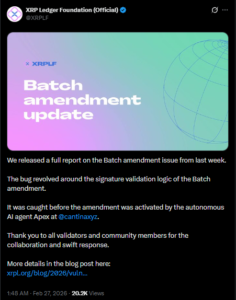
While the diamond tokenization initiative was being finalized, the XRP Ledger Foundation disclosed details of a separate security issue. The XRPLF said a vulnerability in the codebase could have enabled modification of ledger state or unauthorized access to funds if activated under certain conditions.
The foundation warned that a successful large-scale exploit “could have caused substantial loss of confidence in XRPL, with potentially significant disruption for the broader ecosystem.”
The flaw was identified by security researchers from Cantina and Spearbit. According to Spearbit CEO Hari Mulackal, an autonomous bug-hunting tool known as Apex detected the issue through static analysis of Ripple’s codebase.
Mulackal stated that, if exploited, the vulnerability could have represented “the largest security hack by dollar value in the world,” referencing nearly $80 billion at direct risk. The figure appears to correspond to XRP’s broader market capitalization at the time of the disclosure.
Following the report, validators were advised to vote against the proposed amendment linked to the vulnerability. An emergency software update, identified as Rippled 3.1.1, was released on February 23 to prevent the amendment from activating.
The XRPLF stated that the disclosure allowed Ripple’s engineering teams to validate the findings and begin patching the code.
AI Tools Increasingly Used in Code Audits
The vulnerability was detected using automated analysis rather than manual review. Cantina’s AI-based tool conducted static analysis of the Ripple codebase and submitted a disclosure report outlining the issue.
The development follows the broader deployment of artificial intelligence tools in cybersecurity. On February 20, Anthropic introduced Claude Code Security, an AI-driven vulnerability scanner that the company said can reason similarly to a security researcher.
The release was followed by a decline in shares of publicly traded IT security firms, according to market data cited at the time. Nevertheless, as of press time, XRP was trading at $1.39, down more than 3% ahead of crypto options expiry. The 24-hour trading range was $1.39 to $1.45, while daily trading volume fell by more than 30%, according to market data cited alongside the announcements.