Key Insights:
- Controlled and adaptive supply systems replace high-inflation models of the token economy in Tokenomics 2.0.
- Token rewards are based on actual network performance and usage via revenue sharing.
- Utility-focused tokens create increased demand through governance, staking, and access to the platform.
- Cross-chain enablement reduces the total amount of circulating tokens while increasing their overall marketability.
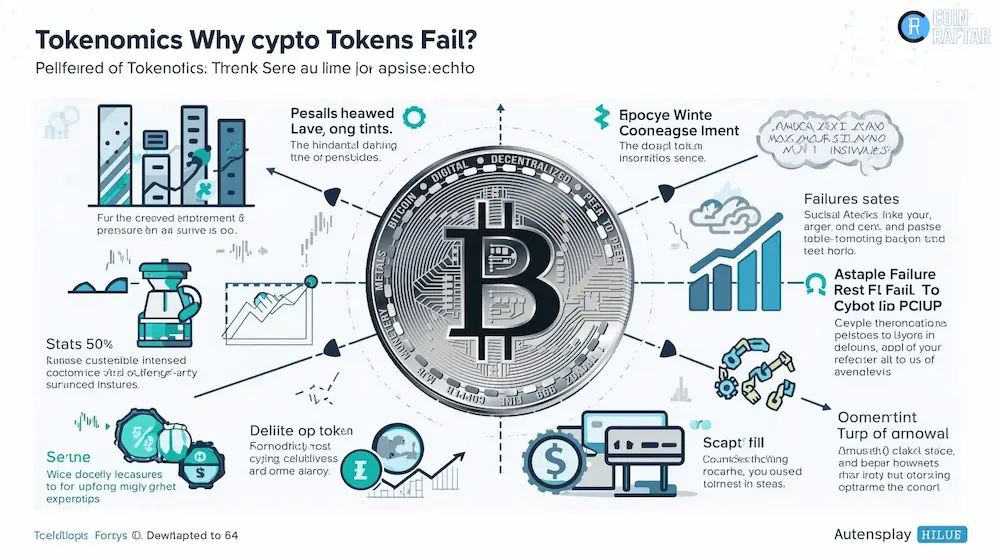
Tokenomics 2.0 is changing how blockchain projects create digital assets over time and with sustainability in mind. Unlike earlier token models that were designed for fast growth, tokenomics 2.0 focuses on controlling the supply, measuring the use of the tokens, and providing an opportunity for everyone to make decisions about what will happen to the token’s open governance. These features are helping to shape modern-day crypto innovation due to the changing nature of our markets.
The Change between Speculation and Sustainable Design
Earlier token models would tend to concentrate on quick growth and the momentum of price. A lot were heavily dependent on large emissions and barbaric incentives. Nevertheless, such buildings did not work in times of market crashes. Over supply caused devaluation and a lack of trust in the community.
The solution to these vices is the structured supply management of tokenomics 2.0. Emissions are now restricted, and only predictable release times are introduced on projects. The duration of vesting is prolonged to decrease the high pressure of selling in a short time. Consequently, this makes the token supply more open and regulated.
In addition, sustainable design also focuses on the long-term health of the ecosystem. Rewards are pegged on the participation of the user and not on immediate profits. Thus, token holders have interactions with products rather than concentrating on prices solely.
Adjusting Supply and Self-Adjusting Emissions
One of the most important changes in Tokenomics 2.0 is adaptive supply control. The projects also do not have fixed emission rates but rather increase and decrease token issuance depending on the level of activity. This structure helps in curbing inflation when there is low demand.
An example is that there are networks where rewards are decreased as usage decreases. Others raise incentives as the activity increases. Thus, the supply of tokens correlates better with the network performance. This process allows for ensuring economic balance in the long run.
Fire operations are also getting more tactical. Decrease of tokens to the market is by payment of transaction fees or protocol revenue. Burns are now connected directly to the use of platforms as opposed to the past. This way, the interaction of demand and supply is more natural.
True Utility Overshoots Incentive Farming
Yield farming in previous cycles was appealing to large amounts of capital. Nevertheless, most of the participants dropped out after the rewards declined. This trend revealed the flaws of incentive-oriented systems.
The second generation of tokenomics is less about tokenomics and more about utility. Tokens are now used to receive access to services and governance rights as well as staking benefits. The user has to have tokens to use to communicate with certain functions. This leads to functionality and not speculative demand.
Moreover, projects incorporate the use of tokens in the operations. The token ownership is required in the payment processing, collateral systems, and access tiers. This design enhances the connection between token value and product adoption.
Revenue sharing and Value capture
The other innovation is direct value capture. Projects are outgrowing the rewards based on inflation. They instead share protocol amounts with tokenholders.
Revenue-sharing schemes pay out a part of the fees to stakers. This will generate a more predictable reward system. Users receive returns based on their performance on the platform and not only on the issuance of tokens.
Also, buyback systems are becoming popular. Revenue is utilized in purchasing tokens in the market through the use of protocols. Bought tokens can either be burned or reused. As a result, the token demand is directly connected with the ecosystem revenue streams.
Such a structure promotes accountability. The activity should be consistent in projects in order to perpetuate rewards. Thus, long-term development would be based on the performance of its products, as opposed to emission tokenism.
Governance and Community Alignment
Tokenomics 2.0 is also changing governance models. Previously, systems allowed voting rights with no incentives to participate. Consequently, the number of voters was low in most projects.
New systems present stakeholder requirements to access governance. To vote, asset locking has to be done by token holders. This minimizes short-term speculation as well as the commitment to protocol decisions.
Delegated voting and a quadratic system of voting are being implemented. These arrangements are meant to equalize power among players. As a result, the administration is more representative and decentralized.
The modern token models still revolve around community alignment. On-chain and transparent reporting enhance trust. Projects post treasury balance and emission schedules. Consequently, users are able to track economic health in real-time.
Cross-Chain Utility and Growing Ecosystems
The tokenomics 2.0 is not limited to the individual networks. Cross-chain compatibility enhances the usability of tokens. Projects have unexplored uses of tokens on various blockchains to enhance liquidity and access.
Bridging solutions allow tokens to flow in other ecosystems. This strategy grows the volume of trade and product penetration. Consequently, token demand does not have a single network context.
Diversified applications are also supported by interoperability. A token can be used in decentralized finance, gaming, or governance between chains. As a result, utility increases without an increase in token supply.
Nonetheless, to ensure the chain expansion, it is sensitive to monitoring the supply. Unified systems of accounting are used in projects to avoid errors experienced during inflation. Thus, the issue of transparency is also a priority of multi-chain strategies.
Risk Management and Long-term Viability
In Tokenomics 2.0, risk management will have a bigger role. Before the introduction of tokens, teams examine the rates of inflation, allocation of liquidity, and treasury deposits. Economic assumptions and reward models are audited by organized inspections.
Liquidity incentives are now being structured in terms of time limits and decreasingly. This helps to avoid over-reliance on the short-term rewards. This leads to a more stable maturing of the ecosystems.
Diversification of the treasury is also coming into the picture. Projects maintain constant assets to facilitate operation in the lean times. Thus, economic stability is enhanced in unstable economic times.
Moreover, the adjustments made based on the data will enable protocols to optimize parameters as time goes by. Governance can revise emission rates, staking rewards, and fee allocations. Such flexibility helps to adapt and does not give up fundamental economic principles.
Final Thoughts
Tokenomics 2.0 is a more rigorous design of digital assets. The integration of utility and supply control and revenue alignment now informs the development of projects. New models are based on durability and responsibility instead of aggressive incentives. With the ongoing increase in blockchain use, the form of tokens is still changing, with stability and quantifiable value creation.