Key Insights:
- Altcoin Season Index relative strength is forming despite Bitcoin holding elevated price levels.
- 2019 and 2022 historical altcoin rallies displayed similar stabilization patterns before a surge.
- Long-term charts indicate that the structure is driven by rotation rather than short-term price direction.
Market Structure Hints at Capital Rotation as Altcoins Hold Support Against Bitcoin
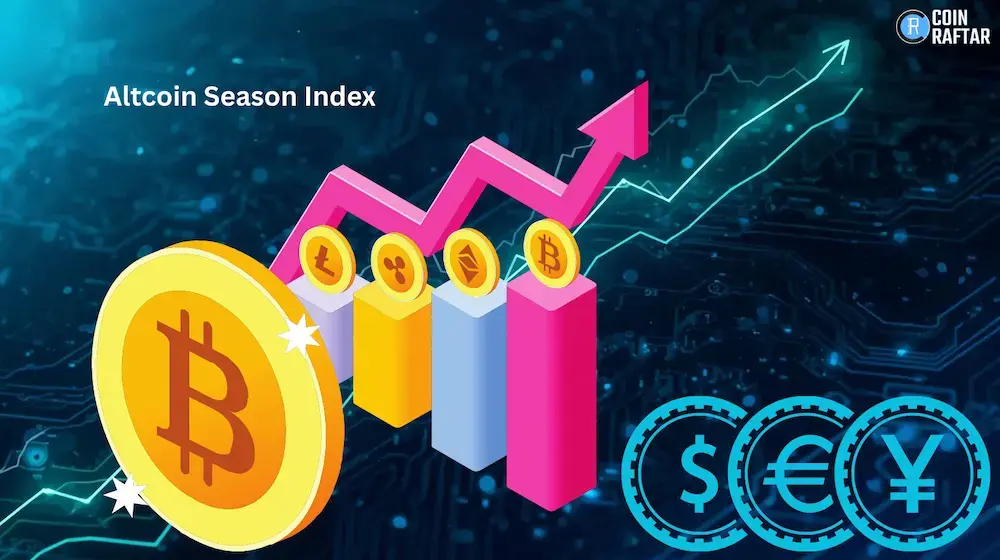
Altcoin Season Index is showing signs of a possible rotation within the crypto markets. This is as altcoins show structural stability. In spite of this Bitcoin remains vulnerable to relative downside pressure.
Relative Performance Signals Emerge Across the Market
The current Altcoin Season Index is approaching a Bitcoin-dominant zone. This is despite underlying signals showing changing relative performance dynamics.
The altcoin season index focuses on comparative strength and not on absolute price movement. This distinction has gained attention among experienced market observers.
Market analyst Joao Wedson remarked that many altcoins are stabilizing after extended drawdowns. In his post the analysts emphasized that Bitcoin still trades above historically elevated levels near $87,000.
https://x.com/joao_wedson/status/2005712410129166545?s=20
This positioning leaves more room for further downside compared to the already compressed altcoin valuations. The Altcoin Season Index has historically shifted upward before all notable altcoin rallies.
Bitcoin corrected more deeply than alternative assets. Relative outperformance emerged even as broader sentiment remained cautious across the markets.
Structural Support Strengthens Altcoin Positioning
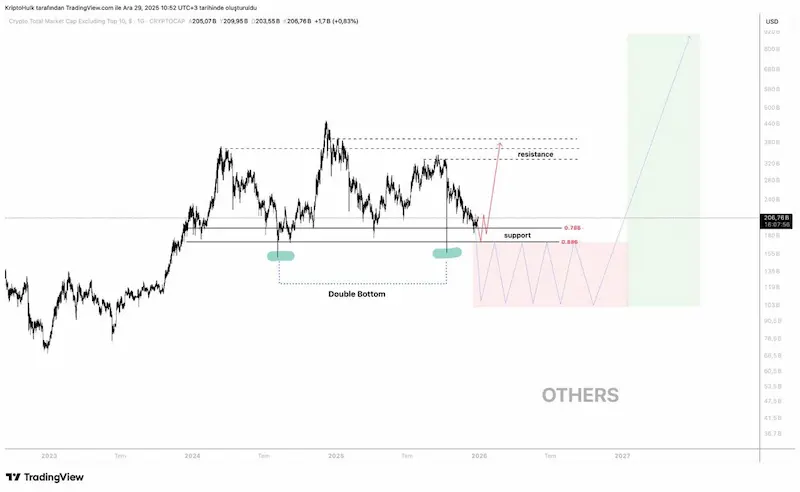
Long-term charts from Alphractal on OTHERS/BTC show the pair holding a multi-year horizontal support zone. This area has repeatedly marked the end of prolonged underperformance cycles since 2020.
Source: X
Each of the previous tests was preceded by sustained relative rebounds. Altcoins have not printed any new relative lows despite Bitcoin reaching higher absolute prices.
This behaviour suggests that sellers within altcoin markets are exhausted. Bitcoin dominance, meanwhile, has continued to face resistance during periods of macro uncertainty.
Momentum indicators on monthly timeframes have shown improving conditions beneath the surface. Momentum is rising from higher lows, but it has remained negative.
Such formations appeared in early 2019 and 2022 before notable shifts in capital allocation.
Mid-Term Cycles Reinforce Rotation Patterns
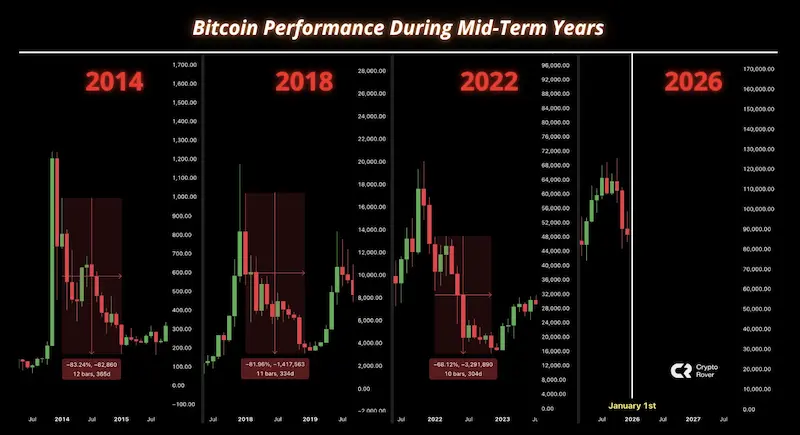
In addition, comparative charts of Bitcoin’s mid-term years have revealed consistent structural behavior. All strong rallies observed in 2014, 2018, and 2022 resulted from extended corrective phases.
 Source: X
Each correction lasted roughly ten to twelve months. However, all drawdowns during these periods became progressively shallower over time.
Bitcoin declined by approximately 83 percent in 2014, 82 percent in 2018, and 68 percent in 2022. This extended consolidation phase led to market maturation that reduced volatility notably.
The projected 2026 framework shows Bitcoin entering consolidation periods but at much higher absolute prices. Time-based corrections will likely appear more prominently to correct all the sharp declines.
In the past, during similar phases, capital rotated toward assets that had already completed their downside processes.
The Broader Market Outlook Of The Altcoin Season Index
Altcoin Season Index continues to reflect compression near historical lower bounds. Analytically, all extended compression periods have often preceded expansions driven by the weakening of Bitcoin’s dominance.
These transitions suggest that price appreciation will likely be gradual as the current market structure resembles the previous rotation phases. Usually, altcoins stabilized, then surged.
Observers have noted that the current environment favours selective positioning and is not good for momentum chasing. Meanwhile, the relative performance is the central metric that will guide the next trend.
Altcoin Season Index remains closely watched. Bitcoin traders are digesting prior gains from the one hundred and twenty thousand dollar mark. Historical context suggests that such periods support redistribution. This phase is crucial, if bulls are to avoid broader market declines.
Analysts have underscored the importance of keenly watching structural signals and all directional forecasts. As we head into 2026 these remain the focus among experienced market participants.