
Key Insights
- ZEC’s Open Interest fell notably after massive long positions got liquidated.
- Retail traders sold aggressively during the decline, and created a negative volume delta with mid-sized participants causing a market divergence.
- Whale selling dominated price action and helped maintain downward momentum and suppress rallies that formed consistent lower highs and lower lows.
Zcash (ZEC) is exchanging hands at $407.14 after falling 6.89% in the last 24 hours. Trading volume reached $651 million as long positions were liquidated. Despite this, ZEC gained 19.16% over the past week. Whale selling and retail panic pressured the market, while mid-sized traders absorbed supply, keeping short-term stability possible.
ZEC Open Interest Signals Long Liquidations
Open Interest (OI) for ZEC has been on a clear downward trend. The price fell from $440–$450 to near $403, and consequently OI decreased from roughly 287 million to 286 million. This decline indicates that traders exited positions and did not initiate new shorts.
These moves show that leveraged traders were reducing their risk rather than placing new bearish bets. The drop in Open Interest along with falling prices indicates that long liquidations were driving the decline. This therefore reduces the likelihood of any immediate short squeeze.
The positions that traders have closed are removing leverage from the market. This could in turn create conditions that could shape sharper reactive bounces after selling pressure exhausts. ZEC’s OI contraction confirms that the market is currently in a distribution phase.
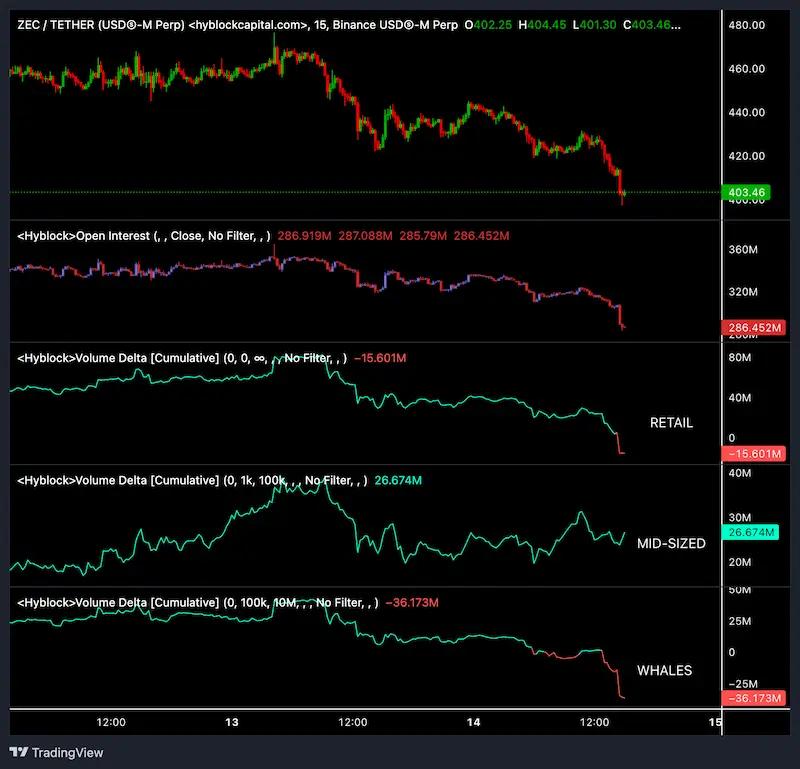 ZEC TETHER USDT Hyper Liquid Chart / Source: X
Late-stage selling is dominating as aggressive liquidations continue in the ongoing sessions. In the meantime the structure could remain weak until price reclaims $420, with $440. A decisive move here could serve as confirmation for a potential price stabilization.
Diverging Market Behavior: Retail Panic vs Mid-Sized Strategy
In addition, retail activity in ZEC shows a deeply negative cumulative volume delta near -15.6 million. Small traders consistently sold and this contributed to the decline, as a result of the panic-driven decisions.
Their selling occurred after structural breaks and it notably accelerated the downside momentum. In contrast, mid-sized traders have maintained a positive cumulative delta of approximately +26.7 million.
While retail participants exited, this group absorbed supply. This indicates a measured buying rather than an impulsive market reaction.
Hopefully, mid-sized traders’ actions could help stabilize ZEC if whales cut down on their selling pressure. This divergence between retail and mid-sized activity highlights the ongoing tension in the market.
Weak hands have capitulated but in contrast stronger hands are strategically accumulating. The continued presence of mid-sized buyers is providing temporary support, despite large whale sales dominating near-term pressure.
Whale Pressure and Price Structure Drive ZEC Decline
Whale movement has registered a pronounced negative volume delta of about -36.1 million, resulting from the ongoing aggressive distribution. However, the selling appears intentional, because it is using liquidity pockets to reduce exposure.
These actions further suppress ZEC’s upside potential despite the mid-sized accumulation. Price patterns for ZEC reveal lower highs and lower lows pointing to a sustained downtrend.
The breakdown from the $440–$450 zone triggered descending relief rallies that caused the final leg steep fall toward $403. The RSI on the one-hour chart confirmed the momentum breakdown and its readings are currently below 30 in the bearish control territory.
Any short-term bounce could be interpreted as corrective rally instead of a full trend-reversing. Overall, retail capitulation combined with declining OI and continued whale selling indicates that the market is approaching a local demand zone. Until $420 is convincingly reclaimed, ZEC is likely to remain within a bearish structural phase.