
Key Insights:
- According to Vitalik Buterin, AI agents can assist users in voting in DAOs and alleviate low participation rates.
- He warns that low DAO turnout can enable governance attacks and centralise control.
- He suggests intent-based wallet security by spending limits and multisig checks via simulations.
Vitalik Buterin says that artificial intelligence tools, particularly large language models for personal assistants, could help address structural weaknesses in decentralised governance while also improving security standards across blockchain applications.
Vitalik Buterin Discovers Attention Gaps in DAO Governance
In a series of posts on X on Sunday, the Ethereum co-founder outlined how AI systems could reduce participation barriers in decentralised autonomous organisations (DAOs) and help users make more informed decisions. He also described a parallel framework focused on transaction simulations and intent-based safeguards designed to align blockchain execution with user expectations.
Vitalik Buterin identified what he called restrictions on human attention as a central problem for both democratic and decentralised systems of governance.
According to estimates cited in his remarks, average participation rates in DAOs range between 15% and 25%. Low engagement levels can contribute to decision-making inefficiencies and increase the concentration of influence among a smaller group of active participants.
He stated that delegation is commonly used to address limited participation. However, he described delegation as disempowering because it transfers authority to a smaller group of representatives.
However, in this case, any ill-intentioned actor might gain enough tokens to approve a harmful offer without the wider community’s knowledge. He said that limited oversight and engagement create conditions where such actions can occur.
To address what he called the “attention problem,” Vitalik Buterin proposed using personal assistant LLMs to help users process relevant information before voting.
He explained that if governance systems require individuals to make numerous decisions, an AI-based personal agent could cast votes on their behalf. These agents would infer user preferences based on written material, conversation history, and direct statements.
He explained the strategy as a way to increase participation without requiring each token holder to use the manual functions regularly. Users should not hand over voting power to their human representatives; rather, they would depend on AI systems to make decisions based on their claimed or implied priorities.
Artificial Intelligence and the Privacy of Decision-Making in Decentralised Organisations
Vitalik Buterin also addressed the situation of governance that implies any private or sensitive information. Certain organisational decisions, including negotiations, internal disputes, and funding allocations, may depend on confidential data.
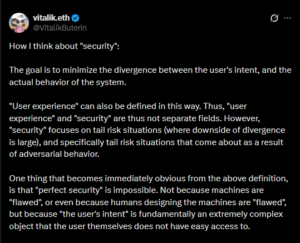
Source: Ethereum Co-Founder Vitalik Buterin
In traditional organisational models, such matters are typically handled by designated individuals who are granted authority to review private information.
He described an alternative structure in which participants submit their personal LLMs to a “black box” system. In this framework, the AI model would analyse private information and generate a decision output without revealing the underlying data.
Asset-Backed Securities and Ethereum Simulation of Security
In another series of comments, Vitalik Buterin discussed wallet and smart contract security improvements through transaction simulation and intent design.
He claimed that user experience and security are connected, since they are both largely about whether blockchain systems perform their intended actions. In an intent-based system, users would specify the action they want to take.
He also cited other protective mechanisms, such as spending limits and multisignature approvals. Under these setups, the transaction would be processed only when the user’s intent, the anticipated outcome, and the predetermined risk limits are aligned.
He maintained that powerful systems must require users to state their intentions in multiple redundant ways. The implementation would occur only when these independent expressions coincide. This redundancy, he said, would help ensure that blockchain protocols perform as users expect.