
Key Insights:
- USDU, a stablecoin, is the first registered USD payment token by CBUAE in the UAE.
- Banks and brokers can use USDU to settle digital assets in a compliant manner.
- The USDU has dollar reserves at 1:1 bank custody, which is attested.
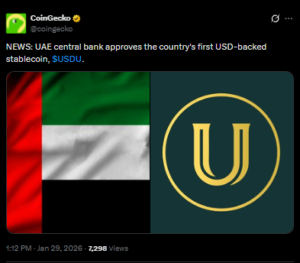
The Central Bank of the United Arab Emirates (CBUAE) has officially registered USDU stablecoin as a Foreign Payment Token under the country’s Payment Token Services Regulation (PTSR), a milestone for the regulatory framework for the digital asset sector in the UAE.
The USDU is registered as the first CBUAE-registered USD payment token.
Universal Digital, a company based in Abu Dhabi, announced that the registration enabled USDU to become the first U.S. dollar-pegged stablecoin to be classified under the federally regulated token payment regime. The registration makes USDU the first U.S. dollar stablecoin to be registered by the CBUAE as a regulated payment token.
Universal Digital stated that the development creates a compliant settlement pathway for digital assets and digital asset derivatives within the UAE, where regulatory rules require that payments must be conducted either in fiat currency or in a Registered Foreign Payment Token.
Source: Coingecko
Moreover, Universal Digital operates under the supervision of the Financial Services Regulatory Authority (FSRA) of Abu Dhabi Global Market, which has authorized it to issue a fiat-referenced token.
Bi-Regulatory Control Enhances Institutional Compliance Channel.
Universal Digital is regulated by the Financial Services Regulatory Authority (FSRA) of the Abu Dhabi Global Market, which has granted it permission to issue a fiat-referenced token.
Universal’s senior executive, Juha Viital, stated that the combined regulatory structure imposes stricter operational and governance requirements across reserve custody, disclosures, governance standards, and operational controls.
According to the company, this regulatory alignment provides a defined compliance pathway for institutions operating in regulated digital asset environments in the UAE.
Since this structure was put in place, regulated financial entities, such as banks, brokers, and licensed trading venues, now have a central-bank-registered U.S. dollar settlement token that can be incorporated into existing compliance, reporting, and settlement processes.
The framework allows institutions to settle digital assets using a USD-denominated instrument that is formally established under the UAE payment regulations.
USDU Stablecoin and UAE Payment Token Regulations.
In the UAE, under the PTSR, digital assets and digital asset derivatives payments must be made in either fiat or a Registered Foreign Payment Token. While UAE-based market participants widely use global stablecoins such as Tether’s USDt and Circle’s USDC through exchanges and over-the-counter desks, they are not registered under the Central Bank’s payment token regime.
Consequently, the USDU stablecoin is the only U.S. dollar stablecoin to have been officially registered under the CBUAE’s requirements for regulation as a digital asset settlement. Such regulatory differences place USDU within the country’s formal settlement system, whereas other USD stablecoins are not subject to registration as payment tokens under UAE law.
Banking Integration, Token Structure, and Reserves.
USDU is a token issued on the Ethereum blockchain under the ERC-20 standard for institutional and professional market participants.
Universal Digital added that the token adheres to a conservative reserve model and includes direct banking integration to enable regulated settlement use cases.
USDU reserves are deposited on a 1:1 basis in U.S. dollars in secure onshore accounts with Emirates NBD and Mashreq. Mbank is a strategic corporate banking partner, and a global accounting firm provides monthly independent attestations of the reserves.
According to Universal, the banking partners are responsible for custody and safeguarding, and the issuer is obliged to fulfil regulatory and operational requirements. The reserve structure combines regulated banking custody, third-party attestations, and regulatory oversight.
Universal stated that this structure is intended to provide transparency and operational certainty for regulated institutions that integrate the token into their settlement and compliance systems.
Domestic Settlement and Institutional Use
Within the UAE regulatory framework, USDU may be used for domestic payment of digital assets and digital asset derivatives.
However, it is not permitted for general retail payments in the mainland market, where dirham-denominated instruments remain the standard medium of exchange.
Universal is also working with AE Coin, a dirham-denominated stablecoin licensed by the Central Bank of the UAE, to support future conversion between USDU and AE Coin for domestic settlement.
The program aims to synchronize U.S. dollar and dirham payment tokens under a single regulatory framework and to allow regulated use cases involving the two currencies to be converted in a compliant manner.
Moreover, Universal has appointed Aquanow as its global distribution partner to widen its institutional access.