
Key Insights:
- The Supreme Court tariffs decision prevents Trump from using IEEPA to impose peacetime duties.
- Trump declares new 10% global tariff under Section 122 authority.
- Bitcoin fell after the news of China tariffs and remains below its October high.
The Supreme Court of the United States ruled Friday that the Executive Branch lacks authority under the International Emergency Economic Powers Act (IEEPA) to impose tariffs, striking down most of the trade measures introduced by President Donald Trump under that statute.
Supreme Court Rejects National Emergency Justification
The court ruled in a 6-3 decision that IEEPA did not confer any authority on the president to impose tariffs in peacetime, and that the legal basis on which Trump relied to impose duties on imports from Canada, Mexico, and China was invalid.
The decision comes after a turbulent season in financial markets, marked by extreme volatility in digital currencies and tariff announcements and threats that continue to wreak havoc among traders.
According to the court, IEEPA has not granted the President the power to impose tariffs. Still, it also said that the President has no inherent power to impose tariffs under the statute.
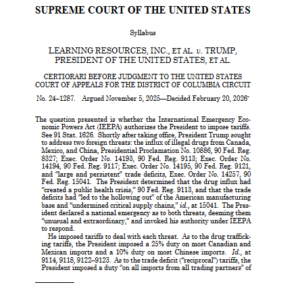
Source: The Supreme Court
The justices highlighted that over the last 50 years, since the enactment of IEEPA, no president has employed it to levy tariffs, especially on such a large scale as is proposed for 2025.
Moreover, President Trump had framed the tariffs as a response to national security threats. He argued that drug inflows from Canada, China, and Mexico created a public health crisis and that trade deficits with China contributed to what he described as the hollowing out of the U.S. industrial base.
On that basis, he declared a national emergency under IEEPA and imposed a 25% tariff on most goods from Canada and Mexico and a 10% tariff on goods from China.
The Supreme Court rejected those premises as grounds for invoking tariff authority under IEEPA during peacetime. The justices stated that no prior administration had interpreted the statute to include tariff powers and found that such an interpretation exceeded the law’s intended scope.
Following the decision, Trump criticized the ruling during a press briefing, calling it “deeply disappointing” and “ridiculous.” He stated that he would pursue alternative legal pathways to reinstate tariffs, including authorities under the Trade Expansion Act of 1962 and the Trade Act of 1974.
On the same day as the ruling, Trump announced that a 10% global tariff would take effect immediately under Section 122, in addition to existing duties. He also confirmed that national security tariffs under Sections 232 and 301 would remain in place.
Market Impact and Crypto Volatility
The court’s decision comes after a year in which tariff announcements repeatedly affected high-risk asset classes. When Trump announced 100% tariffs on China on October 10, 2025, digital asset markets reacted within minutes.
Bitcoin fell from approximately $122,000 to almost $107,000 on the same day, wiping out an estimated $1 trillion in the currency market. Additionally, approximately $19 billion in positions were sold off in 24 hours, making this the largest such event in history.
Nevertheless, market sentiment data platform Santiment indicated that the announcement of the China tariffs was viewed as the primary catalyst by the traders behind the change.
Bitcoin was not the only asset to fall during the October selloff; the cryptocurrency and equity markets were hit as well. The prices of digital assets have since fallen below their levels early in October.
Bitcoin remains nearly 50% below its all-time high of more than $125,000 reached on October 6, even after Trump later moderated aspects of his tariff stance. Moreover, announcements or threats of new duties have coincided with selloffs in both the equities and digital asset sectors, often categorized as high-risk.
Tariff Policy and Revenue Proposals
Tariffs have also featured in Trump’s broader fiscal proposals. During an October 2024 campaign appearance, he floated the idea of replacing the federal income tax with tariff-generated revenue.
In April 2025, he stated that federal taxes would be “substantially reduced” for individuals and households earning less than $200,000 annually once tariff revenue increased.
The Supreme Court’s decision narrows the legal avenues available for implementing tariffs under emergency powers but does not affect existing authorities under other trade statutes. Trump’s administration has indicated it will rely on those alternative provisions to continue pursuing trade measures.