Key Insights:
- Stablecoin adoption is accelerating as payment platforms attract major funding and institutional investment worldwide.
- Venture capital is shifting toward blockchain payment infrastructure instead of trading-focused crypto projects.
- Regulation is becoming the main factor shaping competition among digital-dollar issuers.
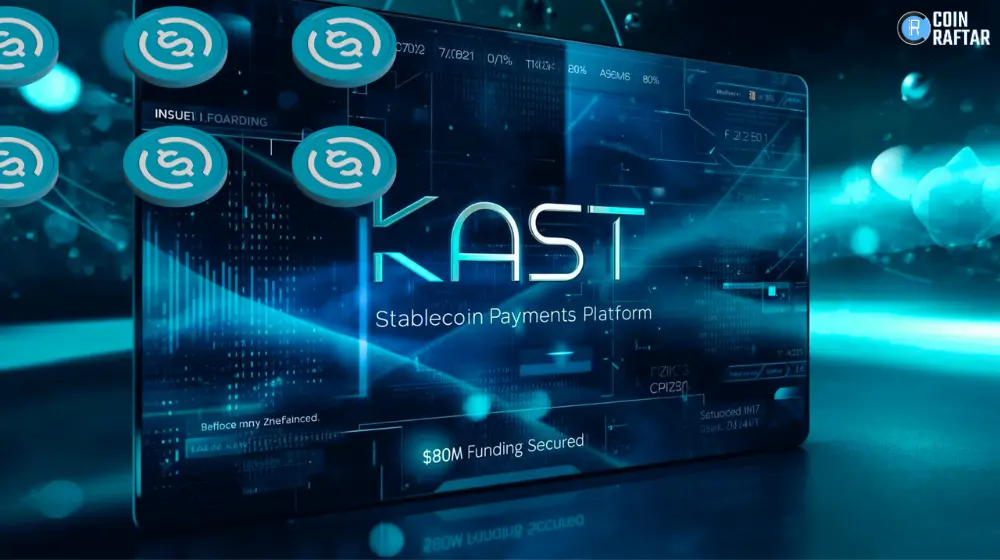
Stablecoin payments company KAST said Monday it secured $80 million in a Series A round to expand its cross-border payments platform built on digital-dollar infrastructure.
The funding was co-led by QED Investors and Left Lane Capital, with participation from Peak XV Partners, HSG, and DST Global Partners, according to a company statement. The deal reportedly valued the firm at around $600 million, reflecting rising investor confidence in payment networks powered by blockchain settlement systems.
The company was founded in July 2024 as a financial technology company and not a bank, and uses regulated partners to provide custody, payments, and on-ramp services.
Visa-supported cards allow users to add, save, and use digital dollars and deliver their transactions via blockchain rails, rather than conventional banking networks. The management indicated that the new capital will help it in hiring, licensing, product development and expansion the region in North America, Latin America and Middle East.
Stablecoin adoption driving demand for payment platforms
The raise is at a time when the Stablecoin market is experiencing a booming development, with tokens being utilized more as a payment and settlement tool rather than as a trading verse.
As per industry statistics, the total number of dollar-pegged tokens has hit a maximum of $300 billion with USDT by Tether holding the largest share of the market. Circle remains the second-largest USDC, and it continues to have institutional eyes on it because of its compliance-focused architecture.
On-chain activity has also reached new highs, reflecting growing use of Stablecoin networks for global transfers and financial settlement between companies and individuals.
Monthly transaction volume on the Solana blockchain reached about $650 billion in February, more than doubling its previous record, according to industry data. Analysts say the increase highlights how blockchain payment rails are becoming a practical alternative to slower legacy settlement systems.
Global expansion strategy targets regulated financial markets
KAST said the latest funding will help the company expand its services into additional regions while strengthening compliance programs required for international financial operations. The platform currently offers dollar-denominated accounts, global pay-ins and payouts, and financial tools designed for consumers and businesses using blockchain infrastructure. Since launch, the firm has grown to more than one million users and processes billions of dollars in annualized transaction volume.
The company expects revenue to approach a $100 million annual run rate this year, supported by steady growth in customers and payment activity across several markets. Hiring has increased as the firm recruits engineers, compliance specialists, and operations staff from major fintech and cryptocurrency companies. Executives said the long-term goal is to become a global financial platform built entirely on Stablecoin rails rather than traditional banking networks.
Funding momentum shows shift toward payment infrastructure
KAST’s Series A round reflects a broader trend of venture capital moving into companies building payment infrastructure instead of speculative trading platforms.
Earlier this year, stablecoin infrastructure firm Rain raised $250 million at a valuation near $2 billion to expand its global settlement network. Other startups focusing on merchant payments and digital-dollar accounts have also secured funding as investors look for practical blockchain use cases.
Market researchers indicate that the volume of transactions in dollars-pegged tokens was at an all-time high in 2025; this was encouraged by stronger regulation and the influx of more institutions. The regulators in some key markets now demand reserve support, licensing and explicit redemption rights of payment tools which forms a more orderly environment. These regulations are making the traditional financial institutions more receptive to the idea of adopting blockchain-based settlement systems.
Regulation and competition reshape stablecoin market structure
Analysts believe that the Stablecoin industry is going into a new stage where the competition is no longer based on the market size, but rather regulatory acceptance and utility. USDT by Tether is the biggest token in terms of market cap, and USDC is still attracting institutions that believe in transparency and compliance. The entry of new regulated tokens to the market is growing competition because governments implement payment-cantered digital assets frameworks.
According to industry observers, the future of the industry will be determined by the success of issuers integrating with banking systems, payment systems and enterprise software platforms. Those companies that integrate high compliance, trusted technology and international distribution are likely to be on the forefront in the next phase of adoption. Stablecoin networks are considered to be mainstream financial infrastructure as blockchain settlement is both becoming faster and cheaper than traditional transfers.