Key Insights:
- The evolution of Solana networks supports continuous iterations, and protocol ossification is unacceptable to it.
- Developer-funded upgrades inform changes in governance and long-term protocol changes.
- There is stability in the operation of validator growth and DDoS resilience.
The evolution of the Solana network has become a key theme in recent debates over how large blockchain networks must balance stability with long-term relevance.
Solana Network Evolution Versus Ethereum’s Ossification Framework
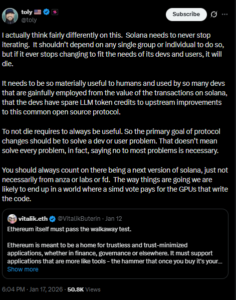
The debate escalated when Solana co-founder Anatoly Yakovenko publicly refuted the notion that blockchain protocols would one day cease their fundamental development, making Solana the explicit opposite of the recent governance direction that Ethereum is taking.
In an X post, Yakavenko provides a framework for understanding the continued importance of continuous iteration, decentralization of contributions, and developer funding for the operational future of Solana, and how those principles are applied in practice, as reflected in recent network performance and the work of the validators.
The discussion began following a January 12 manifesto published by Ethereum co-founder Vitalik Buterin. In that document, Buterin stated that Ethereum aims to reach a stage where it “can ossify if we want to,” once key technical milestones are achieved.
Such milestones as quantum resistance, scalable infrastructure, and full account abstraction are included. Ossification is the intentional constraint or suspension of core protocol change in favour of more stability and predictability.
Source: Solana Co-Founder Yakovenko(X)
Yakovenko responded publicly on Saturday, arguing that Solana network evolution depends on an opposing principle. He stated that Solana must “never stop iterating” to remain useful to developers and users.
According to Yakovenko, any protocol that ceases to adapt to changing technical and economic demands risks long-term decline, regardless of the strength of its existing ecosystem.
He stressed that protocol development should not be pegged on an individual organization or a group of leaders. Rather, Yakavenko described evolution as a shared duty, and cautioned that inertia would make the network less relevant in the long term.
Developer Utility as a Financing Vehicle
Yakavenko proceeded to describe the process of further protocol elaboration as far as he could, and developers were directly involved.
He described a situation in which app developers who generate revenue from applications and transactions on Solana would reinvest in protocol maintenance and upkeep.
In his view, the network’s utility must be substantial enough that contributors can support upstream development efforts without centralized funding structures.
This approach links Solana network evolution to measurable economic activity on the blockchain. Yakovenko stated that protocol changes should focus on solving concrete developer or user problems, rather than attempting to address every proposed improvement.
Governance, Iteration, and External Contributors
A key element of Yakovenko’s comments was the expectation that future Solana upgrades may originate beyond established development organizations.
He observed that, even though groups like Anza, Solana Labs, and Firedancer have traditionally played important roles, the network’s design ought to take into account contributions from a wider, possibly even changing, group of participants.
Yakovenko proposed that the governance structures of Solana, such as its Solana Improvement Document (SIMD) process, might be developed to accommodate this model.
He cited a possible model in which SIMD votes finance the computational resources required to write and maintain protocol code, associating the governance output with the capacity to develop. This view makes the idea of Solana network evolution a continuous, decentralized-incentive-driven process rather than a prescribed roadmap.
Network Robustness in Exceptional States
The debate concerning governance and protocol design is presented in the context of Solana’s operational resilience.
The previous month, the network was hit by a persistent distributed denial-of-service (DDoS) attack that reached almost 6 terabits per second. The attack was also described as the fourth-largest DDoS attack ever recorded on the internet.
https://twitter.com/conorfkenny/status/2012570733516300330
Regardless of the attack’s magnitude, Solana did not show any obvious performance degradation or slow block production.
The incident served as a practical stress test of the network’s infrastructure and provided data points for discussions on scalability and reliability.
Simultaneously with the governance talk, there has been new activity on Solana, with known industry participants adding as validators. STSS and Coinbase have recently created a validator in Solana.