
Key Insights:
- Ripple Zand Bank alliance enhances coordinated stablecoin through regulated frameworks.
- The RLUSD and AEDZ are heading towards mutual payment and settlement applications.
- Custody platform updates support institutional staking and key management.
The Ripple Zand Bank partnership has entered a new phase as Ripple confirmed an expansion of its existing agreement with UAE-based Zand Bank, focusing on broader usage of Ripple’s RLUSD stablecoin alongside Zand’s dirham-backed AEDZ.
Ripple Zand Bank Partnership Builds on 2025 Agreement
According to a press release, the latest step is intended to support interoperability between the two stablecoins and advance their use within regulated financial frameworks.
Ripple stated that the expanded partnership is designed to support the next stage of development, in which RLUSD and AEDZ will be used in coordinated projects. The company described this as a foundational step toward connecting the two stablecoins within shared payment and settlement use cases.
The Ripple Zand Bank collaboration began in 2025, when the two companies decided to collaborate to develop blockchain-based systems to solve cross-border payments. The partnership aimed to enhance settlement efficiency and reduce costs associated with international transfers.
Under the agreement, Ripple provided the underlying technology, and Zand Bank evaluated the potential of integrating distributed ledger systems into its current banking activities.
Reece Merrick, Ripple’s managing director for the Middle East and Africa, confirmed the update in parallel with Ripple’s press release.
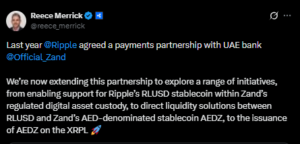
Source: Reece Merrick
Merrick stated that the company plans to explore several projects involving the joint use of the two stablecoins under the expanded agreement. His remarks emphasized operational exploration rather than product launches.
Zand Bank’s AEDZ Stablecoin Enters Integration Phase
Zand Bank introduced its AEDZ stablecoin in late 2025. The token is backed by the UAE dirham and designed for use on public blockchains.
According to prior disclosures, AEDZ is among the first regulated stablecoins denominated in AED and issued within the UAE’s regulatory framework. The expansion of the Ripple Zand Bank partnership positions AEDZ alongside RLUSD in coordinated infrastructure testing.
Ripple confirmed that the updated agreement is intended to support eventual connectivity between the two stablecoins, although no technical details were released regarding bridges or settlement mechanisms.
Michael Chan, chief executive officer of Zand Bank, commented on the expanded partnership, noting that it reflects broader developments in the UAE’s digital asset ecosystem. His statement focused on institutional and governmental use cases rather than retail adoption and did not include performance or growth projections.
Regulatory Advances Facilitate RLUSD Usage
Ripple disclosed that the U.S. Commodity Futures Trading Commission has expanded its list of eligible tokenized collateral on regulated futures markets.
As a result, Ripple said RLUSD now falls under the CFTC’s definition of a payment stablecoin that may be used as eligible collateral within derivatives markets.
Separately, RLUSD has received regulatory recognition in the Middle East. In November, the stablecoin was approved as an Accepted Fiat Referenced Token by the Financial Services Regulatory Authority of Abu Dhabi Global Market.
Ripple said these approvals have contributed to RLUSD adoption across multiple jurisdictions, though it did not provide figures on circulation or transaction volume.
Platform Custody Scale Adds Institutional Infrastructure
Besides the Ripple Zand Bank partnership update, Ripple also announced an extension of its institutional custody platform. The company indicated that it has implemented integrations with Figment and Securosys, enabling banks and custodians to support hardware security modules.
According to Ripple, the new integrations allow institutions to launch custody services and offer staking without running their own validator or key-management integrations.
The custodial platform has now been extended to include on-premises and cloud-based hardware security modules, enabling regulated entities to manage cryptographic keys without compromising compliance requirements.
Consequently, institutions will be able to provide staking services on networks such as Ethereum and Solana, with compliance checks integrated into transaction workflows.
Furthermore, Ripple said the custody integrations are intended to reduce deployment complexity and shorten implementation timelines for institutional clients.
The company recently launched a corporate treasury platform that connects traditional cash management systems with digital asset infrastructure. Ripple described the platform as part of its broader effort to provide financial institutions with integrated tools covering payments, custody, and treasury operations.