
Key Insights:
- PoW is secure and energy intensive, whereas PoS is energy efficient and scalable and might result in centralization issues.
- PoW is more decentralized because of the competition in the mining; PoS can be centralized to major stakeholders.
- POS is more scalable and has higher transaction speeds, which are good in applications with high throughput.
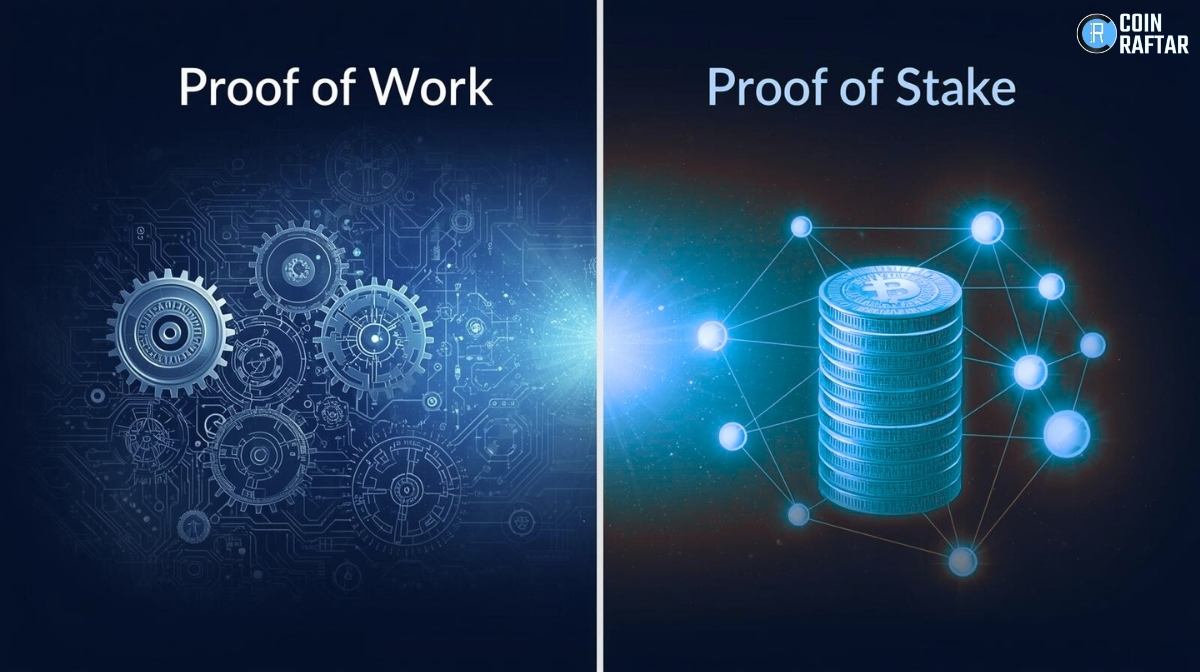
Proof of Work vs. Proof of Stake are the two most widely used consensus mechanisms in blockchain networks, designed to validate transactions and secure decentralized systems. The algorithms that accomplish this aim are known as consensus mechanisms, and their purpose is to make sure that every node (or computer) on the network agrees on the state of the blockchain. The two commonest consensus mechanisms used are proof of work vs. proof of stake. They both have their advantages but differ greatly in the way in which they work, the amount of energy that they use, and the degree of decentralization to which they are run.
What is Proof-of-Work?
The consensus system applied in Bitcoin and other cryptocurrencies is Proof-of-Work (PoW). The miners are challenged to solve complicated cryptography puzzles, and the one who is able to do it first adds a block in the blockchain, winning cryptocurrency. This is called mining, which is very computationally demanding and intensive in power consumption.
PoW is safe because miners must demonstrate that they have consumed resources, and this is mostly electricity and computational power. This contributes to the fact that attackers find it hard to manipulate transaction data. Nonetheless, PoW is energy-intensive, which adds to high electricity use and environmental issues related to carbon emissions.
What is Proof-of-Stake?
The Proof-of-Stake (PoS) algorithm informs the election of validators, allowing them to add new blocks according to the volume of cryptocurrency possession and the stakes within the network. The greater the number of coins that a participant commits to the system, the greater the chances of validating transactions. PoS is also less energy-consuming than Proof-of-Work (PoW), because PoS does not need mining equipment.
PoS provides security as the incentive for the validators to behave truthfully since any manipulation of the system would result in a loss of their staked coins. A participant has more influence with an increase in the size of the stake; however, it may result in issues of centralization.
Proof of Work vs Proof of Stake: Key Differences
Energy Use in Proof of Work vs Proof of Stake
It is one of the major differences between proof of work vs. proof of stake in terms of energy consumption. The cryptocurrencies that use PoW, such as Bitcoin, consume a lot of energy due to mining, and the cryptocurrencies that use PoS, such as Ethereum 2.0, consume much less energy since they do not rely on the process of computation. PoS is the most suitable choice in constructing the sustainability-oriented projects, as this technology has negligible impacts on the environment.
Security and Decentralization in Proof of Work vs Proof of Stake
PoW is more secure due to the fact that attackers find it difficult to get control over more than half of the network computation, but massive mining is likely to result in centralization. The PoS can be more centralized, meaning that anybody with more coins involved in the PoS has a better chance of validating transactions. Nevertheless, PoS networks such as Ethereum 2.0 rely on such mechanisms as staking pools and slashing to mitigate the threat of centralization.
Scalability Comparison: Proof of Work vs Proof of Stake
Proof of Work vs. Proof of Stake on scalability PoS is more scalable than PoW since they do not require solving a complex puzzle, as the former can process transactions much faster. The transition to PoS means that Ethereum has better transaction throughput as well as lower block times as compared to PoW systems such as Bitcoin, whose speeds are comparatively slower; thus, they cannot be used to carry out quick transactions.
Potential Advantages and Disadvantages of Proof of Work vs. Proof of Stake
Advantages of Proof-of-Work
- PoW is battle-tested and more than 10 years old, which offers a strong security level to the Bitcoin network.
- PoW is decentralized, with the mining rewards competition guaranteeing a more distributed network.
- Through a PoW system, it requires substantial resources to attack the system, and therefore, it is not feasible to manipulate the system by malicious actors.
Disadvantages of Proof-of-Work
- PoW uses a huge amount of electricity that is ecologically unfriendly.
- Centralization may be a consequence of the high expenses of mining equipment, as large mining farms will control the network.
- PoW has a slow block time and thus is not applicable in high-frequency contexts such as Bitcoin.
Advantages of Proof-of-Stake
- Compared to PoW, PoS is much more energy-efficient, and thus it is a more environmentally friendly alternative.
- The transaction processing of POS systems can be performed faster, and it is more scalable and applicable in large-scale operations.
- PoS enables any user who has cryptocurrency to join the network and is therefore more accessible as compared to PoW, which requires costly machinery.
Disadvantages of Proof-of-Stake
- PoS may result in centralization when big owners of cryptocurrency obtain an unequal power in the network.
- PoS is a more recent mechanization than PoW, and whereas it has been effective on smaller networks, its long-term security remains untested at a global scale.
- Critics believe that PoS may increase wealth inequality in the network since the more coins a person stakes, the greater power they have.
Which Consensus Mechanism Is Better?
PoW is an established security and decentralization alternative that is energy-intensive and slow. PoS is less energy consumptive, faster and scalable, yet it can be quite prone to centralization and is less proven. The decision is based on the priorities of a blockchain project. PoW is related to security and decentralization, and PoS is associated with energy efficiency and scalability. It is possible that hybrid models can be developed that combine the advantages of proof of work vs. proof of stake.