
Key Insights:
- Vitalik Buterin warns that prediction markets rely too much on naive traders.
- He points out that prediction markets could be developed as a risk-hedging tool for consumers.
- The trading volumes in CertiK Certification markets grew 4 times in 2025.
Prediction markets are at a new stage of scrutiny, following a high-profile critique of their direction by Ethereum co-founder Vitalik Buterin that suggested a structural change to consumer-oriented hedging products.
Buterin Flags Structural Concerns Amid Rapid Market Expansion
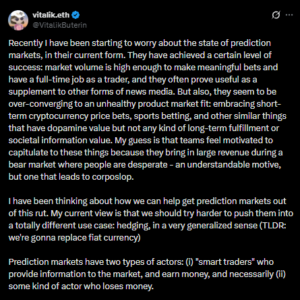
In a recent post on X, Buterin stated that he is beginning to “worry” about the sector’s direction, even as trading volumes and participation levels expand. He acknowledged that prediction markets have achieved measurable traction and now support professional participants.
Source: Ethereum co-founder Vitalik Buterin
However, he cautioned that much of the activity appears concentrated in short-duration cryptocurrency price bets and sports-style wagering, segments he described as generating engagement without delivering sustained informational or societal value.
His remarks come amid a period of rapid expansion for prediction markets, which have moved from niche platforms to widely used financial tools over the past year, according to a recent industry report.
While proponents argue that these markets aggregate forward-looking information and complement traditional media coverage, Buterin outlined what he characterized as structural weaknesses in their prevailing design.
Prediction Markets and the Incentive Structure Debate
Buterin described a core economic feature of prediction markets: informed traders profit when counterparties lose. He grouped participants into three broad categories: uninformed speculators, institutional information buyers, and hedgers.
In his evaluation, the existing platforms are largely based on uninformed traders to make more informed players profitable. He stated that although this structure is not inherently unethical, it can shape incentives in ways that prioritize transaction volume over substantive information discovery.
In his view, models centered on organizations subsidizing markets to extract insights also face limitations. Rather, he suggested bringing prediction markets into the realm of generalized hedging instruments.
In this model, participants would be willing to accept a slightly negative expected return in exchange for the risk of exposure to external risks. For example, an investor who owns shares in a biotechnology firm may use an election-based market to counter policy changes that may impact the industry.
Moreover, in this case, the objective would not be speculative gain but improved risk-adjusted stability. Buterin extended the concept further by describing a system in which individuals and businesses hold “personalized prediction market shares” representing a set number of days of expected future expenses.
He stated that local large language models could analyze a user’s spending patterns and construct tailored baskets of market positions linked to price indices reflecting anticipated costs.
In such a structure, users might combine growth-oriented assets, including ETH or tokenized equities, with customized positions designed to stabilize purchasing power.
According to Buterin, such a model may, in the long term be used as a tailor-made economic stabilizer and lessen reliance on traditional fiat-backed stablecoins
Increase in industry and security problems in the prediction market.
The debate over structure arises as prediction markets have grown significantly. Blockchain security provider CertiK noted that industry trading volumes increased by 4 times over the past year. The firm notes that prediction markets, which had been niche products in 2025, became a common financial tool.
As part of its Skynet Top Board approach, CertiK established the top players in the world as Kalshi, Polymarket, and Opinion. The report described prediction markets as moving from experimental products to financial infrastructure to address real-world uncertainty.
Although the incident did not compromise smart contracts, CertiK stated that it underscored risks associated with hybrid Web2-Web3 designs that incorporate centralized components. The firm noted that expanding participation increases the importance of resilient technical architecture and privacy safeguards.
Academic commentary has also emphasized its informational function. Harry Crane, a professor at Rutgers University, stated that prediction markets can provide insights into global events and financial developments.
He stated that these platforms often produce forecasts that are more accurate than traditional polling and should be treated as a public good.
Crane added that some opponents within the United States government seek to restrict prediction markets because they generate insights that cannot be easily ignored or shaped by centralized entities.