

Key Insights:
- Prediction market Lawsuits continue to expand, with Nevada suing Kalshi over sports contracts.
- The Ninth Circuit’s decision can enable Nevada regulators to act in court.
- CFTC backs federal oversight and challenges state gambling claims.
Prediction market lawsuits escalated this week after Nevada gaming regulators moved forward with a civil enforcement action against Kalshi, seeking to block the platform from offering sports-based event contracts to state residents.
Prediction Market Lawsuits Center on Sports Contracts
The development followed a ruling by the U.S. Court of Appeals for the Ninth Circuit, which denied Kalshi’s request to prevent Nevada authorities from taking action.
The decision cleared the way for the Nevada Gaming Control Board to file suit in state court, marking a significant turn in an ongoing legal dispute that has unfolded for nearly a year and now involves overlapping claims of federal and state jurisdiction.
The Ninth Circuit’s order removed a prior barrier that had temporarily shielded Kalshi from enforcement measures while litigation proceeded. Within hours of the ruling, Nevada regulators filed a civil complaint to stop what they described as unlicensed wagering under state law. The case adds to a growing list of prediction market lawsuits filed by states challenging the operations of event-based trading platforms.
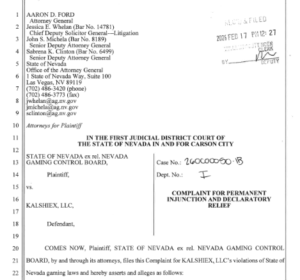
Source: gaming.nv.gov
Nevada regulators contend that these offerings amount to unlicensed wagering within the state. In their filing, authorities stated that Kalshi sought to expand its business rather than maintain the status quo during ongoing legal proceedings.
The Nevada Gaming Control Board stated that its enforcement action aims to block the company from offering what it characterizes as unlawful betting products. Regulators have maintained that such contracts fall under state gaming laws when offered to Nevada residents.
Kalshi, however, has consistently argued that its products are structured as “event contracts” regulated at the federal level. Following the latest lawsuit, the company filed a motion to transfer the case to federal court.
Federal Court Clash and Ninth Circuit Reversal
The court battle between Kalshi and Nevada began in March last year, after the state issued a cease-and-desist order requiring the company to stop all sports-related markets in the state. Nevertheless, Kalshi filed suit against Nevada authorities, challenging the order.
In April, a federal court granted Kalshi temporary relief, blocking Nevada from taking enforcement action pending litigation. That interim protection remained in place until the Ninth Circuit’s latest ruling removed the obstacle to state enforcement.
The appeals court’s decision now allows Nevada’s civil case to proceed in state court, subject to Kalshi’s request to shift the venue to federal jurisdiction. The outcome of that procedural motion could determine which court ultimately hears arguments over the scope of regulatory authority.
CFTC Intervention and Broader Regulatory Conflict
Federal regulators also contribute to the escalation of prediction market lawsuits. On the same day as the Ninth Circuit ruling, Commodity Futures Trading Commission Chair Mike Selig confirmed that the agency had filed an amicus brief in support of Crypto.com in a separate case involving Nevada regulators.
Crypto.com sued Nevada in June after receiving a cease-and-desist letter regarding its event-based contracts. After losing a motion in federal court to block state action, the exchange appealed to the Ninth Circuit in November.
In its brief, the CFTC argued that states cannot intrude upon what it described as the agency’s exclusive jurisdiction over designated contract markets. The filing stated that states cannot reclassify swaps trading on such markets as illegal gambling under state law.
Selig said event contracts qualify as commodity derivatives and fall squarely within the CFTC’s regulatory authority. He added that the agency intends to defend what it views as exclusive federal jurisdiction over those instruments.
Kalshi has cited similar arguments in its filings, maintaining that its contracts are federally regulated derivatives rather than wagers governed by state gaming statutes. Another platform, Polymarket, has advanced comparable claims in its own litigation. Polymarket recently sued Massachusetts regulators, alleging overreach in that state’s enforcement efforts.