
Key Insights:
- Nevada Gaming Control Board, Coinbase’s disagreement focuses on event-based sports and election contracts.
- The regulators are requesting a court order to stop Coinbase’s offers to Nevada residents.
- Coinbase argues that prediction markets fall under federal CFTC oversight
The Nevada Gaming Control Board’s Coinbase enforcement dispute escalated this week after state regulators filed a civil action seeking to block Coinbase Financial Markets from offering event-based contracts on sports and elections to Nevada residents without state gaming licenses.
Nevada Regulators Seek Court Order to Halt Coinbase Contracts
The filing, submitted on Monday in the District Court for Carson City, marks the latest development in a widening jurisdictional conflict between state gaming authorities and federally regulated prediction-market platforms.
Regulators argue that the contracts offered through Coinbase’s mobile application constitute wagering under Nevada law and therefore fall within the state’s licensing and age-restriction requirements, despite Coinbase’s position that the products are regulated exclusively at the federal level.
In a court filing, the Nevada Gaming Control Board sought a permanent injunction and declaratory relief and requested an ex parte temporary restraining order.
The board is seeking immediate court action to halt the offering of event-based contracts to Nevada residents while the case proceeds. The request reflects regulators’ position that the continued availability of the products causes ongoing regulatory and competitive harm.
Nevada Gaming Control Board, Coinbase Complaint and Legal Basis
In a statement released Tuesday, the board stated that it considers sports event contracts and certain other event-based contracts to constitute wagering activity under Nevada Revised Statutes 463.0193 and 463.01962. Under those provisions, any entity offering such wagering activity must hold appropriate state gaming licenses.
“The Board takes seriously its obligation to operate a thriving gaming industry and to protect Nevada citizens,” board chair Mike Dreitzer said in a statement. He added that the legal action was intended to reinforce that obligation.
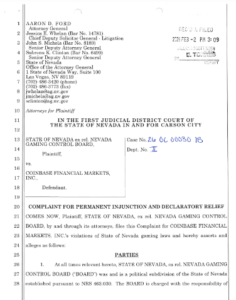
Source: gaming.nv.gov
The filings assert that Coinbase’s platform allows users aged 18 and older to open accounts and trade event-based contracts. Nevada law sets a minimum age of 21 for gambling activity, a discrepancy the board argues places Coinbase’s offering in direct conflict with state requirements.
Coinbase Prediction Markets and the Kalshi Partnership
The Nevada Gaming Control Board Coinbase dispute follows Coinbase’s announcement last month that it had launched prediction markets nationwide through a partnership with Kalshi, a federally regulated designated contract market registered with the U.S. Commodity Futures Trading Commission.
Coinbase stated that at the time that the rollout made prediction markets available to users in all 50 states. While the CFTC oversees Kalshi at the federal level, Nevada regulators maintain that state gaming laws still apply when event-based contracts function as wagering within state boundaries.
The board’s complaint states that Coinbase operates markets tied to outcomes of sporting events, including college basketball, college football, professional football games, and elections. Regulators allege these products fall squarely within the state’s definition of wagering and therefore require licensing.
State Enforcement and Age Restrictions
The court filings ask for an immediate halt to Coinbase’s event-contract offerings in Nevada, citing what the board describes as “serious, ongoing, irreparable harm” each day the platform operates without state authorization.
Regulators argue that allowing unlicensed operators to offer similar products undermines Nevada’s regulatory framework and enforcement authority.
The board also contends that Coinbase’s operations create what it calls a “massive and unfair competitive advantage” over licensed sportsbooks.
Under Nevada law, licensed sportsbooks must pay substantial licensing fees and taxes, maintain physical locations within the state, and comply with extensive consumer protection and compliance obligations.
Prior Actions Against Prediction-Market Platforms
Nevada regulators have taken similar steps against other prediction-market platforms in recent years. The board previously issued a cease-and-desist order against Kalshi in March of last year related to sports event contracts.
A brief injunction in Kalshi’s favor was later lifted in November, a decision the company is currently appealing before the Ninth Circuit.
More recently, Nevada authorities moved against Polymarket. A state court granted a temporary restraining order blocking a Polymarket operator from offering event-based contracts to Nevada residents for two weeks.
In that ruling, the judge cited “immediate” and “irreparable” harm to the state’s ability to regulate betting activity without proper licensing. Additionally, Last week, a Nevada court again issued a temporary restraining order against a Polymarket operator, reinforcing the state’s position that unlicensed event-based contracts violate Nevada law.