Key insights:
- Missouri proposes a bill to create a Bitcoin reserve funded by the state and donated to it.
- The Treasurer can retain Bitcoin for up to 5 years before selling or converting it.
- Other states seek Bitcoin reserves, with similar bills pending.
In the state of Missouri, legislation on Bitcoin reserves has advanced in the state legislature after a legislative proposal was presented that would allow the state to hold Bitcoin using a mixture of state funds and voluntary donations.
Missouri Bitcoin Reserve Framework and Treasury Authority
Representative Ben Keathley introduced House Bill 2080, which would grant the state treasurer authority to invest, purchase, and hold Bitcoin using state-managed funds.
The bill also permits the treasurer to accept gifts, grants, and donations in Bitcoin from Missouri residents or government entities to contribute to the reserve.
Under the proposed bill, the treasurer would be authorised to retain Bitcoin for at least 5 years. After that holding period, the state could transfer, sell, or convert the asset into another token. The legislation also prohibits transactions involving foreign countries or entities located outside of Missouri.
The Missouri Bitcoin reserve proposal establishes specific parameters for custody and use. The bill further includes provisions allowing government entities to accept cryptocurrencies approved by the Department of Revenue as payment for taxes, fees, fines, or other obligations owed by residents.
According to the Missouri House of Representatives, a public hearing date has not yet been scheduled. The legislation carries a proposed effective date of Aug. 28.
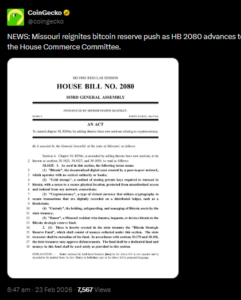
Source: CoinGecko
However, if the House passes House Bill 2080, it will be transferred to the Senate, where it will undergo readings, committee hearings, debate, and a vote. Should it pass the Senate, the bill would then be sent to Mike Kehoe for signature or veto.
The measure was referred to a House committee last week. At that stage, lawmakers are expected to hold a public hearing, consider amendments, and conduct a committee vote before returning the bill to the full House for debate and final consideration.
Past Legislative Initiative and Expansive State Reserve Energy.
The Missouri Bitcoin reserve proposal follows an earlier effort by Keathley. In February of last year, he introduced House Bill 1217, which contained similar provisions.
That measure was referred to the House Special Committee on Intergovernmental Affairs and received a public hearing in March. However, it did not receive a committee vote and did not advance to the House floor.
The renewed proposal arrives as multiple states evaluate digital asset reserve strategies. Asset manager VanEck estimated last year that strategic Bitcoin reserves across American states could generate more than $23 billion in demand if widely adopted.
Missouri’s approach differs in part by allowing the reserve to be funded through voluntary donations in addition to direct state investment. The five-year holding requirement and restrictions on foreign transactions are also explicitly outlined in the bill’s language.
The proposal is advancing while legislative discussions related to the CLARITY Act continue at the federal level. The state-level initiatives are unfolding alongside those broader proceedings.
Other States Advance Similar Measures
Missouri is not alone in exploring digital asset reserves. Lawmakers in Arizona recently advanced a bill that would authorise the state to hold Bitcoin in reserve.
The Arizona measure permits the use of seized crypto assets to fund the reserve and also allows the stockpile to include XRP. It further authorises the state to lend digital assets to earn returns.
In late January, South Dakota introduced legislation to hold Bitcoin as well. That proposal allocates up to 10% of state funds for the purchase of the asset.
Additional states advancing digital asset reserve proposals include Kansas, Utah, and Pennsylvania. Meanwhile, Texas became the first state in the country to establish a Bitcoin stockpile.