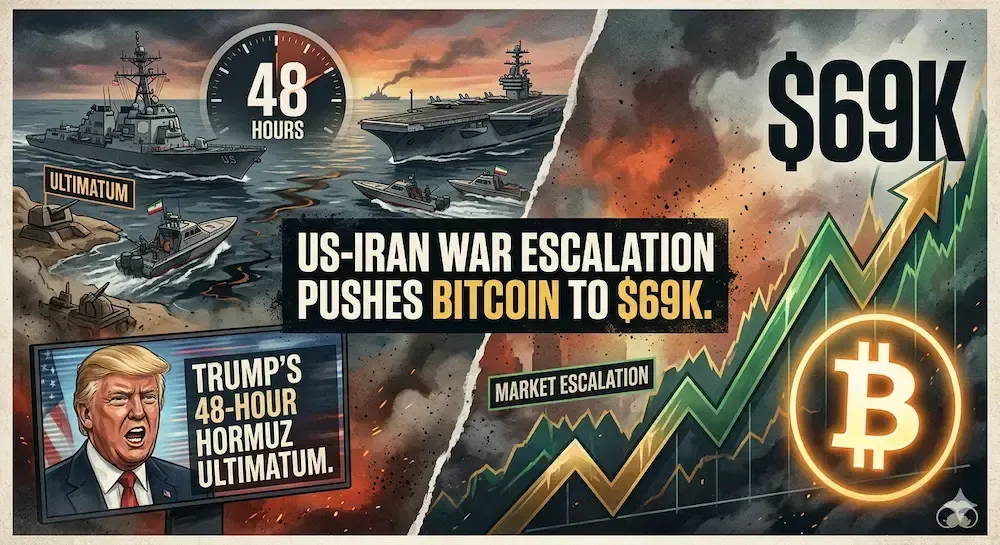
- The war between the US and Iran deepens, pushing Bitcoin down with new geopolitical tension and uncertainty.
- Trump gives a 48-hour ultimatum, and Iran threatens to retaliate against essential infrastructure.
- Cryptocurrency markets experience massive liquidation.
The war tensions between the US and Iran hit a new high after President Donald Trump gave Iran a 48-hour ultimatum to reopen the Strait of Hormuz, a major world energy route. Following Trump’s announcement, Bitcoin declined to $69,192 on Sunday morning, representing a 2.2% drop in 24 hours and a 3.1% decline in the week.
Market Reaction to US-Iran War Escalation.
The latest event concerning the war between the US and Iran comes after the direct threat issued by Trump to Tehran. He stated that failure to reopen the Strait of Hormuz completely within 48 hours would lead to United States strikes targeting Iranian power infrastructure.
In a public statement, Trump said the United States would “hit and obliterate” Iran’s power plants, beginning with the largest facility.
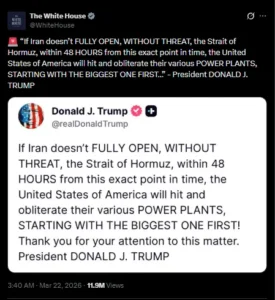
Source: Donald J. Trump
This escalation came just a day after indications that military operations could be winding down. Trump earlier indicated that the United States was already planning for the possibility of peace talks, indicating that the tensions might ease.
Nevertheless, various nations, including the United Kingdom, France, Germany, Italy, South Korea, Australia, the United Arab Emirates, and Bahrain, expressed their desire for an open Strait of Hormuz. These countries condemned what they termed as an Iranian de facto closure of the route and highlighted its significance to the world trade and energy supply chains. These countries condemned what they termed as an Iranian de facto closure of the route and highlighted its significance to the world trade and energy supply chains.
Iran Responds With Infrastructure Threats
Iran responded with a warning that any attack on its energy infrastructure would trigger retaliatory strikes. The country’s Khatam Al-Anbiya military command stated that any attack by the United States would result in strikes against energy, information technology, and desalination infrastructure linked to U.S. interests and its regional allies.
The statement came after a recent Iranian missile attack on the Haifa oil refinery in Israel, which was a development that increased the hostilities between the two regions. The refinery is described as the largest one in Israel, and the attack indicated the increasing nature of the conflict.
The threat exchange between the two parties highlighted the growing vulnerability of energy infrastructure across the region to broader destruction. These changes added to the already high uncertainty in both traditional and digital financial markets.
Liquidations Unveil Bullish Positioning Change.
Based on market data, the crypto sector had been over-allocated to optimistic expectations before the escalation of the US-Iran war. CoinGlass reported that liquidations totaled $299 million in the last 24 hours, affecting 84239 traders. The Long positions were estimated to be worth about $254 million, or about 85 of the overall liquidations.
Bitcoin recorded $122 million in liquidations, and Ethereum recorded $ 95.7 million in losses. However, the greatest one-time liquidation was a 10 million BTC-USDT swap on OKX.
The extended liquidation concentration indicated that traders expected further upward movement after eight days of consecutive gains. This trend was driven by the geopolitical shift triggered by Trump’s ultimatum, which put leveraged positions under immediate downside pressure.
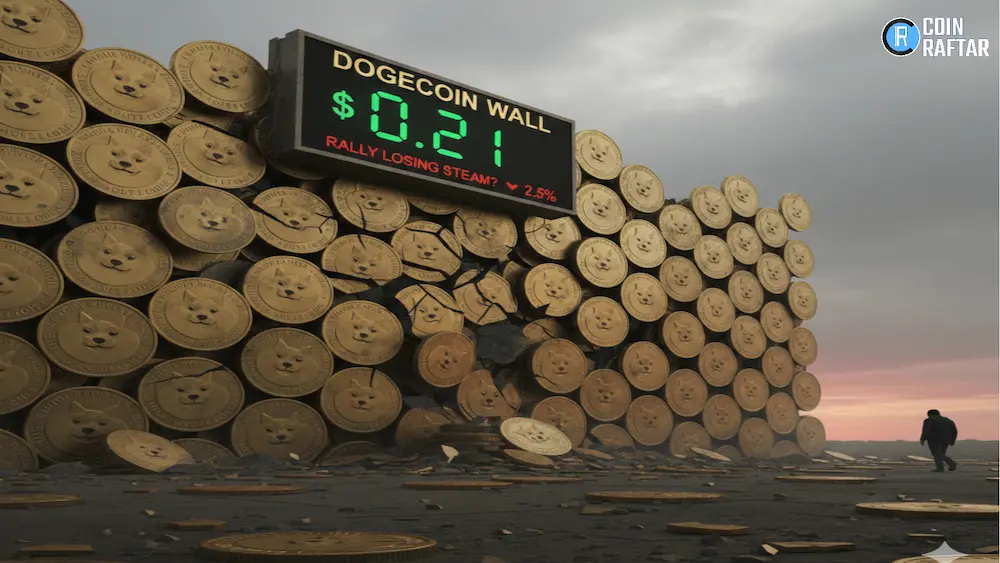
The intensification of the US-Iran war was felt across the main cryptocurrencies. Ethereum was down 1.8% at $2,114, and XRP dropped 2.5% at $1.41. Binance Coin (BNB) fell by 1.4% to reach $633, and Solana fell by 2.1% to $88.55. Dogecoin had the largest percentage decline among major tokens, dropping 2.7% to $0.092.
Nonetheless, the general market movement was driven by geopolitical uncertainty. The time of the sell-off corresponded well with the intensification of the US-Iran war discourse.
The Dynamics of the Oil Markets Put Pressure.
The geopolitical events were also accompanied by rising oil prices, further complicating financial markets. Trump recommended releasing oil from the U.S. Strategic Petroleum Reserve to stabilize prices.
However, GasBuddy petroleum analyst Patrick De Haan stated that such a move would likely have minimal impact, comparing it to “trying to replace a water main with a straw.”
The Strait of Hormuz raised concerns, leading to heightened sensitivity to energy markets, as it is a key transit route for international oil supply. The possibility of disruptions heightened volatility and affected investors’ positioning across asset classes.