

Key Insights:
- Binance continued to lead the market even though the overall crypto trade volume had fallen by 48% to $4.3 trillion.
- The activity of perpetual futures was the order of the day, as it was equivalent to $3.5 trillion in comparison to $0.8 trillion in spot trading.
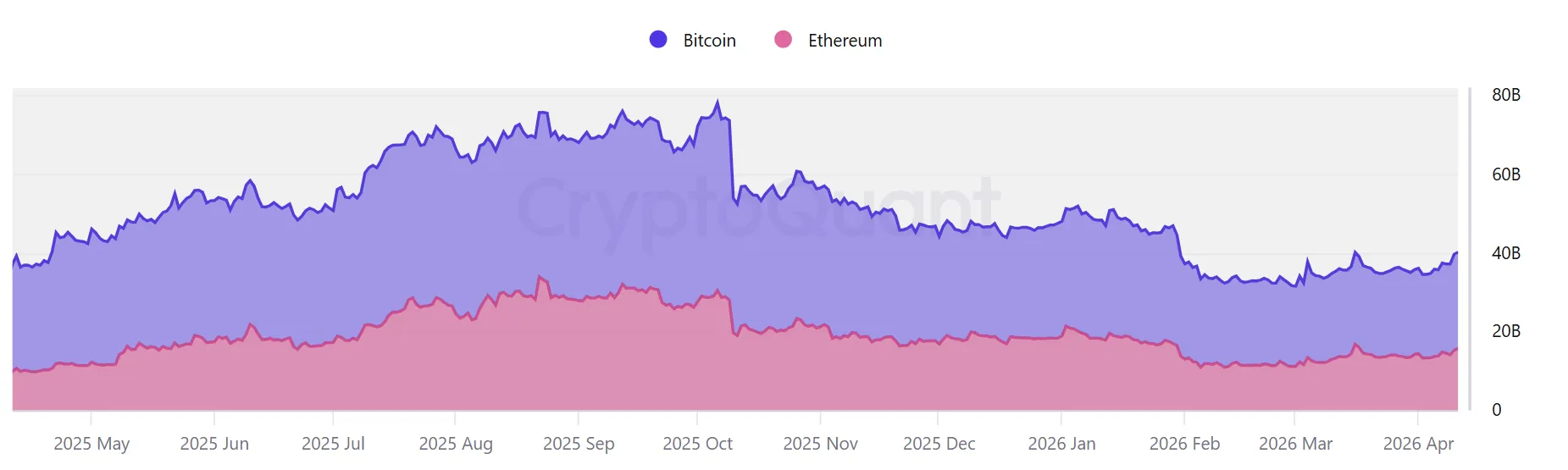
- Bitcoin and Ethereum open interest in exchanges reached to the level of $23 billion and $16 billion.
When the total activity in the centralized exchanges dropped dramatically, Binance was at the heart of crypto trading.CryptoQuant data revealed that the total volume of trading decreased substantially compared with its levels in October of 2025.
It has decreased by around 48% and as of March 2026 volumes stood at a low of $4.3 trillion, the lowest since October 2024.The fall was an indication of decreasing participation of the retail investors as well as institutional investors following the earlier market boom.
The concentration of user activity in large, liquid platforms in volatile price conditions reduced market participation. Binance remained an important recipient of this activity because of its profound liquidity and a comprehensive trading platform.
Smaller transactions experienced more discouraged inflows which underscored a tendency of consolidation towards the market leaders.This transformation highlighted the importance of traders focusing on efficiency and reliability in execution in times of uncertainty in the market.
Cryptocurrency Market Structural Change to Perpetual Futures.
The crypto market was still dominated by perpetual futures trading, which influenced the general trends in the activity in the first quarter. In March, perpetual volume was $3.5 trillion, and that was far ahead of the spot trading volume, which was $0.8 trillion.
This imbalance demonstrated that derivatives had more and more impact on market behavior and price discovery in the key assets. The volume of spot trading was almost four times that of the perpetual contracts in the same period.
The cumulative perpetual trading volume has reached up to $4.5 trillion in 2026, which supports the increased popularity of leveraged instruments. This tendency was further enhanced in the relief rally that was witnessed in the third week of March in the key cryptocurrencies.
Derivatives markets became the favorite of traders who aimed to take advantage of the opportunities in the short-term price movements and volatility in the market. The prevalence of perpetual futures signified structural change in the manner the market participants utilized crypto trading strategies.
Binance secures a market lead in derivatives trading.
Binance continued to dominate the derivatives market, with 40% of the volume in its perpetual futures markets.The platform registered about $1.4 trillion derivatives volume every month, which was miles ahead of other rival exchanges.
OKX was next, with a market share of 19% and Bybit had a 13% share of the derivatives environment. Even in times of market recovery, Binance still amassed most of the new open interest.
In mid-March, Binance had registered the highest 24 hour growth in open interest in both Bitcoin and Ethereum contracts.During the market recovery, open interest in Bitcoin on Binance increased by $829 million in one day.
The Ethereum open interest growth rose even further, adding the same margin of $1.6 billion in the 24-hour period.On all exchanges, Bitcoin and Ethereum perpetual open interest was at $23 billion and $16 billion respectively.
Spot Volume Trends Binance Retaining Lead.
Binance further maintained its lead in the spot market though the total trading volumes could be observed to have been dwindling. The exchange registered an exchange volume of $248 billion in spot trading in March and its presence in the market is high.
This provided Binance with 32% of the spot market, which was down to 37% in October of 2025.Binance was still far ahead of its nearest competitors in the spot segment even with lower share.
Competitive positioning was moderate with MEXC and Bybit taking 9% and 7% of the market share respectively. Other exchanges included Gate and Crypto.com, which saw growth, but their impact overall was relatively small.
The overall market setup did not change much and Binance was still in control of the spot and derivative markets. This uniformity underscored the strength of Binance when the markets were not engaging in trading and when the trading preferences were shifting.