
Key Insights:
- Hyperliquid Policy Centre opens in Washington to inform US DeFi policy and derivatives.
- The Center is provided 1M Hype tokens, valued at approximately $29M, to finance initial operations.
- Its launch comes as Congress debates crypto regulation and stablecoin rules
The Hyperliquid Policy Centre has formally launched in Washington, positioning itself as a policy-focused organization dedicated to decentralized finance and perpetual derivatives.
Hyperliquid Policy Center Outlines Regulatory Focus
Announced on Wednesday, the organization said it intends to serve as a resource for U.S. lawmakers and regulators as Congress continues debating legislation that would define oversight of digital asset markets.
The initiative is funded by the Hyper Foundation and led by legal and policy professionals with experience across crypto advocacy groups and private practice. The launch comes as federal lawmakers remain divided over key provisions in pending crypto legislation, particularly those related to stablecoins.
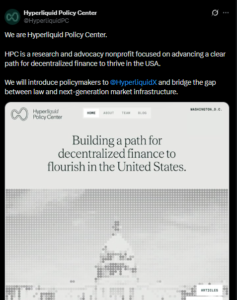
The Hyperliquid Policy Center said its mandate is to advance what it describes as a clear regulatory pathway for decentralized finance to operate in the United States.
Source: Hyperliquid Policy Centre
According to a press release, the organization will focus specifically on decentralized market infrastructure, with particular attention to perpetual derivatives and blockchain-based financial systems.
The Chief Executive Officer and founder, Jake Chervinsky, claimed that the blockchain networks are set to be fundamental building blocks in the financial system.
He said policymakers face a decision between adapting regulatory frameworks to accommodate the technology or allowing other jurisdictions to move ahead.
Chervinsky previously served as chief legal officer at Variant, a venture capital firm that has invested in DeFi projects, including Uniswap and Morpho. Before that, he worked at the Blockchain Association, a Washington-based nonprofit trade organization representing digital asset firms.
The Hyperliquid Policy Center stated that it will not operate as a general crypto lobby but will instead concentrate on policy matters tied to decentralized derivatives markets, particularly perpetual futures.
Funding and Organizational Structure
The Hyper Foundation, an independent entity that supports the Hyperliquid ecosystem, has contributed 1,000,000 HYPE tokens to fund the center’s initial operations.
Moreover, according to data from CoinGecko, that allocation was valued at approximately $29 million on Wednesday. The native HYPE token had risen 22% over the previous month at the time of the announcement.
The founding team also includes newly appointed policy director Salah Ghazzal, who previously served as Variant’s policy lead, and policy counsel Brad Bourque, a former associate at Sullivan & Cromwell. The law firm has been publicly associated with the now-bankrupt crypto exchange FTX.
Hyperliquid co-founder and Chief Executive Officer Jeff Yan said on X that the launch comes at a critical moment in U.S. policy discussions and that the platform had previously lacked a unified presence in those conversations.
He stated that financial regulation developed in the United States would influence global standards and that engagement in the policy process was necessary.
Legislative Context and Policy Debate
The debut of the Hyperliquid Policy Centre coincides with ongoing legislative efforts in Congress to clarify how digital asset markets should be regulated. Lawmakers are working on a bill that would define the roles of market regulators in policing cryptocurrency activities.
Chervinsky has previously commented on proposed regulatory measures affecting the decentralized finance sector. In October, he criticized a proposal from Senate Democrats that would require websites used to access DeFi protocols, commonly referred to as front ends, to register with regulators and implement Know Your Customer procedures.
He argued at the time that such rules could enable the U.S. Treasury Department to effectively ban certain DeFi projects. However, in public statements, he described the proposal as unconstitutional and said it could prompt U.S.-based DeFi developers to relocate abroad or shut down their domestic operations.
The Hyperliquid Policy Center said its approach differs from that of organizations such as Coin Center and the Chamber of Digital Commerce, both of which advocate on a broad range of crypto-related issues. Instead, the new center stated that it will concentrate specifically on decentralized derivatives infrastructure and related regulatory frameworks.