

Key Insights:
- Ether declined to below $2500 amid liquidations and leverage unwinding across the market.
- BitMine Ether holdings fell to approximately $9.6 billion from a peak of roughly $13.9 billion.
- Whale trading and liquidation activities generated volatility at major exchanges.
Ether fell below $2500 this week, exacerbating the Ethereum price crash amid widespread market stress. Ethereum was trading at $2,370 at press time, down 12.27% over the past 24 hours, according to CoinMarketCap. The weekly and monthly losses were about 20% and 21%, respectively.
Ether declined amid a broader market sell-off over the weekend
According to data compiled by Dropstab, BitMine’s holdings of Ether have dropped to an estimated $9.6 billion at current prices.
However, this contrasts with a peak valuation of about $13.9 billion in October, highlighting the extent of unrealized losses from the recent fall.
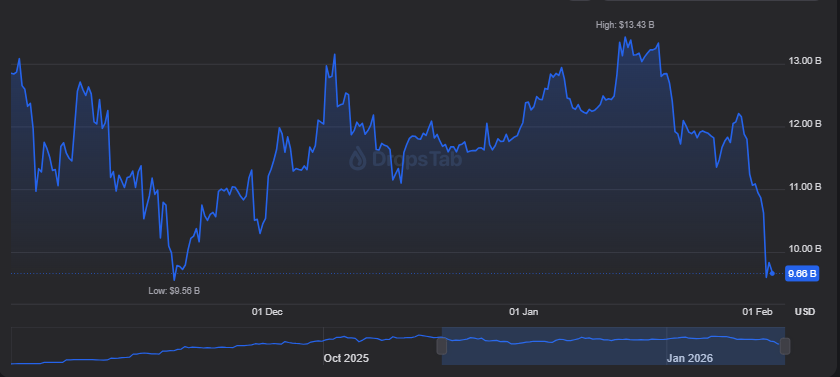
Source: Dropstab
The Ether price decline was accompanied by a broader market sell-off, which gained traction throughout the weekend. Ether dropped to the 2300 range as liquidity across all trading platforms became diluted.
Also, market depth was lower, leading relatively small sell orders to trigger sharp price declines. The fall accelerated as leveraged positions unwound, reversing previous gains and intensifying downside pressure.
According to analysts at The Kobeissi Letter, high leverage and concentrated positioning were among the factors that triggered further downside pressure as selling compounded.
Nevertheless, the decline accelerated as leveraged positions were liquidated, extending losses without an immediate price stabilization.
Liquidations, ETF withdrawals, and downside levels
The latest leg of the Ethereum price crash followed Bitcoin’s roughly 6% decline, which triggered about $1.6 billion in liquidations across the market.
Renowned Crypto analyst Jake Wujastyk said in an X post that Ether could trade in a $1,800 to $1,850 range if the fallout intensifies, citing the scale of forced selling and reduced risk tolerance.
In addition, Market analyst G. Martin noted that while Ethereum’s higher-timeframe structure still appears stronger than Bitcoin’s, most indicators continue to point toward a sustained downtrend.
He identified a potential support zone between $2,000 and $2,200, with a deeper area of focus between $1,600 and $1,800 should selling pressure persist.
Martin added that as long as Bitcoin remains structurally bearish, Ether prices are likely to stay under pressure.
Large holders add to selling pressure
Whale activity also featured prominently during the downturn. Vitalik Buterin transferred $44 million worth of ETH as prices remained under pressure, according to on-chain data.
Separately, analytics platform Lookonchain reported that long-term Bitcoin holder Garrett Jin deposited 3,183 ETH, valued at $8.04 million, into Binance, a move interpreted as preparation to sell.
Jin’s ETH long position had previously exceeded $700 million in value but was ultimately liquidated, resulting in a reported loss of approximately $250 million.
Before the last liquidation, he cut the position to about $472 million earlier in the day. The trades came amid heightened trading and volatility on exchanges.
Market forecast related to wider recovery factors
Although the Ethereum price has kept falling, market participants stressed that a lasting recovery will be driven by broader systemic factors rather than individual rebounds. A recent report by Wintermute stated that it would take renewed traction in Bitcoin and Ether, greater involvement of exchange-traded funds, and increased adoption by corporate treasuries to stabilize prices.
The company also cited the lack of retail inflows as a decisive limitation, as well as investor focus on more rapidly advancing themes such as artificial intelligence and quantum computing.
Ethereum Foundation advances post-quantum security efforts
Alongside market developments, the Ethereum Foundation announced steps to elevate post-quantum security as a core strategic focus.
The foundation formed a dedicated Post Quantum team and committed $2 million to the initiative. Ethereum researcher Justin Drake announced the effort, which will be led by Thomas Coratger, alongside Emile, a contributor to leanVM.
Drake said the foundation has quietly been researching quantum resilience since 2019, before formally making it a top-level priority.
The plan includes research, development, and ecosystem coordination, with new developer calls focused on user-facing security, two $1 million cryptography prize programs, multi-client post-quantum testing networks, and global workshops to accelerate readiness across the ecosystem.