- Ethereum account abstraction can be released with Hegota within the next year, according to Buterin’s assertions.
- EIP 8141 introduces frame transactions and supports gas payments in non-Ether tokens.
- By 2026, Ethereum retained a high share of total value locked, while Ether dropped by 36%.
Ethereum account abstraction is expected to ship with the network’s planned Hegota upgrade within a year, according to comments made by Ethereum co-founder Vitalik Buterin over the weekend.
EIP-8141 connects Hegota Upgrade to Long-Running Account Overhaul.
The long-discussed overhaul of how accounts function on the blockchain is now tied to EIP-8141, described as a comprehensive proposal intended to resolve the remaining technical challenges associated with account abstraction.
The development comes as Ether trades near $1,900 following a 36% decline in 2026, even as core protocol upgrades continue to focus on scalability, privacy, and quantum resistance.
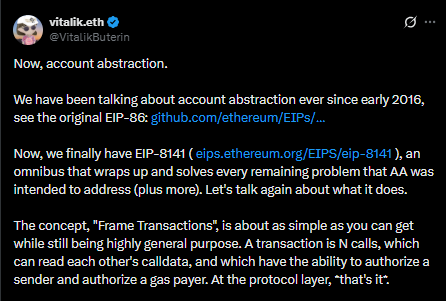
Buterin stated that the discussions around account abstraction date back to early 2016. He added that EIP-8141 serves as an “omnibus” proposal designed to address the original objectives of account abstraction and additional issues identified during years of research and refinement. Deployment is slated for the upcoming Hegota fork, which he said could make the feature operational within a year.
Ethereum Account Abstraction and the Hegota Fork
The Ethereum account abstraction framework restructures how transactions are processed by introducing a concept called “frame transactions.”
Source: Vitalik Buterin
Instead of treating a transaction as a single operation, the new structure organizes it into a sequence of frames that can reference shared data. Each frame can authorize a sender or designate a gas payer.
The system also allows paying gas fees with tokens instead of Ether. The structure eliminates intermediaries during asset conversions, thereby avoiding transaction fees, aligning with Ethereum’s stated goal of reducing dependence on centralized components.
Moreover, Buterin pointed out that privacy-conscious users are likely to find the elimination of public broadcasters beneficial, since such a feature has been known to cause user experience issues in protocols like Railgun and Tornado Cash. In the proposed model, they would be replaced by a general-purpose public mempool.
Performance and Network Activity in the 2026 Market.
The Ethereum account abstraction timeline comes amid price and activity contractions. Ether is down 36% in 2026 and remains below $3,000. The asset fell by 9% in the first half of the year, outperforming the broader cryptocurrency market.
Simultaneously, monthly decentralized exchange volumes on Solana dropped to $95.5 billion in October, a 21% decline from August. The decrease in transaction volumes has burdened network fees and income for decentralized applications. The decrease in fee income reduces the immediate incentive to hold Ether, especially as activity declines.
Nevertheless, Ethereum has retained more than half of the overall value locked in decentralized finance protocols, equal to 57%. The share increases to 65% with the addition of layer-2 networks such as Base, Arbitrum, Polygon, and Optimism.
JP Morgan Asset Management, Citigroup, Deutsche Bank, and BlackRock have introduced on-chain programs that deploy Ethereum infrastructure. Such projects consist of tokenized funds, stablecoins issued by banks, and layer-2 rollups.
Long-term Roadmap based on Ethereum Account Abstraction.
The planned base-layer structural change with the Hegota upgrade is the abstraction of the Ethereum account. By formalizing smart accounts, enabling alternative gas payment methods, and reducing reliance on intermediaries, the proposal consolidates several design goals pursued over the past decade.
Buterin said that after years of incremental progress, the combination of frame transactions and EIP-8141 creates a pathway to full implementation. If deployed as scheduled, the Hegota fork would mark the first time Ethereum account abstraction becomes native to the protocol.