
Highlights:
- Apple sees access drop as Apple removes VPN apps amid tighter proxy restrictions
- VPN tools are more aggressively blocked and less effective, and the Russian regulator extends its authority.
- New cryptocurrency policies limit retail use and the use of licensed intermediaries for digital transactions.
Apple moved into sharper focus after Telegram CEO Pavel Durov accused Apple of removing several VPN and proxy tools from the Russian App Store amid ongoing disruptions to Telegram access in Russia.
Apple Removes Proxy and VPN Apps After Telegram Disruptions
Reports showed that Apple removed applications used for custom proxy connections, including Streisand, V2Box, v2RayTun, and Happ Proxy Utility. Data from AppleCensorship indicated that those apps were no longer available in Russia and China. The removals came days after Telegram users reported widespread connectivity problems, linking platform outages to tighter restrictions on circumvention tools.
The Telegram VPN ban in Russia and the Apple issue followed reports that several proxy-based applications had been removed from the Russian App Store. Apple censorship data showed that the applications were unavailable in both Russia and China.
Developers affected by the removals shared notices from Apple stating that the actions were taken to comply with local laws. Those notices also said the delisted apps would no longer receive updates or security patches. The removals followed a period of major connectivity problems for Telegram users in Russia. Users experienced disruptions over the prior two weeks, according to the information provided.
Those interruptions came after announcements that monitoring systems had improved, reducing access reliability and increasing attention on the tools users relied on to bypass restrictions. As Telegram access declined, demand for VPN services rose.
Pavel Durov responded publicly to the removals. He said the prohibitions were intended to push users toward state-controlled platforms. He also said the restrictions increased pressure on independent communication channels.
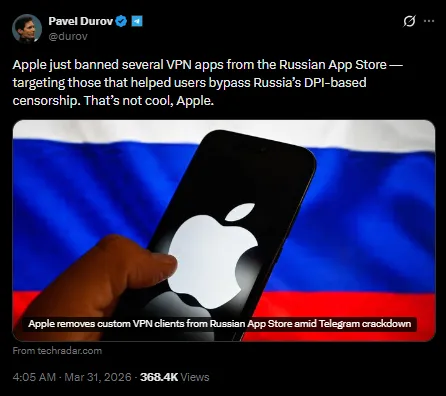
Source: Pavel Durov
Durov rejected official allegations against Telegram and described the measures as part of a broader effort to impose surveillance through other platforms. He mentioned the Kremlin-backed MAX messaging app and raised concerns about its surveillance capabilities.
Telegram VPN Ban Russia Apple Developments Follow Wider Enforcement
Roskomnadzor, Russia’s communications regulator, confirmed that it had introduced consistent restrictions on Telegram. Officials said the measures were intended to ensure compliance with national laws and protect citizens. The agency also accused Telegram of failing to safeguard personal data and address criminal activity. Durov denied those allegations.
Russian officials also said they could now restrict VPN traffic more effectively. Lawmaker Andrey Svintsov warned that bypass tools might no longer work against Telegram restrictions. That statement came as authorities expanded technical enforcement and monitoring capabilities. According to the information provided, some services were still able to bypass restrictions, but enforcement tactics had shifted toward broader and more aggressive blocking methods.
Amnezia VPN founder Mazay Banzaev confirmed that new user numbers increased as Telegram disruptions intensified. He said detection systems had become more precise while some services continued to operate. His comments indicated that access restrictions and bypass efforts were moving in parallel, with enforcement becoming more targeted and broader at the same time.
The latest removals also followed earlier action in 2024. During that year, Apple was said to have removed at least 60 VPN apps from the Russian App Store, including NordVPN, ExpressVPN, and Proton VPN. In the same year, lawmakers introduced a law regulating the supply of tools used to bypass internet restrictions. That legal framework supported a wider crackdown on VPN services.
Crypto Bills Add Another Layer to Russia’s Digital Controls
The Telegram VPN ban in Russia, Apple’s story developed alongside a separate set of government measures covering digital assets. Russia’s government approved a package of draft bills that would route domestic crypto trading through licensed intermediaries and tighten limits on retail investors. The Finance Ministry said the government had approved bills legalizing the circulation of digital currencies and digital rights in Russia, as well as amendments to certain legislative acts and changes to the administrative offenses code.
Under the proposed framework, transactions involving digital currency without regulated intermediaries would be prohibited. The package would increase state oversight of digital assets while preserving limited access for non-qualified investors and broader access for qualified investors.
Retail investors would be allowed to buy only the “most liquid digital currencies” as defined by the Bank of Russia. They would also be required to pass a test and would face a purchase limit of up to 300,000 rubles, or about $3,700, per year through a single intermediary.
The proposal would still allow residents to buy crypto abroad using foreign accounts, provided the transactions are reported to tax authorities. The framework also created a licensing regime for crypto operations, including digital exchanges and custodial services, while permitting banks and brokers to participate under specific regulatory requirements.