

Key Insights:
- Crypto ETF options caps are removed, and trading limits now expand under new exchange rules.
- The SEC approved the filings immediately and removed the 25,000-contract cap on ETF options trading.
- FLEX options now allow custom contracts and expand strategies for institutional participants.
Crypto ETF options have entered a new phase in U.S. derivatives markets after NYSE Arca and NYSE American filed rule changes with the Securities and Exchange Commission to eliminate position and exercise limits tied to spot Bitcoin and Ether exchange-traded funds.
Crypto ETF Options Move Beyond Initial Safeguards
According to Federal Register notices scheduled for publication, the exchanges removed the long-standing 25,000-contract cap that had governed these products since their launch. The SEC approved both filings without applying the standard 30-day waiting period, allowing the changes to take effect immediately.
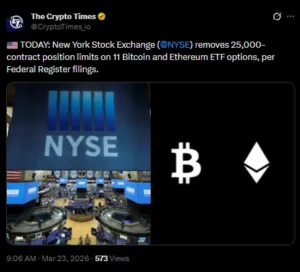
Source: The Crypto Times
The 25,000-contract cap was introduced in November 2024, when crypto ETF options began trading in the United States. During that period, there was a policy of exchange reserves, which set conservative limits to minimize the risk of market manipulation and undue volatility.
However, both position limits and exercise limits were limited by a 25,000-contract limit that restricted the scale at which the parties could trade these derivatives. With the new rule amendments, crypto ETF options are now subject to each exchange’s standard position limit framework. Such a structure determines the exposure allowed based on trading volume and the number of shares outstanding.
Following these criteria, exchange-traded funds with high liquidity may be subject to a position limit of over 250,000 contracts, which is far more liberal than the former limit. The shift also introduces crypto ETFs to a more similar treatment than other commodity-based ETFs receive.
Additional FLEX Options Capabilities Introduced.
Besides eliminating position limits, the filings also introduce another form of structural change: crypto ETF options can now be traded as FLEX options. In the past, these products could not be organized in this format due to the constraints. The new regulations eliminate these restrictions, allowing trading or hedging participants to structure contracts to their needs.
FLEX options are currently being applied in other market segments, especially in large or complex trades of commodity and equity ETFs.
Nevertheless, the changes affect a total of 11 BlackRock crypto ETFs, including iShares Bitcoin Trust (IBIT), Wise Origin Bitcoin Fund (FBTC), and the ARK 21Shares Bitcoin ETF (ARKB), among others.
Industry-Wide Shift Across U.S. Options Exchanges
The NYSE filings complete a broader transition across the U.S. options market. Earlier in 2026, several exchanges moved to remove the same restrictions. Nasdaq ISE and Nasdaq PHLX submitted filings in January, followed by MIAX in the same month. MEMX filed in February, and Cboe introduced its version in March.
As NYSE Arca and NYSE American now follow a similar structure, every major U.S. options exchange has adopted uniform rules for crypto ETF options. The SEC pointed out that the proposals did not introduce new regulatory considerations, stating that the same changes are already accepted and implemented at other venues.
Moreover, such a cohesive movement signifies uniformity in exchanges, and crypto ETFs are treated similarly regardless of the trading venue.
Institutional Trading Strategies and Market Structure.
The new regulations have a direct impact on the application of crypto ETF options in institutional trading strategies. However, lifting the position constraints will permit the latitude of employing hedging methods, such as basis trades and portfolio overlay programmes. Such strategies tend to have position sizes that are much larger than those allowed under the capped framework.
In addition, the availability of FLEX options increases the number of available strategies. Institutions can now negotiate customized contractual terms to suit a particular risk profile or investment purpose. This functionality was already available for comparable products such as commodity ETF options, including those linked to gold and silver funds.
The earlier 25,000-contract cap had been viewed as conservative by some market participants. On the first day of options trading in IBIT, the fund created notional exposure of around $1.9 billion, even though it operated within its limits.
Additionally, Nasdaq ISE has submitted a separate proposal to increase position limits for IBIT-specific options to 1 million contracts. This filing, currently under SEC review, has reached its fifth amendment stage.
If approved, the proposal would align IBIT options more closely with the scale of the largest equity ETF options. A separate notice indicates that Nasdaq International Securities Exchange is also pursuing a similar increase for the same product.