Key Insights:
- Bitcoin could break its four-year cycle amid stronger US policy support.
- Institutional demand continues to reinforce Bitcoin market confidence.
- Regulatory clarity strengthens long-term Bitcoin growth expectations.
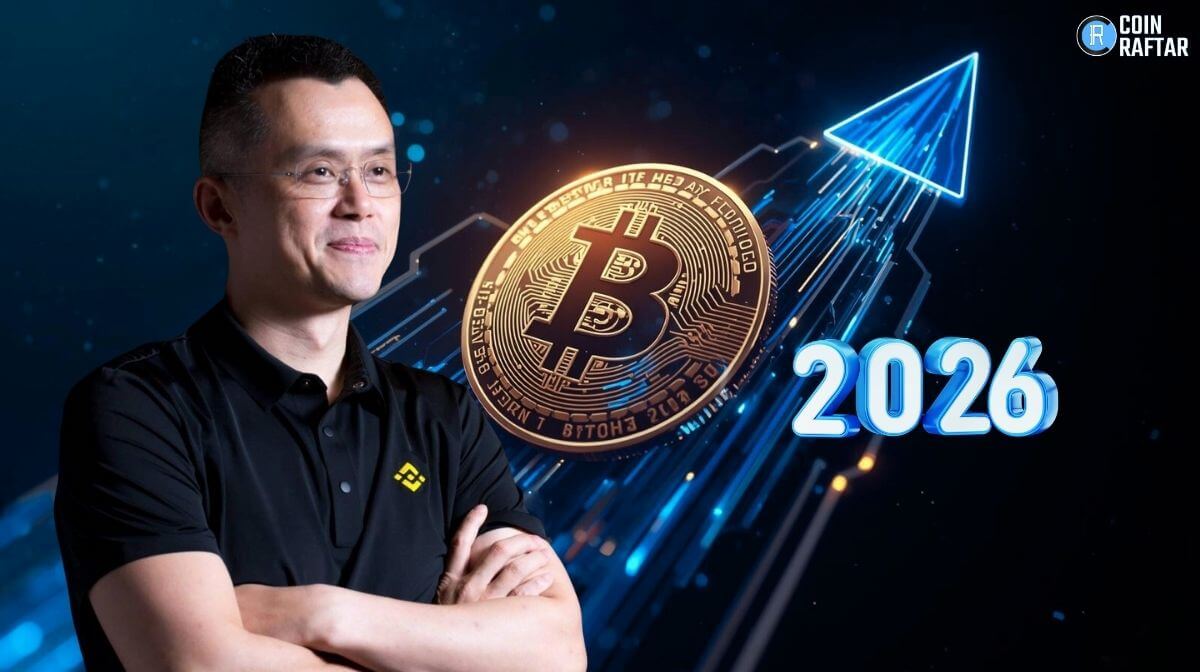
Bitcoin may enter a supercycle phase as early as 2026, according to Binance founder Changpeng Zhao. He linked this outlook to a sharp shift in US crypto policy under President Donald Trump. Speaking publicly, Zhao said growing government support could push Bitcoin beyond its traditional four-year cycle.
CZ links Bitcoin supercycle to US policy shift
During an interview at the World Economic Forum in Davos, Zhao shared his outlook on Bitcoin’s long-term trajectory. He told CNBC anchor Andrew Ross Sorkin that he strongly believes 2026 could mark a Bitcoin supercycle. However, he avoided assigning a specific price target.
Zhao reports that the US has become more relaxed about digital properties. Consequently, other governments can take this way. As a result, Bitcoin may not have abrupt post-halving falls but rather long-term growth.
Bitcoin’s four-year cycle may face disruption
In the past, analysts have been following Bitcoin in a four-year cycle that is linked to halving events. Usually, the prices increase and peak and then, they correct. However, Zhao proposed that this trend can be undermined.
Due to the fact that Bitcoin is the largest crypto-market player, its movement usually determines the pace of other asset ones. Consequently, a cyclical shift in Bitcoin could redefine the overall market activity. Furthermore, this trend may be supported by institutional interest over the long term.
Industry leaders set ambitious Bitcoin price targets
While Zhao avoided predictions, other industry figures offered bold targets. Ripple CEO Brad Garlinghouse projected Bitcoin could reach $180,000. Meanwhile, BitMEX co-founder Arthur Hayes forecast a $200,000 level.
Although the targets of the market leaders are different, they agree on the long-term potential of the growth of Bitcoin. This was also echoed by Zhao. He indicated that predicting Bitcoin in the coming five to ten years will be easy with further growth.
CZ addresses Trump ties and pardon speculation
During the interview, Zhao rejected claims linking him directly to President Trump. He denied any involvement in political lobbying or crypto-related coordination. Zhao stated he has never spoken with Trump.
However, speculation followed Trump’s decision to pardon Zhao last October. Reports noted that MGX, an Abu Dhabi investment firm, invested $2 billion into Binance using the USD1 stablecoin. World Liberty Financial, backed by the Trump family, issues the stablecoin.
Zhao responded by calling the situation a misunderstanding. He explained that MGX chose USD1 after Binance requested crypto payments. He also said he prefers avoiding banks. According to Zhao, he only saw Trump from a distance at Davos.
US regulation fuels Bitcoin market confidence
The remarks of Zhao come as Washington restructures its crypto paradigm. The US has also started to reverse policies of the past years that are heavy on enforcement. Quite on the contrary, clarity of regulation is now being underlined by the lawmakers.
Last July was the beginning of a new era with the GENIUS Act. The legislation was the initial federal payment stablecoins system. Consequently, stablecoins became identified as financial infrastructure.
The focus is now on the CLARITY Act. The Senate Banking Committee intends to debate the bill on January 15. It would entail collaboration between SEC and CFTC in case it is passed.
The indications of such a change are already present. SEC removed crypto oversight in its 2026 examination priorities list. Rather, the agency switched the priorities to artificial intelligence and vendor risks.
Institutional capital has been the follower. Since 2024, spot Bitcoin ETFs have gained more than 56 billion. Meanwhile, JPMorgan and Morgan Stanley have increased crypto-related products.
Nevertheless, Zhao was a moderator. According to him, nobody can tell exactly what is the future of Bitcoin. Nevertheless, he did not lose faith in long-term growth of Bitcoin.