
- Babylon and Ledger have integrated Bitcoin staking infrastructure with hardware wallets, allowing users to keep all their private keys in their own possession.
- Self-custodial vaults are gaining popularity in the crypto market, enabling users to earn yield while retaining ownership.
- Strategy sold preferred equity and used the proceeds to purchase 1,420 Bitcoin.
The infrastructure for staking Bitcoin is growing, with Babylon Labs announcing a collaboration with hardware wallet maker Ledger, enabling Bitcoin holders to interact with on-chain vault contracts while retaining their status as self-custodians of their assets.
The development reflects a broader effort within the digital asset sector to enable Bitcoin holders to participate in financial strategies without transferring custody of their funds to third parties.
Bitcoin Staking Infrastructure Adds Hardware Wallet Security
The integration allows Ledger devices to function as the secure signing layer for transactions within Babylon’s BTCVault framework. Ledger hardware wallets, in their structure, serve as the signing layer for transactions involving vaults. The user must authenticate transactions on the device itself, and any vault actions should be authorized via the wallet interface.
Ledger uses Clear Signing technology in its system, displaying human-readable transaction details on the hardware wallet’s screen. The feature allows a user to access transactions and authorize them to see what is being approved.
Source: Mordor Intelligence
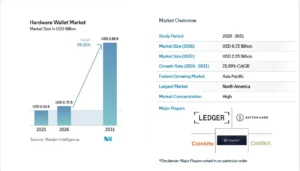
However, Babylon’s Bitcoin staking infrastructure will integrate programmable financial interactions with on-hardware transaction verification by requiring Ledger signers as part of the BTCVault model. Ledger claimed to have sold over 8 million hardware wallets worldwide, making it one of the largest providers of self-custody hardware for accessing digital assets.
Self-Custodial Vaults Are an Emerging Crypto Application.
Under this structure, users typically retain ownership of their private keys even while their assets are deployed within structured strategies.
Vault-based approaches have appeared in several areas of decentralized finance. Protocols such as Yearn Finance previously introduced automated vaults that allocate deposits across lending markets and liquidity pools.
Additionally, the messaging platform Telegram added yield-based vault products to its built-in crypto wallet. The feature allows users to deposit assets, including Bitcoin, Ether, and Tether’s USDt, into structured strategies designed to generate returns.
Strategy Expands Bitcoin Holdings Through Preferred Equity Sales
Separate developments involving Bitcoin treasury accumulation have also drawn market attention to the asset. Michael Saylor’s company, Strategy, which is widely known as the largest public corporate holder of Bitcoin, recently raised capital through the sale of its variable-rate perpetual preferred equity, Stretch (STRC).
Data from STRC.live indicates that Strategy sold roughly 2.4 million shares of STRC through its at-the-market (ATM) program. Based on the reported capital raised, the company is estimated to have purchased approximately 1,420 BTC in a single day. The transaction represents the largest estimated daily issuance of STRC shares tied to Bitcoin purchases. The figure exceeded the previous record of 1,069 BTC referenced in a Monday post from STRC.live.
Strategy disclosed in a filing with the U.S. Securities and Exchange Commission that the company sold about $378 million worth of STRC during the latest capital raise. The company recently amended the rules governing its ATM sales program. The updated structure now allows a second sales agent to participate in the distribution of STRC shares outside normal U.S. market hours, including premarket and after-hours trading.
The preferred stock pays monthly variable cash dividends, with the annualized rate for March set at 11.5%. Some market observers indicated that the updated sales structure could make it easier for the company to issue stock during premarket and after-hours trading sessions.
According to estimates cited by STRC.live, proceeds from the issuance were previously expected to fund a weekly purchase of approximately 4,300 Bitcoin, valued at about $303 million.