- Aave liquidations impacted 10938 wstETH when an oracle error had placed prices below real-world prices
- Aave reported that the system did not have bad debt and restored some of the liquidation rewards to compensate the affected users.
- It reignited interest in Oracle pricing risks and governance arguments within the Aave ecosystem.
Aave liquidations involving approximately $27 million worth of wrapped staked Ether (wstETH) occurred after a configuration error in a risk-oracle system applied an incorrect exchange rate during collateral calculations. The incident resulted in the forced liquidation of several positions that were already close to their risk thresholds.
Aave Liquidations Linked to Oracle Configuration Error
According to a post-mortem report published by the decentralized lending protocol on Tuesday, the issue stemmed from a mismatch in oracle configuration parameters, leading to a rate below the on-chain market value. The protocol stated that the configuration problem had been corrected and outlined steps to compensate affected users.
The Aave liquidations occurred after the protocol’s oracle system used an exchange rate that was 2.85% below the live market rate for wstETH and Lido staked Ether. According to Aave, 10,938 wstETH, valued at about $27.1 million, was liquidated due to the pricing difference. The incorrect rate resulted from an inappropriate configuration of Oracle’s pricing parameters and timestamp data.
The error caused the system to calculate a maximum allowable exchange rate below the on-chain value. The protocol explained that the issue was associated with the Chaos Risk Oracles system, an external risk-management tool integrated into the lending platform’s infrastructure.
According to Aave founder and CEO Stani Kulechov, the system had processed more than 1,200 payloads and 3,000 parameters without problems before the configuration issue occurred. Kulechov stated in a message published on X that the event resulted from a technical misconfiguration and not from malicious activity or a failure in the underlying protocol.
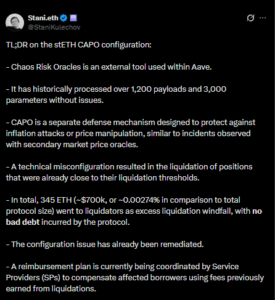
Source: Aave founder and CEO Stani Kulechov
“A technical misconfiguration resulted in the liquidation of positions that were already close to their liquidation thresholds,” he said. The configuration problem has since been addressed, and the oracle parameters were adjusted to restore alignment with the on-chain market rate.
Liquidation Proceeds and User Compensation Plan
Following the Aave liquidations, the protocol confirmed that the event did not produce any bad debt within the lending system. Instead, liquidators who executed the transactions received a liquidation bonus.
Aave reported that 345 Ether, valued at roughly $700,000, was paid out to liquidators as an excess liquidation windfall during the process. The protocol subsequently recovered a portion of those proceeds through internal mechanisms.
According to the report, 141 ETH, estimated at $285,000, was recaptured through BuilderNet refunds. The protocol also collected 13 ETH in liquidation fees tied to the transactions.
Aave stated that the recovered funds will be used to compensate users whose positions were liquidated as a direct result of the configuration error. The project emphasized that the lending protocol’s balance sheet remained intact and that the incident did not generate system-wide liabilities.
Oracle Risk Controls Face Ongoing Criticism.
The Aave liquidations occurred at a time when greater attention was being paid to pricing and oracle-based risk management in decentralized finance lending markets. The proper price feeds and configuration parameters are crucial in collateral valuation in the lending protocols. If pricing information is misaligned with market conditions, borrowers near the liquidation thresholds may be forced to liquidate, even if the broader market price remains unchanged.
The incident follows another event at the end of February involving a decentralized lending pool related to the YieldBlox DAO and the Blend protocol. In that case, attackers used price manipulation techniques to drain approximately $10 million from the lending pool.
While the Aave case involved a configuration error rather than a manipulation attack, the event adds to ongoing industry attention surrounding oracle infrastructure and collateral pricing systems.
Governance Debate Emerges Inside the Aave Ecosystem
The Aave liquidations also occurred during a period of governance discussion within the protocol’s community. The Aave Chan Initiative (ACI) confirmed in an announcement earlier this month that it would not renew its cooperation with the Aave decentralized autonomous organization.
The mentioned group raised concerns about governance standards and voting dynamics during proposal processes in the DAO. The development prompted Kulechov to respond to the operational challenges faced by decentralized governance structures.
According to Kulechov, DAOs tend to face operational challenges due to long-lasting forum debates, temperature checks, and repeated voting rounds before being accepted. He also stated that governance discussions in DAOs can become politicized when community members align around competing proposals.
“DAOs also become politicized very quickly, and it’s easy for voting to become about attention,” Kulechov said. He added that participants sometimes form alliances to advance proposals in future votes.