
Cryptocurrency regulation is in a whole new phase, with governments having moved from the investigative stage to the enforcement stage. In large economies, regulators have established classifications for cryptocurrencies in relation to the existing or newly formed financial system.
Governments prefer to use financial laws to regulate crypto assets, introduce innovative compliance measures, and impose total prohibitions on digital currencies.
What is the Definition of Crypto Regulation among Different Nations?
Crypto regulation across nations involves classifying and regulating digital currencies according to each country’s legal framework.
In the United States, regulatory bodies such as the SEC and CFTC assume this responsibility. Regulatory bodies have regulated this field of digital finance under the 2022 framework.
Enforcement encompasses the measures that regulatory agencies take against corporations, such as Ripple, Coinbase, and Binance, involving their crypto-assets as securities.
Classification of the asset can depend on judicial decisions. In this case, according to a 2023 United States court decision, XRP trades could be deemed securities transactions if institutional investors dealt in these coins.
As a result of another judicial decision, the regulators had to reconsider the Bitcoin application. Eventually, in 2024, Bitcoin spot ETFs and Ethereum ETFs were launched. However, even with these changes, regulatory jurisdiction is still divided among various agencies.
Approaches to Crypto Regulation in the World
Strict Model
The People’s Bank of China bans crypto trading and mining in China due to concerns of financial instability and illegal funding. Instead of cryptocurrency, China has supported the development of its e-CNY.
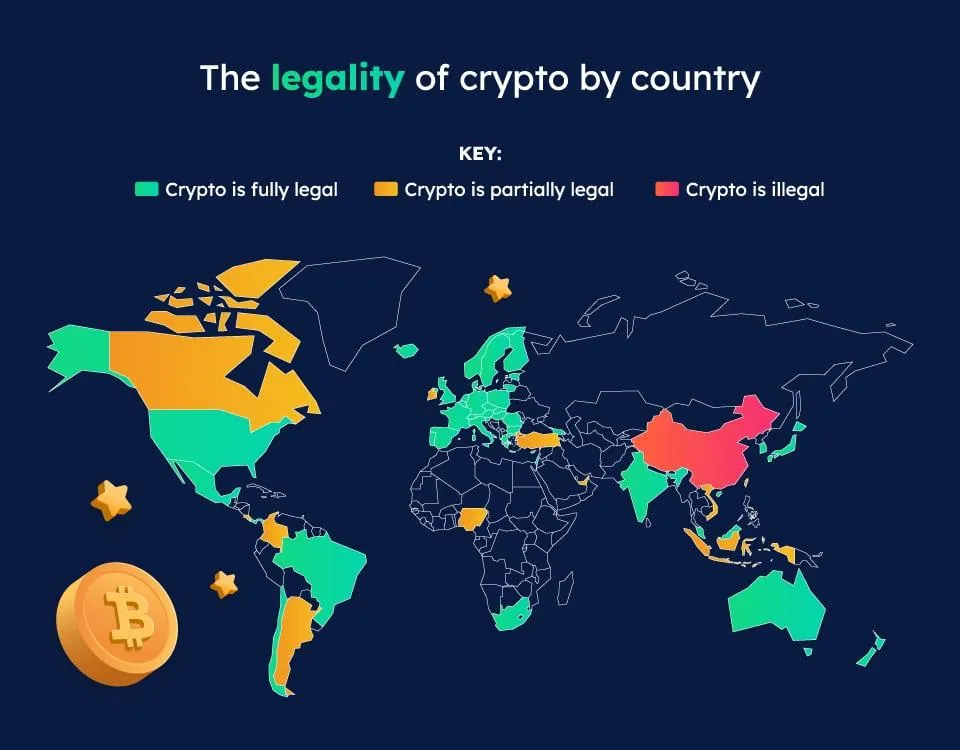
Source: Forexsuggest
Algeria has opted for a similar approach as well. In Algeria, the possession, dealing, and mining of crypto have been made illegal under Law 25-10 that came into effect in July 2025.
Uniform Regulated Systems
MiCA regulation is one such example in Europe, introduced by the European Union and became operative from December 2024.It stipulates that crypto companies must be licensed, where reserves must back stablecoins.
Additionally, project planning token releases are required to present white papers that specify potential risks and operations.
Also, MiCA obligates energy consumption reporting and prohibits foreign companies from conducting business without complying with regulations. Thus, the goal of the regulation is to provide standardized regulations in the cryptocurrency sphere for the European jurisdiction.
Compliance and Taxation-Based Systems
In Japan, cryptos are recognized as property that needs registration with the Financial Services Agency (FSA). Stablecoins can only be released by authorized institutions since 2023.
Australia, too, has similar legislation: cryptocurrency property is taxed under the capital gains tax, and crypto exchanges must be registered with AUSTRAC.
Crypto regulation in Singapore can be achieved via the Payment Services Act, which issues crypto licenses, as well as crypto reserves for stablecoins.
In South Korea, crypto regulation is done through registration and consumer protection legislation. Meanwhile, in India, a tax-based approach has been adopted, with a 30% tax rate applied to profits generated from cryptocurrency.
Legal Development of the Crypto Sector
Legal developments in the crypto sector are occurring across different countries. In several markets, courts have helped determine the status of digital currencies, while regulators have issued licenses and other compliance requirements for users and companies.
On the other hand, some countries have prohibited digital assets, while others have incorporated crypto into their financial systems through structured regulation.
Impact of Developments on Global Structure
Recent regulatory developments suggest that such measures will affect how the crypto sector operates, with many jurisdictions issuing licenses and enforcing rules in these markets. Some markets without regulations have already begun adjusting their operations.
Developments that will impact the future structure of the crypto sector include the fact that most jurisdictions now have clear regulations for cryptocurrencies, even though there are significant differences in classification and other aspects.
Implications for Market Players
- Different jurisdictions have different regulations
- There is an increasing trend toward licensing and regulation compliance worldwide
- Taxation laws differ between nations
- Classification determines asset trading and oversight
Conclusion
Crypto regulations in different countries are continually evolving as more nations formulate their approaches to regulating cryptocurrencies. Although some countries adopt an organized approach to cryptocurrency compliance, others restrict its use, leading to varying cryptocurrency laws worldwide.
Frequently Asked Questions (FAQ)
Is cryptocurrency legal in all nations?
Cryptocurrency is not legal everywhere; in some nations, it can be used, whereas in others it is banned.
Is cryptocurrency regulated equally in all nations?
No, there are different ways to regulate cryptocurrency in different nations.
Is there unity in global crypto regulations?
No, crypto regulations across countries remain inconsistent, even as policies continue to evolve.