
Key Insights:
- The crypto rallied to over 78K with the Trump Strait reopening announcements, and is highly reactive to geopolitical news.
- Iranian authorities gave conflicting reports, which added some uncertainty, restricting the ability to maintain bullish trends in crypto markets.
- Further developments or failures in diplomacy will probably frame the short-term price trend and investor behavior of Bitcoin.
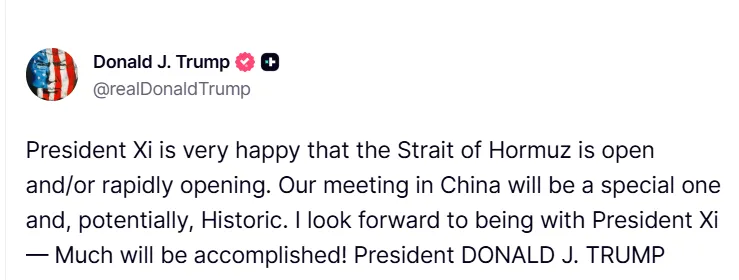
Bitcoin shot up on April 17 when Donald Trump said that the Strait of Hormuz was opening to world shipping operations. The news, which was spread via social media, meant that Iran had announced that the route was now open to all maritime traffic once again.
He also mentioned that naval mines were either cleared or were being cleared with the aid of the United States. This declaration was quickly spreading to international opinion, with investors believing that the development was an indication of lightening of geopolitical tensions in an important energy route.
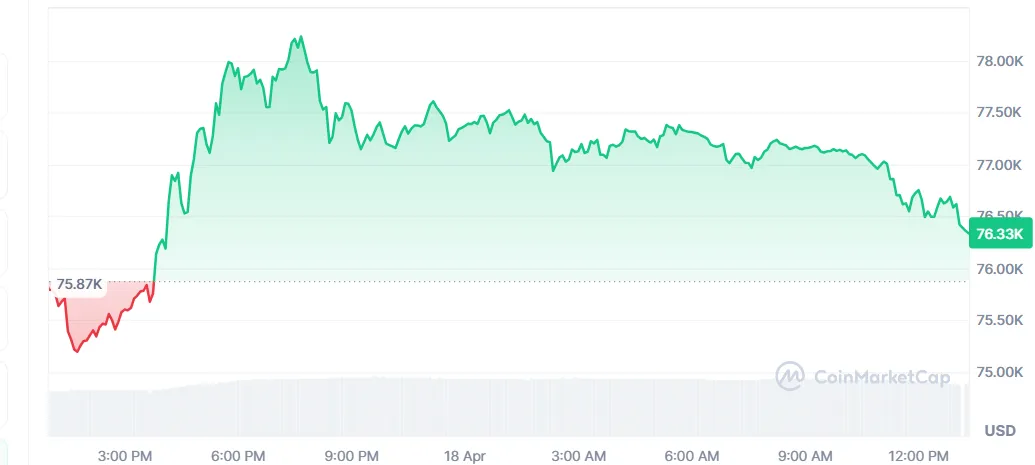
Bitcoin responded nearly immediately to climb higher than $78,000 and hit around $78,400, the highest point in ten weeks. The shift was indicative of a more general risk-on reaction in financial markets, as traders adjusted positions in the light of decreased uncertainty.
As of reporting, Bitcoin was trading close to the price of $77,163, indicating a 3% increase every day. The asset increased by 6.37% in the last week, which continues to be a positive development in the cryptocurrency industry.
Bitcoin Market Response Powered by the Significance of the Oil Route.
The Strait of Hormuz is among the most crucial international oil transit routes with almost a fifth of the total shipments of crude supply. Any form of interference in this path normally leads to a rise in the price of oil and strain on the international financial markets.
The opening of the passage contributed to decreasing the short-term supply issues and, as a consequence, decreasing volatility in both conventional and digital goods. Bitcoin was lucky to experience this shift because investors switched to risk assets after geopolitical situation indicators started to stabilize.
Other remarks made by Trump indicated that there would be continued collaboration between the United States and Iran to keep safe passage through the strait. Such developments led to revived optimism and this saw traders re-entering positions it had cut earlier on because of uncertainty.
The larger crypto market was also reacting well, as Ethereum gained 3% a day and a weekly 5.88%. The coordinated action signified a broader advance in investor confidence throughout digital assets.
Contrasting statements bring about ambiguity over agreement.
Although there was an optimistic beginning, the conflicting reactions of Iranian officials brought doubt on the actual position of the Strait of Hormuz. Iranian legislator Mahmoud Nabavian dismissed the idea of the route being open all the way, giving a different viewpoint.
He said that Iran would remain in charge of shipping business and might even collect tariffs on commercial ships that would pass by. State-affiliated media reportedly backed this position, casting uncertainty on whether the reopening was here to stay.
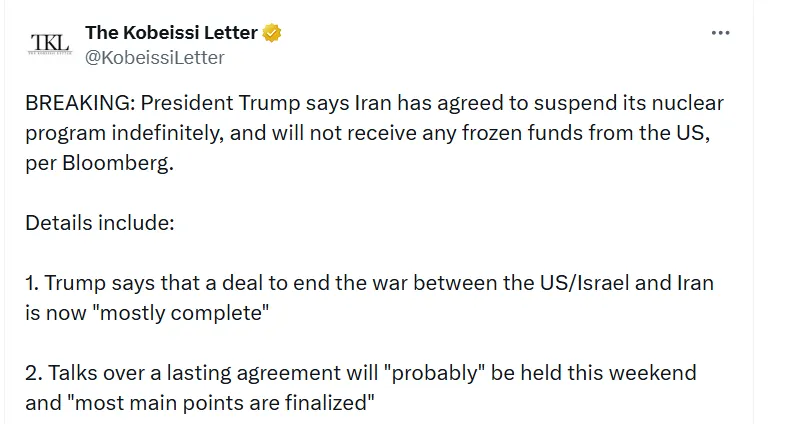
More confusion arisen on financial dealings of the supposed accord between the United States and Iran. Authorities who were conversant with discussions revealed that they had discussed the availability of $20 billion of frozen funds as a concession to nuclear talks.
But Trump subsequently refuted these allegations in a televised interview, further complicating the new situation. European leaders, such as Emmanuel Macron and Keir Starmer, gave warnings, stating that no economic change can be entirely responded to before it is proven.
Bitcoin is at risk in case of a new surge of tensions.
The rise of Bitcoin can be subject to pressure in case of the worsening of the geopolitical situation or conflicting claims come true. Iranian Parliament Speaker Mohammad Bagher Ghalibaf refuted some of the words that Trump had said, terming them as deceptive.
He stressed that the operational realities would be used to make decisions about the Strait as opposed to rhetoric. Ghalibaf also indicated that the passage would continue to be under the control of the Iranian authorization and changing circumstances on the ground.
These comments caused a small decline in Bitcoin, as the asset fell off its high of over $78,000 to close to $76,000. The reaction highlighted how sensitive crypto markets remain to geopolitical developments and conflicting narratives.
In case the tensions reoccur or negotiations do not work, Bitcoin may not be able to sustain the recent gains, especially since the rally was mostly fuelled by de-escalation expectations. The market players are now keenly following future diplomatic negotiations, which will be decisive in determining the direction of the prices in the short run.