Key Insights:
- Circle insists that the freezing of USDC is not discretionary acts by the government, but a legal act.
- The Drift Protocol vulnerability revealed the loopholes between blockchain performance and the current regulatory systems.
- Those against this claim that sluggish responses point to the inefficiency of existing compliance and enforcement systems.
Circle has already made an official statement in response to criticism related to the $270 to $285 million Drift Protocol exploit. The attack was associated with North Korean group UNC4736, and it posed some urgent questions regarding the capabilities of intervention.
The company made it clear that it has no discretion to freeze USDC, but rather it has to do it by legal requirement. Circle wrote that enforcement measures must have valid legal trigger such as court orders or sanctions directives.
The statement says that asset freezes cannot be justified by the pressure of the masses or internal judgment within its compliance system. Circle highlighted that this strategy guarantees neutrality and keeps it in line with the global regulatory standards.
The company also stated that its policies would help avoid arbitrary decisions that might negatively affect the confidence in digital assets. It contended that intervention based upon rules ultimately safeguard legitimate users against the disruption caused by politics or lack of reason.
Circle points at regulatory loopholes that are slackening quick crypto intervention.
Circle cited a larger structural issue which argued that legal frameworks are lagging behind quickly developing blockchain technology. Although there are technical means to stop suspicious transactions, the clarity of regulations is still lacking to take co-ordinated actions.
The company attributed this disparity to a natural effect of old regulatory regimes that were not able to keep pace with the decentralized innovations in finance. Circle warned that unless new legislation was enacted, there would be future cases that would show the same fissures in the entire ecosystem.
To curb these fears, the company called on legislators to promote the GENIUS Act and CLARITY Act bills. These steps, as Circle suggested, would bring about an awareness of clear compliance channels without infringing privacy or ownership rights.
Circle positioned the situation as a pivotal time where policymakers should take action before another mass exploit drives receptive actions. It emphasized that active regulation would allow balancing the rate of enforcement with maintaining open financial systems
Drift exploit provokes questioning on response timelines to compliance.
The scandal is based on the April 1, 2026 exploit that emptied about $285 million out of Drift Protocol. It has been reported that a considerable part of stolen money was exchanged into USDC and transferred between chains.
Critics believe that Circle should have done more to be able to act as blockchain transactions are transparent. They insist that the mechanisms of freezing, which were available, would have interfered with the flow of illegal money at an earlier stage.
Circle, nevertheless, argued that it would act illegally, which would be against the compliance requirement, and that doing so would subject the company to liabilities. It has re-emphasized that enforcement should be done in a manner that is in accordance with the set legal frameworks, despite the crisis or the attention of the masses.
The case has sparked a discussion of whether compliance systems should be modified to enable a quicker response in the apparent instances. It is observed that delayed response can offer good people a chance to exploit regulatory inefficiencies by bad actors.
Circle is confronted by ZachXBT following exploit scandal.
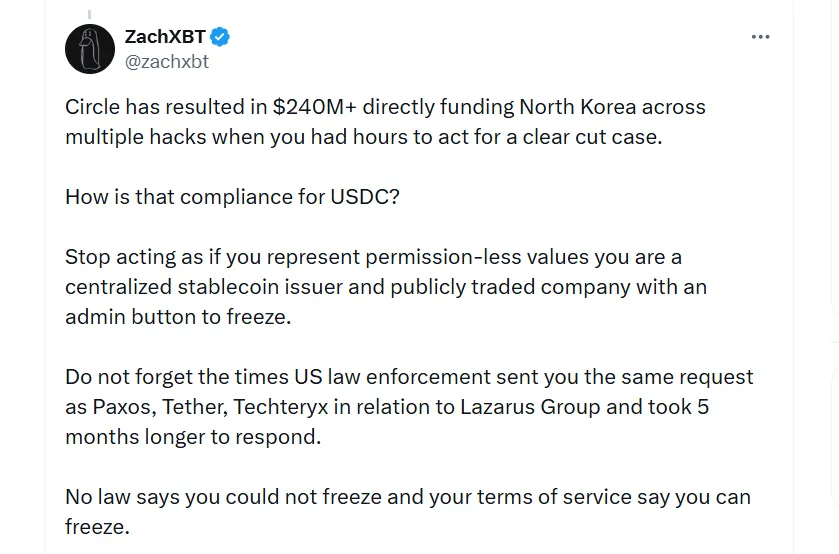
On-chain investigator ZachXBT has come out publicly to criticize the explanation given by Circle, raising the question of the effectiveness of its practices in compliance. He complained of more than $420 million of compliance failures in connection with several incidents in a detailed report.
He also alleged that around $240 million helped fund North Korean activities in a variety of exploits in an indirect manner. ZachXBT claimed that the structure at Circle does not seem to be matched to the pace at which to combat illicit activity.
The investigator pointed out what he termed as a contradiction between proclaimed policies and operational results. He indicated that this problem could be as a result of inner decision-making and not necessarily legal limitations.
Circle has not specifically responded to these particular claims but it has been reiterating that it complies with regulatory standards. The company restated that compliance integrity is a core element in ensuring trust in the digital asset ecosystem.