
Cloud mining continues to operate legally in many jurisdictions in 2026, although regulatory approaches vary widely as governments respond to the growth of digital assets.
Cloud mining is a service that allows users to lease processing capacity in remote data centers to mine cryptocurrencies such as Bitcoin without installing their own hardware. The process helps blockchain networks to verify transactions to curb duplication.
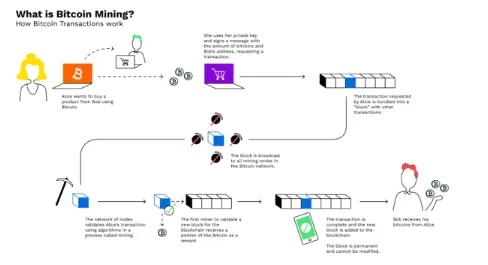
How Cloud Mining Works and the Important Things to Take into Account
Cloud mining resembles traditional proof-of-work (PoW) mining, which requires specialized machines and wastes electricity. Rather, they offer per-provider-charged hashing power, which has reduced barriers to technical entry.
The key characteristics of cloud mining:
- No need to mine on your own.
- Reduced the technicality level of entry.
- Remote access to the mining infrastructure.
- Reduced operation expenses among users.
Nevertheless, the infrastructure behind it still requires a lot of energy. Consequently, cloud mining operators are usually subject to the same regulations as traditional mining activities.
Investor protection is another major reason cited by the authorities, especially following the historical scams of fraudulent mining contracts.
United States and Western Markets Remain Legal
The US does not have a countrywide ban on cloud mining. However, the operators must comply with the overall provisions of energy consumption, the environment, and local provisions.
Taxation is one of the key issues. According to Internal Revenue Service (IRS) rules, mining rewards are treated as income, with their fair market value recognized at the time they are received. They may impose additional taxes on the sale or trading of such assets.
The United Kingdom also legalizes cryptocurrency mining, including cloud-based applications. The government can impose restrictions on energy consumption and levy income taxes.
Nevertheless, Canada is no exception. Even though cloud mining is legal, some provinces have measures in place that depend on electricity demand.
People are allowed to engage in cloud mining in most of the countries in Europe. However, when operating on a large scale, it might be required to adhere to the energy and financial laws, particularly in a country such as Germany. Meanwhile, the officials of the European Union continue to improve regulatory environments to ensure greater transparency and consumer protection.
Mixed Policies in Emerging Markets and Asia
Regulatory measures in Asia and other developing markets remain mixed, and clarity varies. In India, the legal aspects of cloud mining remain unclear, as there is neither a ban nor a clear regulatory framework to govern the process.
In Russia, mining is allowed under certain circumstances, and energy and financial flows are more closely controlled. The non-compliant may face punishment under the amended rules and regulations.
Indonesia has allowed the cryptocurrency trade, but it is not viewed as a form of payment. Even though cloud mining is not explicitly prohibited, broader measures against crypto use may affect its use.
However, China has maintained a complete ban on cryptocurrency mining. The government has also closed its operations in the country, citing financial risks and excessive energy use. Cloud mining services are limited in the country.
Countries that have a Strict Ban on cloud mining
Some countries have been more stern in their approach, and they tend to use financial stability or energy reasons.
These include:
- Algeria
- Nepal
- Bolivia
- Egypt
In these jurisdictions, mining, trading, and crypto ownership are punishable.
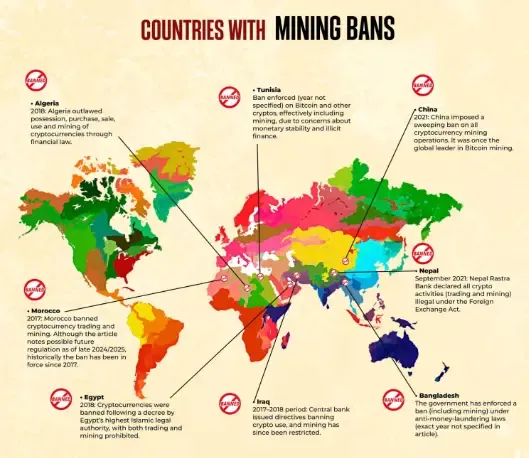
Experts advise individuals to ensure they comply with local regulations when engaging in any mining activities.
Africa Exhibits New Regulatory Environment.
The attitude toward cryptocurrencies in Nigeria remains rather liberal, and cloud mining is not specifically banned; however, the regulatory landscape is currently evolving.
Some crypto service providers have already been banned by regulators and new measures can also tax crypto asset incomes, including mining payments.
Moreover, the regulation on the continent is not uniform, and some countries emphasize financial regulation, while others emphasize infrastructure and energy concerns.
Taxes and Energy Consumption Impact World Policy.
Energy consumption is one of the primary sources of regulation. Mining processes are major electricity consumers, and some governments have resorted to limiting mining activities during periods of high demand.
Further, mining rewards are treated as taxable income in most jurisdictions, and investors must report earnings and pay local taxes.
According to a compliance expert, tax treatment and energy policies are the two primary influences on the national approaches towards mining.
Mining rewards can also be taxed as self-employment income in the United States if the activity is considered a business. Other territories also apply income tax regulations when rewards are received or converted into fiat.
However, failure to report could lead to sanctions, especially amid increased government regulation of crypto-related income.
New Trends Are Defining the Future.
The latest trends indicate that regulatory measures will continue to evolve alongside technological dynamics. Other mining projects are looking into the use of renewable energy sources to address environmental problems and improve the laws governing energy use.
In the meantime, global usage of electron prompting policymakers to reconsider pr by policymakers. As a result, countries will be able to create less opaque, uniform guidelines on cloud mining.
Nevertheless, future regulation of cloud mining will likely hinge on two key factors: the widespread adoption of energy-efficient mining and the broader acceptance of cryptocurrencies in national financial systems.









You have brought up a very good details, appreciate it for the post.