
Key Insights:
- Nasdaq’s tokenized stocks proposal would enable shares to be traded as blockchain tokens or as regular equities.
- The same CUSIP number will be used in tokenized shares, and they will settle using the DTCC infrastructure.
- Nasdaq plans to launch the tokenized stocks program in the first half of 2027.
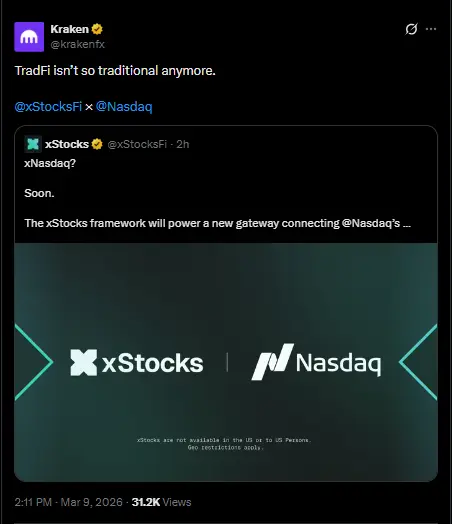
Nasdaq announced it is working with cryptocurrency exchange Kraken and public companies to develop a framework for tokenized stocks that would allow equities listed on its exchange to exist in both traditional and blockchain-based formats.
Nasdaq Tokenized Stocks Plan Targets Interoperable Equity Markets
According to the company, the plan would allow tokenized versions of publicly traded shares to circulate alongside conventional equities, enabling issuers to manage their tokenized securities while preserving the operational structure of U.S. equity markets.
Nasdaq stated that the tokenized structure would operate within its existing exchange environment. Under the plan, investors would be able to trade certain high-volume equities either as traditional shares or as tokenized versions recorded on blockchain.
Source: Kraken
According to the exchange operator, the Nasdaq tokenized stocks initiative is designed to allow equity securities to exist in token form without altering their legal classification under U.S. securities law. The program aims to ensure that tokenized equities remain fully integrated with regulated financial market infrastructure while also enabling interaction with blockchain-based systems.
Nasdaq said tokenized shares would carry the same CUSIP identification numbers as their traditional counterparts. Maintaining identical identifiers is intended to ensure that both formats remain interchangeable within the broader financial system.
The company also confirmed that settlement for these securities would continue to occur through the Depository Trust & Clearing Corporation (DTCC), which processes a large share of U.S. stock transactions. In the proposal, investors would be able to trade tokenized equivalents of popular stocks like Nvidia or Tesla alongside their standard shares. Both versions would exist within the same trading environment and reflect the same underlying equity security.
The exchange said the tokenization structure is intended to integrate blockchain networks with traditional financial systems without disrupting the regulated market framework that currently supports equity trading.
Issuer Participation and Governance Functions
Nasdaq stated that the program would allow public companies to issue tokenized representations of their shares while keeping issuers central to the equity market structure.
According to the company, this issuer-sponsored model is designed to give companies more direct oversight of their tokenized securities. The exchange said tokenized stocks could support programmable mechanisms for investor engagement related to corporate governance and shareholder rights.
Tal Cohen, President of Nasdaq, said tokenization could enable new forms of market access and shareholder engagement while preserving the central role of public companies within equity markets.
Nasdaq noted that participation in the program would remain voluntary. The company said it plans to work with additional market participants as the framework develops, including issuers, regulators, transfer agents, infrastructure providers, and other industry stakeholders. The exchange stated that its tokenization approach seeks to establish industry standards that support interoperability between regulated financial systems and blockchain-based networks.
Kraken Partnership Connects On-Chain and Regulated Markets
Nasdaq said its collaboration with Kraken is intended to help enable tokenized equities to move between regulated exchanges and global on-chain markets. The partnership follows Kraken’s acquisition of the xStocks issuer in December.
According to the announcement, connecting Nasdaq’s market infrastructure to Kraken’s xStocks ecosystem could enable tokenized securities to circulate between traditional market venues and decentralized networks while preserving issuer rights and regulatory compliance.
Nasdaq stated that the system is designed to preserve price integrity and ensure that tokenized shares reflect the same underlying securities traded on regulated exchanges. The exchange also said the interoperability framework could allow blockchain-based markets and traditional equity markets to function within a coherent market structure for securities trading.
Nasdaq said the tokenized stocks program is expected to become operational beginning in the first half of 2027. Additional services for issuers may also become available as the program develops.
The initiative comes as competition among financial market operators expands in the tokenized securities sector. As reported earlier by CoinRaftar, Intercontinental Exchange announced that it invested in cryptocurrency exchange OKX to permit tokenized equivalents of stocks traded on the New York Stock Exchange.