Key Insights:
- House Democrats are investigating World Liberty Financial over an alleged investment linked to the UAE.
- Members of Congress are requesting documents on stablecoin-related transactions and payments of ownership.
- The probe also examines stablecoin use, export control, and policy decisions.
The increased scrutiny of the Washington financial sector by World Liberty Financial, following inquiries by U.S. House Democrats into a $500 million investment involving an Abu Dhabi royal. The investigation focuses on the ownership of the crypto company, foreign investment reporting, and possible connections between private dealings and policy-making in the U.S.
World Liberty Financial Draws Attention From House Democrats
The investigation was announced by Ro Khanna, a Democrat from California, who said he had launched a probe into a reported investment in World Liberty Financial by an entity linked to the United Arab Emirates.
In an X post on Thursday, Khanna stated the issue concerns “public trust and transparency” and linked to a Wall Street Journal report on the transaction and related developments.
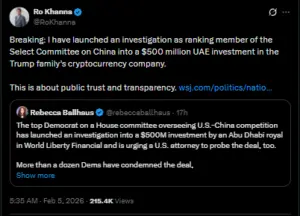
Source: Khanna
Khanna has also urged a U.S. attorney to examine the deal. According to the Journal’s reporting cited by the lawmaker, an investment group connected to an Abu Dhabi royal agreed to acquire a 49% stake in World Liberty Financial for approximately $500 million. The agreement was reportedly signed shortly before President Donald Trump took office.
Trump Denies Knowledge of the Transaction
President Donald Trump addressed the matter earlier in the week, saying he was not aware of the reported investment. Speaking to reporters, Trump said that his sons and other family members manage the business interests connected to World Liberty Financial and handle outside investments.
He added that various parties invest in those ventures, but maintained that he had no direct involvement in the transaction described in the Journal report.
The company has been described as linked to members of Trump’s family, a factor that has intensified congressional interest in the reported foreign investment and its timing.
Reported Role of the UAE National Security Adviser
According to WSJ, the investor group backing the $500 million deal is linked to Sheikh Tahnoon bin Zayed Al Nahyan, who has served as the UAE’s national security adviser since 2016.
The report stated that through the investment, the group obtained a 49% ownership stake in World Liberty Financial. Further, the report also states that Sheikh Tahnoon had pressed U.S. officials for access to advanced artificial intelligence chips.
Khanna has mentioned this aspect of the reporting as a concern, suggesting that it casts doubt on whether private financial dealings were crossing into U.S. technology and export control policies.
As the investigation unfolded, Khanna formally wrote a letter to World Liberty Financial co-founder Zach Witkoff seeking ownership documents, payment documents, and internal communications regarding the investment and dealings. He requested that the company create the documents and provide responses before March 1, 2026.
The requested materials include agreements related to the reported 49% interest, records of payment transactions, contacts with UAE-related officials, and documents related to board nomination and due diligence procedures.
World Liberty Financial and Stablecoin Transactions
The letter also highlighted another UAE-linked transaction involving World Liberty Financial’s USD1 stablecoin. Khanna wrote that the stablecoin was used in connection with a reported $2 billion investment into Binance by MGX, an entity described as being tied to Sheikh Tahnoon.
According to Khanna, this use of USD1 contributed to the stablecoin becoming one of the world’s largest by market size, a development he said could have increased revenues for the project and its shareholders.
Khanna linked the Binance investment to subsequent policy developments, including decisions on export controls for advanced AI chips and a presidential pardon granted to Binance founder Changpeng Zhao.
The lawmaker cited a former pardon attorney who said the circumstances surrounding the pardon were unprecedented in terms of the influence of money and the potential benefits to individuals connected to the president.
Export Controls and National Security Questions
In his letter, Khanna argued that the Journal’s reporting suggested the UAE-linked investment “may have resulted in significant changes to U.S. government policies designed to prevent the diversion of advanced artificial intelligence chips” to China.
He asked World Liberty Financial to disclose any discussions regarding U.S. export controls, the U.S. policy toward the UAE, and strategic competition with China.
The letter also sought information on communications related to President Trump’s decision to pardon Zhao, as well as any interactions with U.S. officials regarding technology policy.