
Key Insights:
- Ryan James’s wedding arrest creates a decade-long international search.
- Officials attribute the network of cocaine payments and cryptocurrency to his case.
- The United States authorities seized drugs, crypto, and weapons associated with the operation.
The arrest of Ryan James Wedding has concluded a multi-year international pursuit involving U.S. and Mexican authorities and renewed scrutiny on the use of cryptocurrency in transnational drug trafficking operations.
Ryan James Wedding Arrest After More Than a Decade on the Run
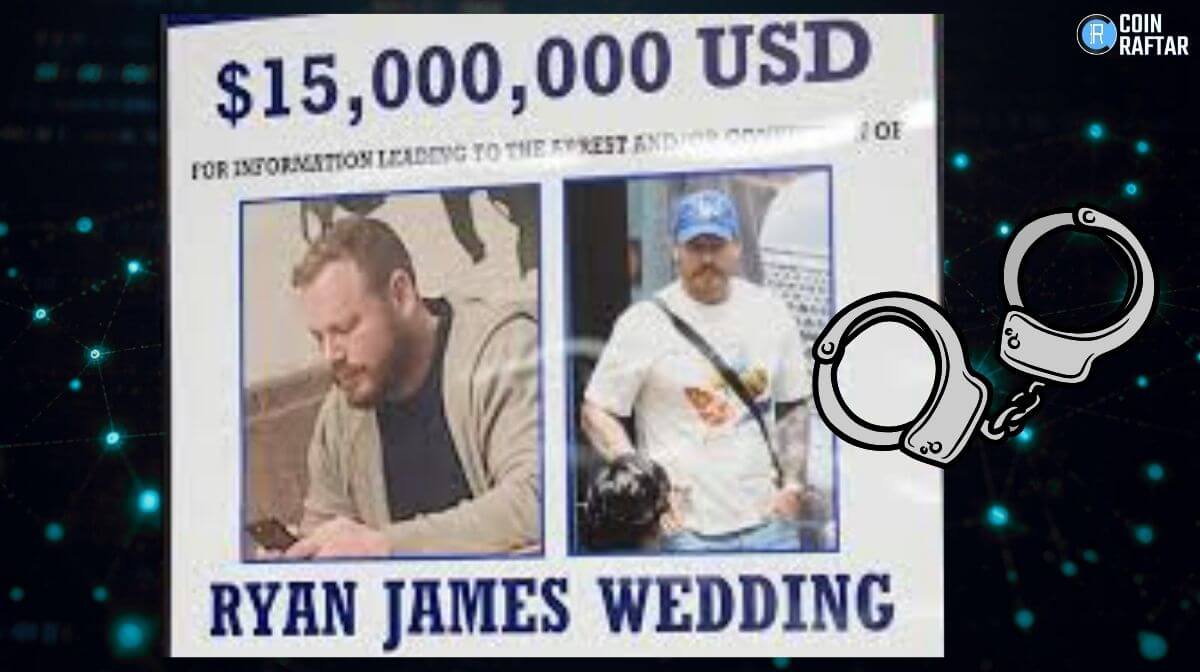
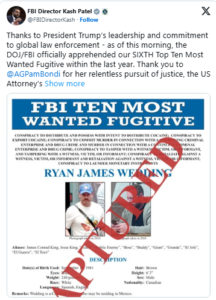
The Ryan James Wedding arrest was confirmed on Friday by FBI Director Kash Patel, who said the former Olympian had been located in Mexico after more than ten years of evading law enforcement.
Patel stated that Wedding was arrested in Mexico and is being transported to the United States to face trial. The FBI credited cooperation with Mexican authorities for locating and detaining Wedding after an extended international search.
Mexico’s Security Secretary Omar García Harfuch stated that Wedding voluntarily surrendered at the U.S. Embassy before being handed over to the FBI.
Moreover, Patel later told reporters that Wedding had been hiding in Mexico for over a decade and was believed to be under cartel protection.
Cocaine Trafficking and Violent Criminal Activity
In 2024, the United States prosecutors accused Wedding of operating a business of cocaine trafficking that supplied the narcotics in Colombia and delivered them through Mexico and North America.
Investigators claim Wedding was a top-level figure in the Sinaloa Cartel’s distribution networks in Mexico, which controlled deliveries to the United States and Canada.
Source: FBI Director Kash Patel
Attorney General Pam Bondi characterized Wedding as a former one-time Olympian snowboarder. She alleged that he was a violent cocaine kingpin, and the federal government would charge him with drug trafficking, homicide, and the running of a criminal enterprise in several nations.
Officials also indicated that at its height, the organization of Wedding had been making over one billion dollars in illicit proceeds each year, an indication of the magnitude of the suspected criminal network.
Cryptocurrency Payments and Sanctions associated with the Case
According to the allegations made by the officials, the network was so dependent on cryptocurrency to make payments and launder money acquired through drug trafficking.
Prosecutors stated that the drug runners used QR codes to receive payment in the stablecoin Tether (USDT) for cocaine transactions.
The U.S. Treasury Department’s Office of Foreign Assets Control sanctioned Wedding in November, citing the organization’s use of digital assets to obscure financial flows and conceal large sums derived from narcotics trafficking.
The Treasury Department stated that cryptocurrency transactions were part of the organization’s financial infrastructure and that drug profits were shifted and laundered through digital assets.
Confiscated Assets and Inquiry into any Investigation
Officials of the law enforcement purported to have seized weapons, luxury cars, works of art, and other belongings of the suspected criminal organization. Federal officials suggested that more arrests could be made later, as the investigation is ongoing.
Furthermore, U.S. officials have not provided further information about possible co-conspirators; however, they indicated that the case spans several jurisdictions and is coordinated between U.S. and Mexican authorities.
The seizure of both physical and non-physical assets highlights the scope of the so-called operation and the importance of cryptocurrency in the organization’s financial operations.
Past Criminal History and Previous Law Enforcement
The Ryan James Wedding arrest is not his first and last interaction with U.S. law enforcement.
In 2008, Wedding had been arrested in California in a cocaine trade sting, which involved a sting operation based in Vancouver. In 2009, he was found guilty and sentenced to 4 years in prison, and was released in 2011.
Before his apparent connection with international drug-dealing circles, Wedding competed as a snowboarder at the 2002 Winter Olympics as Canada’s representative.
Authorities stated that his transition from professional sports to alleged criminal activity is central to the federal case being prepared against him.
Similar Crypto Crime Prosecutions emphasize Wider Enforcements
The arrest is also in line with other crypto-related criminal charges in the United States. In another matter, United States prosecutors claimed that a 23-year-old Brooklyn resident, Ronald Spektor, had stolen approximately $16 million in cryptocurrency from the accounts of 100 Coinbase consumers through an alleged phishing and social engineering attack.
The government claims that Spektor went after victims to get access to the victim authentication credentials and emptied online accounts.
Federal officials have highlighted that crimes associated with cryptocurrencies have been accorded priority in enforcement efforts alongside traditional financial crimes, with various agencies working together.