
Key Insights:
- BitGo’s IPO is overpriced and aims for approximately $212.8 million in gross proceeds.
- Custodial and staking are the primary sources of most revenue, and the institutional demand is elevated.
- The IPO is issued amid market volatility and the postponement of major regulatory initiatives.
Crypto custody firm BitGo has priced its initial offering at $18 per share, above its earlier market price range of $15 to $17 per share, as announced by the firm. The offering has a valuation of approximately $2.1 billion before its initial trading on the New York Stock Exchange under the symbol BTGO on Thursday.
BitGo IPO Highlights Institutional Crypto Custody Market
The state of BitGo’s IPO positions the company in the same league as publicly listed crypto enterprises, including Coinbase and Circle, whose business models revolve around custody and financial services rather than trading.
The company claims it has over $90 billion in assets under custody since its inception, with more recent data showing over $104 billion in assets under management, a nearly 100% year-over-year increase.
According to recent financial reports, nine-month revenue increased by about 65% year over year, reaching almost $140 million, driven by increased demand for services amid the use of digital assets.
The company is a business with custody and staking services as the fundamental part of its business model, generating more than 80% of its revenues, according to research commentaries, reports, and market research.
The shares being sold are both primary shares issued by Bitgo and secondary shares issued by existing shareholders.
Ownership Structure and Insider Holdings
In the U.S., share ownership by BitGo founders, executives, and investors is reported in Form 3 filings with the U.S. Securities and Exchange Commission.
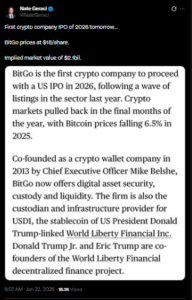
Source: Nate(X)
Chief Executive Officer Michael Belshe holds one million Class A shares, largely in the form of restricted stock units that vest over time.
He also holds several million Class B shares, which are convertible into Class A shares, as well as option grants that could add millions of shares if exercised.
Other disclosed stakeholders include Chief Revenue Officer Fang Chen and Board Chairman Brian Brooks.
Other new directors, such as Vivek Krishna Pattipati, registered zero shareholding on the date of filing. The company also has investment companies, such as Valor Equity Partners and Redstone, that have interests in it.
Financial and Market Conditions of the Offering
The BitGo IPO is in the backdrop of heightened volatility in the markets for digital assets.
At the time of writing, Bitcoin is trading slightly below $90,002 due to macroeconomic fears, regulatory issues, and forced sales in the cryptocurrency markets.
Companies such as Gemini Space Station and Bullish have reported price declines following their listings during periods of market stress.
Revenue Projections and Valuation Assessments
VanEck’s head of digital assets research, Matthew Sigel, commented in a research note that BitGo has reported revenue growth amid a less favorable crypto market environment.
Sigel compared BitGo’s performance to Coinbase, which reportedly increased assets under management by 60% and net revenue by 46% over a comparable period.
Sigel projects that BitGo could generate more than $400 million in revenue and over $120 million in EBITDA by 2028, based on its custody-focused business model.
VanEck estimated a fair value market capitalization of approximately $2.4 billion, representing a roughly 30% upside from the midpoint of the IPO marketing range.
Underwriting Structure and Share Distribution
The company officially stated that the offering will include 11.8 million shares of Class A common stock, of which 11 million shares were issued by BitGo and 795,230 shares by some of its existing stockholders.
The underwriters leading the IPO are Goldman Sachs and Citigroup. The underwriting syndicate has received a 30-day option to purchase up to 1.77 million additional shares of Class A common stock at the public offering price, which, if exercised, could increase the size of the offering.
The IPO is expected to raise approximately $212.8 million at the offering price, excluding any additional shares that could be acquired under the underwriting option.